4DCT Ventilation Functional Avoidance in Lung Cancer Radiation Therapy: Clinical Evidence, Workflow, and Quality Assurance
Applied Radiation Oncology — Vol. 15 , Issue 3
Published: September 1, 2026
1 Department of Radiation Oncology, Taussig Cancer Institute, Cleveland Clinic, Cleveland, OH
2 Cleveland Clinic Lerner College of Medicine of Case Western Reserve University, Cleveland, OH
3 Department of Radiation and Cellular Oncology, The University of Chicago, Chicago, IL
4 Department of Radiation Oncology, Sidney Kimmel Medical College, Thomas Jefferson University, Philadelphia, PA
* Corresponding author: Nader Ghassemi (nad.ghasemi@gmail.com)
Abstract
Radiation pneumonitis and post-treatment pulmonary function decline remain clinically important toxicities after curative-intent thoracic radiation therapy. Conventional whole-lung dose constraints such as mean lung dose and V20 remain fundamental because they are practical, validated, and embedded in standard thoracic planning, but they implicitly treat lung parenchyma as functionally uniform. In many patients with lung cancer, comorbidities such as emphysema, airway obstruction, atelectasis, prior infection, and tumor-related dysfunction produce marked regional heterogeneity in baseline pulmonary function. Functional avoidance attempts to preferentially spare better-functioning lung while preserving target coverage and established organ-at-risk constraints. Four-dimensional CT (4DCT) adds respiratory-phase information to conventional treatment-planning CT, allowing tumor and lung motion to be incorporated into thoracic radiation therapy planning. This review focuses on 4DCT ventilation-based functional avoidance because it uses the planning 4DCT acquired for motion assessment, integrating naturally into modern thoracic simulation workflows. This convenience should not be overstated. 4DCT ventilation is a deformable-registration-derived surrogate rather than a direct physiologic measurement, and its clinical value depends on respiratory image quality, registration quality assurance, and disciplined plan review. Current prospective clinical evidence supports 4DCT ventilation functional avoidance as a promising and implementable strategy in experienced thoracic programs, particularly for conventionally fractionated curative-intent treatment of locally advanced or stage 3 non-small cell lung cancer. However, available data do not yet support its routine use in all thoracic radiation therapy patients or establish the technique as a universal standard of care.
Keywords
4DCT ventilation imaging, functional lung avoidance, locally advanced NSCLC, stage 3 NSCLC, deformable image registration, thoracic radiation therapy, quality assurance, radiation pneumonitis
Categories
Introduction
Avoidance of radiation-induced lung toxicity is a central planning concern in thoracic radiation therapy. Mean lung dose and V20 (the percentage of normal lung tissue receiving 20 Gy or more) are indispensable in that regard because they are easy to interpret, are widely used in protocol design, and have a durable relationship with the risk of symptomatic pneumonitis.1 Their limitation is conceptual rather than procedural: conventional dose-volume metrics do not distinguish between poorly functioning and well-functioning lung. In a population in which baseline lung function is often regionally abnormal, that simplification may obscure clinically meaningful differences in what tissue is actually being irradiated.2-4
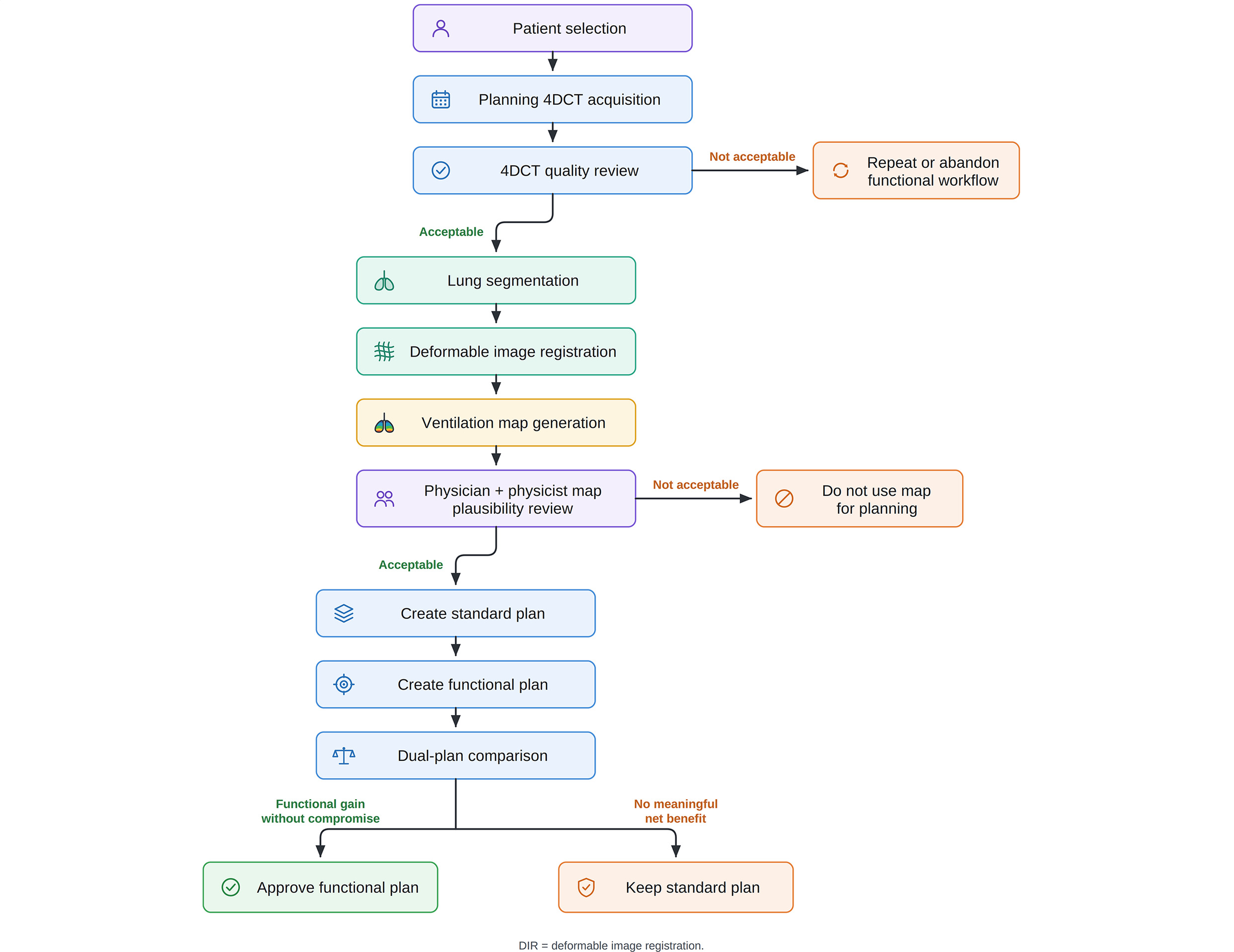
Functional lung avoidance emerged from this observation. Its goal is not to replace standard thoracic constraints, but to refine them by preferentially avoiding better-functioning lung when a safe and practical opportunity to do so is available.2,5,6 Several functional imaging platforms can support that concept, including SPECT, hyperpolarized-gas MRI, and V/Q PET/CT.3,7-9 This review focuses on four-dimensional CT (4DCT)-derived ventilation imaging because, among currently available functional avoidance approaches, it is one of the most practical to integrate into routine thoracic radiation therapy workflows when high-quality planning 4DCT datasets are already acquired.4,10-12 The key question is not whether the concept is attractive in principle, but whether the current evidence justifies selective clinical use and what conditions must be met before implementation should be attempted. The proposed clinical workflow is summarized in Figure 1 and discussed in detail in the implementation and quality assurance (QA) sections.
Rationale for Functional Lung Avoidance
The rationale for functional avoidance is strongest in the same patients in whom conventional thoracic radiation therapy is most challenging: those with bulky or centrally located tumors, nodal disease, prior smoking-related lung injury, and baseline heterogeneity in regional pulmonary function. In such patients, a conventional plan may meet standard anatomic lung constraints while still depositing substantial dose in the best-preserved lung regions.1,2,5,6 Functional planning asks whether that distribution can be improved without compromising planning target volume (PTV) coverage or other organ-at-risk (OAR) goals.
That rationale is clinically sensible, but it is not universally actionable. Functional avoidance requires 2 conditions: First, the patient must have meaningful baseline functional heterogeneity; if the map is essentially homogeneous, there is very little information to exploit.2,4,6 Second, the geometry must permit redistribution; if the PTV is already encasing the best-functioning lung or if sparing that region worsens esophageal, heart, cord, or target metrics, the functional plan may add complexity without real gain.2,5,6 These findings support patient selection as a central requirement, rather than a secondary consideration. Accordingly, Figure 1 should be read as a clinical decision algorithm rather than only a software workflow: functional avoidance is most actionable when baseline functional heterogeneity is present, the geometry permits dose redistribution, source 4DCT and deformable image registration (DIR) quality are acceptable, and the functional plan improves functional lung sparing without compromising PTV coverage or conventional OAR constraints.2,4,6,13
The literature now supports a fairly specific clinical use case. The clearest prospective signal has emerged in conventionally fractionated curative-intent therapy, most commonly for locally advanced or stage 3 non-small cell lung cancer (NSCLC) treated with concurrent chemotherapy.2,6,13-16 By contrast, current data do not justify routine use for all early stage lung cancer stereotactic body radiation therapy (SBRT) cases, where treated lung volumes are smaller and the opportunity for meaningful dose redistribution may be limited.3,4,13 Severe baseline pulmonary impairment is not, by itself, a contraindication, but it increases the importance of rigorous map review because poor image quality, irregular breathing, and anatomic distortion can all degrade the reliability of a 4DCT-derived functional surrogate.4,12,17-19
Generation of 4DCT Ventilation Maps
Operationally, most 4DCT ventilation workflows include respiratory-phase selection, lung segmentation, DIR between selected respiratory phases or to a reference phase, voxelwise calculation of regional expansion and/or density change, and conversion of the resulting ventilation surrogate into either a reviewed functional region or a graded planning objective. This stepwise structure is clinically important, as uncertainty can enter at each stage: source 4DCT quality, phase selection, lung contouring, DIR accuracy, ventilation algorithm choice, and final map thresholding or weighting all influence the map that is eventually used for planning.4,10,11,17,19 A planning 4DCT acquired for motion management contains phase-resolved information about the lung across the respiratory cycle. If inhale and exhale phases can be accurately registered, voxel-wise or region-wise changes in volume and density can be used to estimate regional ventilation.10,11 Early methods relied primarily on density change or Jacobian-based formulations.10,11 At a practical level, commonly reported CT ventilation approaches can be grouped as density change, Jacobian or volume change, and mass conservation methods; these workflows share the same dependence on 4DCT image quality and DIR but differ in how respiratory-related anatomic change is converted into a ventilation surrogate.10,11,17,18 More recent work has emphasized more numerically robust mass conservation approaches intended to reduce instability and improve reproducibility.18
For day-to-day clinical use, however, the “mathematics” matter less than the implementation implications. 4DCT ventilation is not a direct ventilation measurement. It is an image-derived biomarker that depends on segmentation, phase selection, deformable registration, and the algorithm used to convert deformation and density information into a ventilation surrogate.4,11,12,17,18 Different software applications and processing methods can therefore produce different ventilation maps from the same source 4DCT. The practical consequence is that a center should commission one workflow, understand its failure modes, and avoid assuming that maps generated by different vendors or algorithms are interchangeable.4,17,19
This dependence on input data quality supports a concise presentation of technical details while clearly defining the prerequisites for reliable implementation. A clinically credible 4DCT ventilation program begins with a clinically credible 4DCT. If the planning scan shows irregular breathing, incorrect respiratory-phase sorting, major image artifacts, or incomplete visualization of tumor or lung motion, the derived functional map becomes difficult to defend regardless of the sophistication of the downstream algorithm.4,12,19
Validation of 4DCT Ventilation Imaging
Validation studies have established biologic plausibility but have also clarified the method’s limits. Vinogradskiy et al compared 4DCT ventilation with nuclear medicine V/Q imaging and found clinically meaningful correlation, supporting the idea that CT-derived ventilation maps capture relevant regional physiology.20 Yamamoto et al compared 4DCT-derived ventilation with pulmonary function tests and SPECT ventilation imaging, again supporting biologic relevance but not perfect equivalence.21 Brennan et al extended this validation against pulmonary function test data, showing associations between 4DCT ventilation metrics and global pulmonary function across a patient cohort; however, they did not establish 4DCT ventilation as a definitive patient-specific or voxel-level physiologic truth standard.22
The field matured further when validation moved beyond single-institution comparisons. The Ventilation And Medical Pulmonary Image Registration Evaluation challenge was important because it demonstrated, in a multi-institutional setting, that CT ventilation results are meaningfully influenced by algorithmic choice and implementation details.17 That message remains essential. Validation does not mean interchangeability. A method can be biologically plausible and clinically useful while still being sensitive to registration error, segmentation choices, noise, or the specific transformation model used.4,17,18
Accordingly, the available evidence supports a cautious interpretation of the validation literature: 4DCT ventilation has enough biologic and technical validity to justify prospective clinical testing and selective implementation, but it should still be treated as a surrogate functional biomarker rather than a definitive physiologic measurement.4,17,18,20-23
Functional Avoidance Planning and Dose-Function Metrics
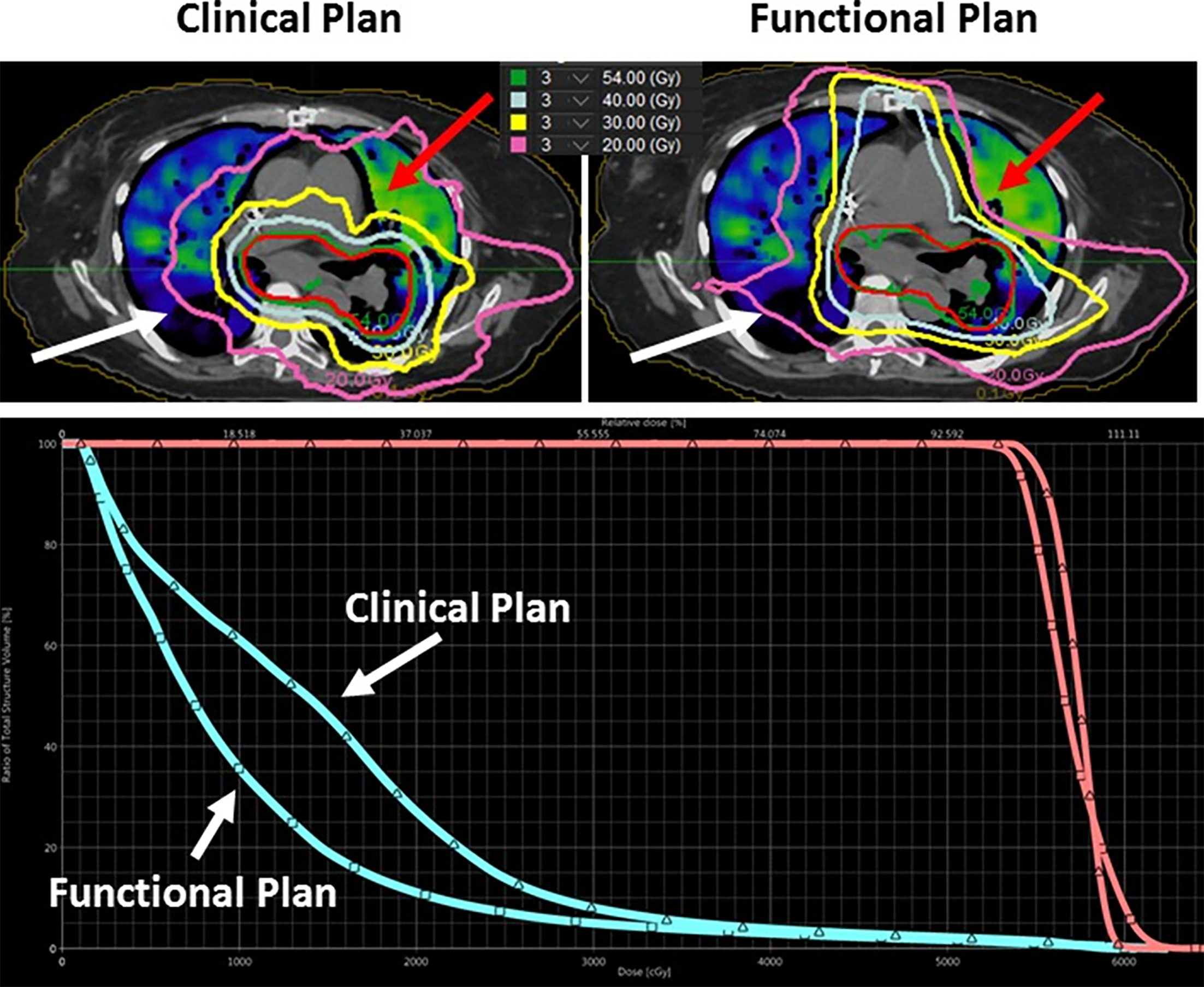
The practical planning question is how to incorporate a functional map without destabilizing an otherwise sound thoracic workflow. Based on the current evidence, a dual-plan strategy remains the most defensible approach. A standard anatomic plan should be created first using established target and OAR objectives. A functional plan should then be generated using the same clinical intent, with additional objectives designed to reduce dose to higher-functioning lung. The functional plan should be adopted only if it preserves target coverage and conventional OAR constraints while producing a meaningful improvement in functional lung sparing.2,4,6 A representative comparison of a standard clinical plan and a 4DCT ventilation-guided functional avoidance plan is shown in Figure 2, illustrating that functional sparing should be evaluated in the context of preserved PTV coverage and conventional OAR acceptability.
Several approaches to optimization have been reported, including binary contouring of “functional lung” above a chosen threshold and more graded or voxel-informed weighting strategies.2,4-6 A key practical consideration is that no single thresholding approach has yet emerged as broadly generalizable across patients, imaging workflows, and institutions. Published studies have used different definitions of functional lung, different optimization priorities, and different levels of automation.2,4-6 Given this variability, the literature does not currently support a universal contour-generation threshold or planning rule. Unlike PET standardized uptake value (SUV)-based workflows, 4DCT ventilation functional avoidance does not have a validated universal cutoff that reliably separates clinically actionable from nonactionable functional lung across scanners, algorithms, and patient populations. Therefore, binary high-function contours, percentile-based thresholds, and graded or voxel-weighted objectives should be prespecified within a commissioned institutional workflow rather than selected ad hoc for an individual plan.2,4,5,17,19 Instead, institutions implementing functional avoidance should prospectively define the functional lung segmentation method, thresholding criteria, and optimization approach, and then apply these parameters consistently across patients.
The same caution applies to dose-function metrics. Additional work evaluating dose to highly ventilated lung has further supported the association between functional dose metrics and symptomatic radiation pneumonitis, but it also reinforces that optimal functional lung constraints remain investigational rather than standardized.3,5,25 Faught et al evaluated candidate dose-function metrics and showed that not every functional dose endpoint performs equally, particularly when functional heterogeneity is spatially complex.5 For a clinically oriented review, the minimal reporting set should remain focused: mean lung dose and V20 for the standard anatomic plan; functional mean lung dose and functional V20 for the functional assessment; and, when low-dose bath is a relevant planning tradeoff, functional V5 or V10, defined as the functional lung volume receiving 5 Gy or 10 Gy or more, particularly for intensity-modulated radiation therapy or volumetric-modulated arc therapy.2,4-6 Changes in PTV coverage should also be reported, along with any clinically relevant dose tradeoffs involving the heart, esophagus, spinal cord, or brachial plexus when these arise. A minimum reporting set for functional avoidance plans is provided in Table 1.
| Metric | Why It Matters | How to Report It | Supporting Evidence |
|---|---|---|---|
| Mean lung dose | Standard benchmark for thoracic toxicity risk | Report standard anatomic mean lung dose for both plans | 1,2,6 |
| Lung V20 | Standard benchmark with strong clinical familiarity | Report standard anatomic V20 for both plans | 1,2,6 |
| Functional mean lung dose | Captures dose to better-functioning lung | Report absolute value and absolute/relative change vs standard plan | 2,5,6 |
| Functional V20 | Most practical functional high-dose-volume endpoint | Report absolute value and change vs standard plan | 2,5,6 |
| Functional V5 or V10 | Helps interpret low-dose bath with IMRT/VMAT | Report if low-dose tradeoff is relevant | 4,5 |
| Functional lung definition | Needed because thresholds are not standardized | State exact thresholding/weighting rule prospectively | 2,4-6 |
| PTV coverage | Functional gains are uninterpretable if coverage worsens | Report coverage metrics side by side | 2,6 |
| Nonlung OAR tradeoffs | Functional sparing may shift dose elsewhere | Report relevant changes in heart, esophagus, cord, and other priority OARs | 2,4,6 |
| Clinical endpoints | Dosimetry alone is insufficient | Report grade ≥ 2 pneumonitis, pulmonary function, and PROs when available | 2,3,13-16 |
A further point that deserves emphasis is that functional dose reduction should not be described in isolation. A plan that lowers functional V20 by a few percentage points but worsens target conformity, elevates esophageal dose, or materially complicates treatment delivery may not be the right choice for an individual patient.2,6 Functional avoidance should therefore be presented as an incremental planning strategy layered onto standard thoracic planning and not as a new competing paradigm.
Clinical Evidence
The clinical evidence is best interpreted in tiers rather than as a single uniform body of proof. Early method development, planning, and validation studies established feasibility and biologic plausibility, but they did not establish clinical benefit.10,11,17,20-24 The strongest prospective 4DCT ventilation evidence comes from conventionally fractionated curative-intent treatment of locally advanced or stage 3 NSCLC, where functional avoidance has been associated with measurable reductions in functional lung dose and encouraging, although not definitive, toxicity and pulmonary function signals.6,13,14,26 By contrast, the evidence is weaker for routine use in all early stage SBRT patients, for patients without meaningful baseline functional heterogeneity, and for centers without a commissioned 4DCT ventilation and DIR QA workflow.3,12,13,15,17,19 Therefore, the current literature supports selective consideration in appropriately chosen patients rather than universal adoption.3,6,13-15 Table 2 is therefore intended to separate method development and validation evidence from prospective clinical evidence, companion analyses, randomized data, and related non-4DCT functional imaging trials.
| Study | Design | Imaging/Planning Method | Population | Main Finding | Clinical Relevance | Limitations |
|---|---|---|---|---|---|---|
| Guerrero et al10 | Method development | Dynamic ventilation imaging from 4DCT | Technical development | Established the foundational concept of deriving ventilation from phase-resolved CT | Landmark method paper | Not a clinical validation study |
| Castillo et al11 | Method comparison | Density change vs Jacobian methods | Technical development | Showed that algorithm choice affects derived ventilation | Important for understanding no interchangeability | Technical focus only |
| Vinogradskiy et al20 | Clinical validation | 4DCT ventilation vs nuclear medicine V/Q imaging | Patients with lung cancer | Demonstrated clinically meaningful correlation with nuclear medicine imaging | Supports biologic plausibility | Correlation, not equivalence |
| Yamamoto et al21 | Clinical validation | 4DCT ventilation vs PFTs and SPECT ventilation | Patients with lung cancer | Supported correlation with physiologic and imaging measures | Reinforced external validation | Method dependent |
| Brennan et al22 | Clinical validation | 4DCT ventilation vs PFT data | Thoracic patients | Showed relationship between 4DCT ventilation and PFT data | Supports clinical interpretability | Population-level rather than definitive patient-level truth standard |
| Kipritidis et al17 | Multi-institutional validation | Comparative CT ventilation pipelines | Multi-institution study | Demonstrated algorithm dependence and lack of full standardization | Key QA and implementation relevance | Does not identify a single universally best algorithm |
| Vinogradskiy et al6 | Prospective 2-institution clinical trial | 4DCT ventilation-guided functional avoidance | Conventionally fractionated locally advanced lung cancer | Feasible; reduced functional lung dose; early toxicity signal acceptable | First prospective clinical workflow signal | Interim analysis; nonrandomized |
| Vinogradskiy et al2 | Multicenter phase 2 | 4DCT ventilation-guided functional avoidance | 67 evaluable patients | 67 evaluable patients; mean functional V20 reduction 3.5 percentage points; grade ≥ 2 pneumonitis 14.9% vs 25% historical benchmark2 | Strongest multicenter prospective 4DCT ventilation functional avoidance evidence to date | Historical benchmark, not randomized superiority |
| Miller et al14 | Prospective companion analysis | PFT outcomes after functional avoidance | Trial cohort | Modest average declines in DLCO, FEV1, and FVC after functional avoidance | Useful physiologic follow-up; supports inclusion of pulmonary function endpoints | Companion analysis from related prospective cohort; not randomized proof |
| Ghassemi et al26 | Secondary predictive analysis | 4DCT ventilation dose-function metrics and PFT change modeling | 56 patients from the prospective functional avoidance cohort | Dose-function metrics were associated with post-treatment PFT changes, particularly FEV1 decline26 | Supports dose-function metrics as clinically relevant planning and follow-up endpoints | Secondary analysis; not randomized; early 3-mo PFT endpoint |
| Lombardo et al15 | Prospective companion analysis | QoL after functional avoidance | Trial cohort | Patient-reported decline still occurred, dosimetric associations were modest | Adds patient-centered evidence and reinforces need for PRO follow-up | Single-arm interpretation |
| Baschnagel et al13 | Randomized phase 2 | 4DCT ventilation functional avoidance vs standard planning | NSCLC; mixed conventional and SBRT cohort | Whole cohort did not meet primary imaging endpoint; conventionally fractionated subgroup favored functional avoidance signal | Most important randomized evidence to date; supports the conventionally fractionated subgroup as a key population for future study | Subgroup signal should be interpreted cautiously; not evidence for routine use in all thoracic RT patients |
| Yamamoto et al8 | Single-arm prospective pilot | CT ventilation-guided avoidance | Lung cancer | Prospective pilot; grade ≥ 2 pneumonitis 17% vs 25% historical reference; feasible and safe but nonrandomized8 | Supports implementation feasibility and favorable safety signal | Early phase, single-arm; historical reference |
| Bucknell et al9 | Prospective functional imaging trial | 68Ga 4D-V/Q PET/CT-guided avoidance | Locally advanced NSCLC | Showed feasibility of V/Q-guided avoidance | Supports broader function-guided paradigm | Not a 4DCT ventilation study; does not establish the optimal role of ventilation vs perfusion or combined V/Q imaging |
| Poiset et al16 | Historical comparison PRO analysis | PROs after functional avoidance compared with thoracic RT benchmarks | Functional avoidance cohort compared with historical thoracic RT benchmarks | Compared functional avoidance PROs with historical thoracic RT benchmarks; selected PRO signals favored functional avoidance, but comparison was historical rather than randomized | Helps contextualize PROs in contemporary thoracic RT practice | Related/overlapping cohort; historical comparator rather than independent randomized validation |
| Yaremko et al7 | Double-masked randomized controlled trial | Hyperpolarized helium-3 MRI-guided functional avoidance | Patients with locally advanced lung cancer | Underaccrued trial; similar QoL results between arms in the published report7 | Important comparator using a more direct functional imaging modality rather than 4DCT ventilation | Not a 4DCT ventilation study; underaccrual limits interpretation |
Early patient-level feasibility work demonstrated that CT ventilation-guided treatment could be delivered in practice.23 The more persuasive evidence began with the prospective 2-institution study reported by Vinogradskiy et al in 2018. In that interim analysis, functional avoidance was feasible, reduced dose to functional lung, and showed sufficiently favorable early toxicity results to justify continued study.6 Importantly, the trial population reflected what remains the strongest current use case: conventionally fractionated curative-intent thoracic radiation therapy rather than SBRT or palliative treatment.6
The multicenter phase 2 study was notable because it tested whether this approach could be exported across institutions rather than confined to a single expert center. That study reported 67 evaluable patients, an average reduction in functional lung V20 of 3.5 percentage points, and a grade 2 or higher pneumonitis rate of 14.9% compared with the 25% historical benchmark used in the trial design.2 A balanced interpretation is that the study supports multicenter feasibility and provides encouraging outcome-level evidence but does not independently establish randomized superiority over standard planning.
The companion reports are useful, but should be interpreted with caution. Importantly, the Miller, Ghassemi, Lombardo, and Poiset analyses should be interpreted as companion or secondary analyses of the same prospective 4DCT ventilation functional avoidance program, or closely related trial cohort, rather than as fully independent validation cohorts.2,14-16,26 Miller et al reported modest average declines in diffusing capacity of the lung for carbon monoxide, forced expiratory volume in 1 second (FEV1), and forced vital capacity (FVC) at 3 months, findings that the authors interpreted as qualitatively encouraging relative to historical expectations.14 In a secondary analysis of the same prospective 4DCT ventilation functional avoidance cohort, Ghassemi et al found that dose-function metrics were associated with post-treatment PFT changes, particularly FEV1 decline, supporting their use as clinically relevant planning and reporting endpoints.26 Lombardo et al later reported the quality-of-life results from the prospective functional avoidance program and showed that patient-reported decline still occurred, although the dosimetric associations were modest and the overall signal remained encouraging rather than definitive.15 Poiset et al then compared patient-reported outcomes (PROs) from the functional avoidance cohort with historical thoracic radiation therapy benchmarks, including outcomes from RTOG 0617 and a PACIFIC-era comparator framework intended to reflect more contemporary chemoradiation and immunotherapy-era practice. They reported fewer clinically meaningful declines in selected patient-reported endpoints, although this comparison remained historical rather than randomized.16 These studies strengthen the clinical plausibility of the strategy, but they remain single-arm or historical comparison data rather than level 1 proof.
The randomized phase 2 study reported by Baschnagel et al is important because it tested 4DCT ventilation functional avoidance against standard planning in a randomized setting. In the overall cohort, functional avoidance did not improve the primary endpoint, which was based on 3-month change in 4DCT-derived ventilation.13 However, in the conventionally fractionated subgroup, functional avoidance was associated with lower grade ≥ 2 pneumonitis, 8.2% vs 32.3%, and smaller 3-month declines in FEV1 and FVC.13 This finding should be interpreted cautiously, but it supports the view that the most promising current population may be conventionally fractionated locally advanced or stage 3 NSCLC rather than all thoracic radiation therapy patients.
Other prospective studies provide broader context without directly elevating 4DCT ventilation to universal standard-of-care status. These non-4DCT studies are included as contextual comparator evidence because they use functional imaging modalities that are more directly physiologic or combined functional anatomic approaches, rather than the deformable registration-derived 4DCT ventilation surrogate emphasized in this review.3,7,9 This broader evidence base is important because it shows that functional avoidance is being investigated across multiple institutions, imaging platforms, and trial designs, even though the strongest 4DCT ventilation data remain concentrated in a limited number of prospective cohorts.3,7-9,13 The Functional Lung Avoidance for Individualized Radiation Therapy trial used hyperpolarized helium-3 MRI rather than 4DCT ventilation and was under accrued, with similar quality-of-life results between arms in the published report.7 Yamamoto et al later reported a single-arm prospective pilot of CT ventilation-guided functional avoidance, supporting feasibility and safety but still in an early phase framework.8 In that prospective pilot experience, the reported grade ≥ 2 pneumonitis rate was 17% compared with a 25% historical reference, supporting feasibility and a favorable safety signal but not establishing randomized superiority.8 Bucknell et al showed that functional avoidance guided by 68Ga-4D-V/Q PET/CT is feasible in locally advanced NSCLC, further supporting the broader concept that function-guided thoracic planning is clinically workable.9 Collectively, these studies support the paradigm of functional imaging-informed planning, but they do not yet resolve whether ventilation-guided, perfusion-guided, or combined V/Q-guided planning is optimal, nor do they justify describing 4DCT ventilation as universally “proven.”3,4,9 Taken together, the prospective clinical data suggest a consistent but still evolving signal: 4DCT ventilation functional avoidance can reduce dose to better-ventilated lung and may reduce clinically meaningful pulmonary toxicity in selected conventionally fractionated patients.2,6,8,13 The most useful quantitative signals are the multicenter phase 2 functional V20 reduction of 3.5 percentage points with 14.9% grade ≥ 2 pneumonitis, the Yamamoto prospective pilot pneumonitis rate of 17% against a 25% historical reference, and the Baschnagel conventionally fractionated subgroup result of 8.2% vs 32.3% grade ≥ 2 pneumonitis.2,8,13 However, these data should be interpreted cautiously because available studies include single-arm designs, historical comparisons, overlapping datasets, subgroup findings, heterogeneous ventilation algorithms, and limited randomized outcome evidence.2-4,13-17,19
Practical Implementation Workflow
As summarized in Figure 1, clinical implementation should begin at simulation rather than optimization. The planning 4DCT must first satisfy the same quality standards required for a robust thoracic motion-management workflow. That includes appropriate respiratory coaching, stable phase sorting, and explicit review for artifact, mis-binning, patchy motion capture, and severe streak or truncation artifact.4,12 If the 4DCT is not good enough for confident thoracic planning, it is not sufficient for ventilation mapping. Practical implementation steps and QA decision points are summarized in Table 3.
| Workflow Step | Key Action | Primary Team Member | QA Concern | When to Proceed | Stop/Repeat Criterion |
|---|---|---|---|---|---|
| Patient selection | Confirm curative-intent case, functional heterogeneity likely, and plausible dosimetric opportunity | Radiation oncologist | No expected gain from functional guidance | Clear potential benefit and acceptable complexity | Homogeneous function expected or no plausible dosimetric advantage |
| Simulation | Acquire high-quality planning 4DCT with respiratory coaching | Therapist and simulation team | Irregular breathing, motion truncation, severe artifact | Stable respiratory trace and interpretable phases | Major artifact, mis-binning, or incomplete motion capture |
| Image review | Review raw 4DCT before map generation | Radiation oncologist and physicist | Poor phase sorting or anatomy distortion | Source scan acceptable for thoracic planning | 4DCT not acceptable for standard clinical use |
| Segmentation | Confirm lung contours and exclude gross errors | Dosimetrist/physicist with physician review | Segmentation leak, missing lung, tumor-lung boundary issues | Contours anatomically credible | Gross contour failure or unresolved ambiguity |
| DIR | Run commissioned deformable registration workflow | Physicist | Nonphysiologic deformation, edge failures | Deformation anatomically plausible on review | Registration clearly implausible |
| Ventilation map review | Inspect hot/cold regions for plausibility | Physicist and physician | Artifact-driven extremes, map-anatomy mismatch | Map pattern clinically plausible | Map dominated by artifact or unexplained extremes |
| Standard plan | Build conventional plan first | Dosimetrist | Baseline plan not optimized | Standard plan meets clinical goals | Baseline plan not clinically acceptable |
| Functional plan | Add functional objectives using same clinical intent | Dosimetrist and physicist | Functional sparing worsens coverage or OARs | Measurable functional-sparing gain with preserved clinical acceptability | Functional gain only achieved by unacceptable tradeoff |
| Dual-plan comparison | Compare standard vs functional plan using prespecified metrics | Physician, dosimetrist, physicist | Cherry-picking metrics | Functional plan shows meaningful net benefit | No meaningful gain or conflicting priorities |
| Documentation | Record map definition, QA outcome, metrics, and rationale for plan choice | Entire team | Unclear reproducibility and audit trail | Workflow and rationale fully documented | Incomplete QA or missing decision record |
The next step is segmentation, phase selection, and deformable registration. Here, the principles of the American Association of Physicists in Medicine Task Group 132 report on image registration and data fusion in radiation therapy are directly applicable: the institution should use a commissioned registration workflow, perform patient-specific review rather than relying on the software output alone, and document how failed or suspicious registrations are handled.19 In practical terms, this requires assessment of whether fissures, vessels, bronchi, tumor-lung interfaces, and pleural boundaries deform plausibly; whether ventilation hot and cold regions are anatomically credible; and whether apparent extreme values may instead reflect noise or artifact.4,17,19
Only after the map is approved should optimization proceed. A conventional plan should first be generated, followed by a functional avoidance plan, with the 2 plans compared side by side. The functional plan should be selected only if it achieves the prespecified functional sparing objective while maintaining coverage and conventional OAR acceptability.2,4,6 This dual-plan benchmark may appear conservative, but it is the most practical way to ensure that “functional avoidance” represents a real patient-specific gain rather than a theoretical exercise.
Quality Assurance and Sources of Uncertainty
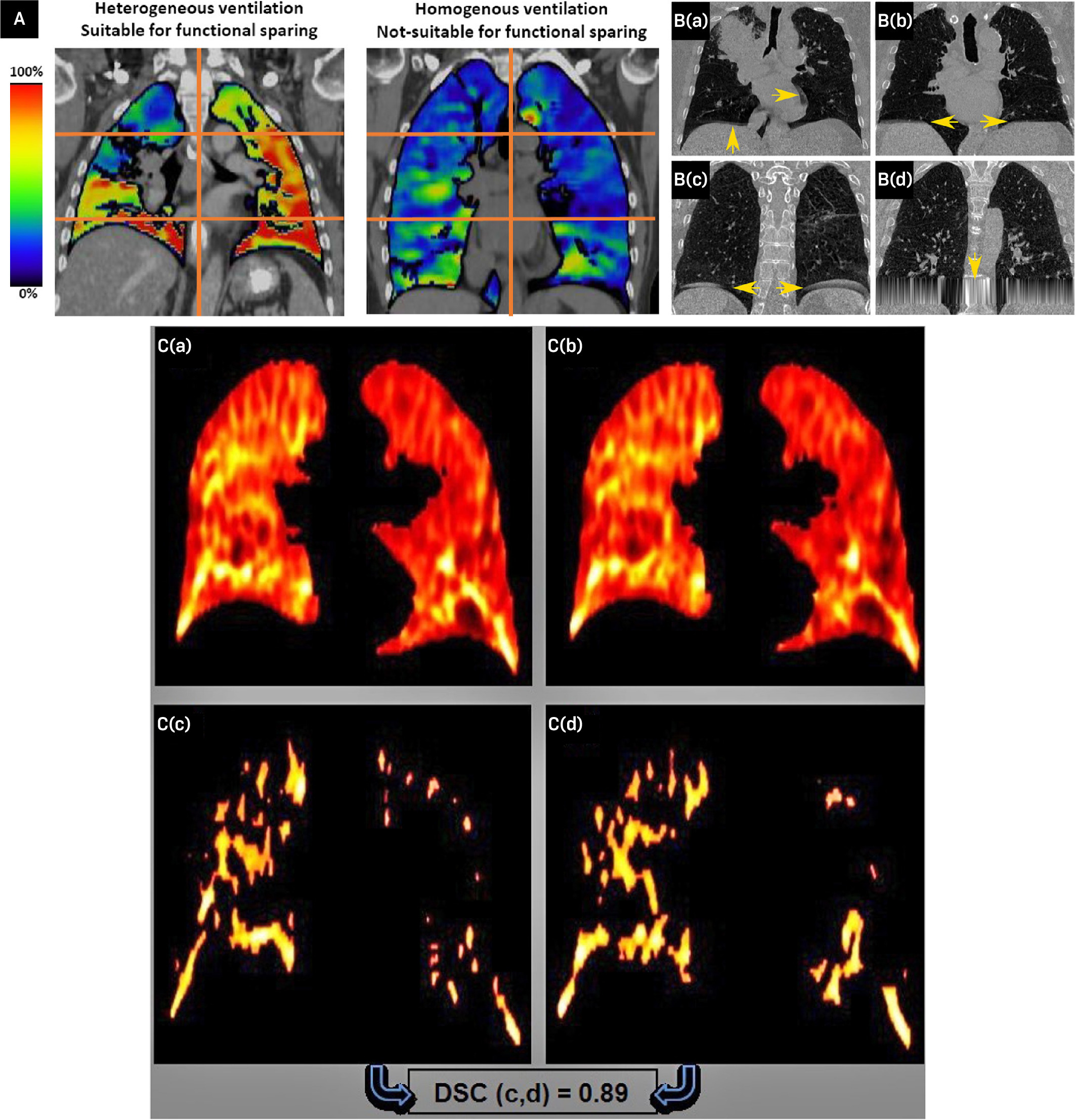
The first QA gate is respiratory imaging quality. The AAPM Task Group 76 report on respiratory motion management remains relevant because the entire 4DCT ventilation chain depends on respiratory resolved source images.12 Irregular breathing, poor respiratory-phase sorting, inadequate phase definition, motion truncation, and severe artifact can all distort the source data and propagate into the ventilation estimate. Representative examples of patient selection and QA challenges are shown in Figure 3; they include heterogeneous vs homogeneous ventilation patterns, source 4DCT artifacts, and DIR- or algorithm-dependent ventilation results. The purpose of Figure 3 is to emphasize that map review should be a clinical QA decision point: heterogeneous maps may be actionable only when the underlying image quality and registration are credible, whereas homogeneous maps, artifact-dominated scans, or algorithm-dependent extremes may be nonactionable even if a ventilation map can technically be generated. In practice, this means the functional map should not be used for planning when the source 4DCT is not acceptable for standard thoracic planning, respiratory-phase sorting is clearly unreliable, deformable registration is anatomically implausible, or the ventilation map is dominated by artifacts rather than credible regional lung function patterns.
The second major source of uncertainty is deformable registration. TG-132 provides the most useful radiation therapy-specific framework for acceptance testing, end-to-end validation, and patient-level review.19 For clinical use, that should translate into a short list of operational rules: use one validated institutional workflow; track software version changes; perform patient-specific visual review of the deformation field and propagated anatomy; and reject maps that are anatomically implausible or obviously artifact dominated.4,17,19 The literature does not support any single algorithm.
The third source of uncertainty is how the map is converted into a planning objective. Functional thresholding, binary-vs-weighted optimization, segmentation boundaries, and even whether ventilation alone is the optimal biologic target remain unsettled.3-5 This uncertainty does not argue against the method, but it does require transparent reporting. Overstating technical certainty in an area that still lacks standardization may make the clinical argument less convincing.
Current Limitations and Future Directions
The current literature supports selective implementation, not universal adoption. Key unresolved issues include the absence of phase 3 outcome data, heterogeneity of ventilation algorithms and thresholding rules, uncertain reproducibility across newly adopting centers, and unclear incremental benefit in modern chemoimmunotherapy-era practice.3,4,13,17 The evidence remains strongest in experienced thoracic programs with robust 4DCT acquisition, physics support, and prospective QA discipline.2,4,13 That raises an external validity question: how well will the reported outcomes generalize to low-volume or newly adopting centers? The answer remains uncertain. In addition, much of the prospective evidence was generated before all contemporary combined modality practice patterns became routine, so the size of incremental benefit in current practice may differ from what earlier cohorts suggested.2,4,13-16
The maturity of adjacent areas of functional avoidance research also should not be overstated. Proton-based functional avoidance remains attractive but is still supported mainly by planning and early feasibility literature rather than robust comparative outcome data.3,4 Adaptive functional radiation therapy is conceptually appealing because ventilation may change during treatment as tumors regress or airways reopen, but prospective evidence linking adaptive reventilation strategies to better clinical outcomes remains limited.3,4 AI-generated ventilation surrogates may improve automation and workflow efficiency, yet current evidence is still predominantly technical or dosimetric rather than prospective clinical-outcome based.4,29 Pulmonary perfusion imaging deserves separate consideration because ventilation and perfusion provide related but nonidentical information about regional lung function. Perfusion can be assessed using nuclear medicine approaches such as SPECT or V/Q PET/CT, and investigational CT-based approaches including dynamic contrast CT or CT-derived vascular/perfusion biomarkers. Available data support continued evaluation of perfusion-guided and combined V/Q-guided planning, but they do not yet establish whether ventilation-guided, perfusion-guided, or combined ventilation/perfusion avoidance is optimal for routine clinical implementation.3,4,9,30,31 Accordingly, AI-based automation, adaptive functional replanning, and proton-based functional avoidance should be framed as priorities for prospective testing and workflow maturation rather than as evidence of routine clinical readiness.3,4,29
The next generation of trials should therefore be more selective and better targeted rather than simply broader in scope. Priority should be given to conventionally fractionated locally advanced or stage 3 NSCLC, with prospectively specified 4DCT and DIR credentialing, a compact and interpretable set of functional dose metrics, and clinically meaningful endpoints, including grade 2 or higher pneumonitis, longitudinal pulmonary function, and validated PROs, rather than imaging endpoints alone.2-4,13-16 Comparative work between ventilation-guided and perfusion-guided strategies is still needed, and combined V/Q approaches may ultimately prove more clinically informative than ventilation alone.3,4,9
Conclusion
4DCT ventilation map-based functional avoidance is technically feasible, biologically plausible, and supported by a growing prospective literature.2,6,13-18,20-23 In experienced thoracic programs that can deliver high-quality 4DCT simulation, vetted deformable registration, patient-specific map QA, and disciplined dual-plan review, the technique may be a reasonable but selective option for conventionally fractionated curative-intent lung radiation therapy, especially in locally advanced or stage 3 NSCLC with clear baseline functional heterogeneity.2,4,13 Clinically, the technique should be viewed as an add-on to conventional thoracic planning and QA, not as a replacement for validated whole-lung, target-coverage, or nonlung OAR constraints.1,2,4 What the literature does not yet justify is routine use in every thoracic patient or the claim that 4DCT ventilation functional avoidance is already a universal standard of care.
References
- Marks L, Bentzen S, Deasy J. Radiation dose-volume effects in the lung. Int J Radiat Oncol Biol Phys. 2010;76(3 suppl):S70-S76. doi:10.1016/j.ijrobp.2009.06.091.
- Vinogradskiy Y, Castillo R, Castillo E. Results of a multi-institutional phase 2 clinical trial for 4DCT-ventilation functional avoidance thoracic radiation therapy. Int J Radiat Oncol Biol Phys. 2022;112(4):986-995. doi:10.1016/j.ijrobp.2021.10.147.
- Midroni J, Salunkhe R, Liu Z. Incorporation of functional lung imaging into radiation therapy planning in patients with lung cancer: a systematic review and meta-analysis. Int J Radiat Oncol Biol Phys. 2024;120(2):370-408. doi:10.1016/j.ijrobp.2024.04.001.
- Vinogradskiy Y, Bahig H, Bucknell N, Buchsbaum J, Shu H. Conference report: review of clinical implementation of advanced quantitative imaging techniques for personalized radiotherapy. Tomography. 2024;10(11):1798-1813. doi:10.3390/tomography10110132.
- Faught A, Yamamoto T, Castillo R. Evaluating which dose-function metrics are most critical for functional-guided radiation therapy. Int J Radiat Oncol Biol Phys. 2017;99(1):202-209. doi:10.1016/j.ijrobp.2017.03.051.
- Vinogradskiy Y, Rusthoven C, Schubert L. Interim analysis of a two-institution, prospective clinical trial of 4DCT-ventilation-based functional avoidance radiation therapy. Int J Radiat Oncol Biol Phys. 2018;102(4):1357-1365. doi:10.1016/j.ijrobp.2018.07.186.
- Yaremko B, Capaldi D, Sheikh K. Functional lung avoidance for individualized radiation therapy: results of a double-masked, randomized controlled trial. Int J Radiat Oncol Biol Phys. 2022;113(5):1072-1084. doi:10.1016/j.ijrobp.2022.04.047.
- Yamamoto T, Kabus S, Bal M. Four-dimensional computed tomography ventilation image-guided lung functional avoidance radiation therapy: a single-arm prospective pilot clinical trial. Int J Radiat Oncol Biol Phys. 2023;115(5):1144-1154. doi:10.1016/j.ijrobp.2022.11.026.
- Bucknell N, Hardcastle N, Woon B. The HI-FIVE trial: a prospective trial using 4-dimensionalGa ventilation-perfusion positron emission tomography-computed tomography for functional lung avoidance in locally advanced non-small cell lung cancer 68. Int J Radiat Oncol Biol Phys. 2023;117(4):887-892. doi:10.1016/j.ijrobp.2023.05.039.
- Guerrero T, Sanders K, Castillo E. Dynamic ventilation imaging from four-dimensional computed tomography. Phys Med Biol. 2006;51(4):777-791. doi:10.1088/0031-9155/51/4/002.
- Castillo R, Castillo E, Martinez J, Guerrero T. Ventilation from four-dimensional computed tomography: density versus Jacobian methods. Phys Med Biol. 2010;55(16):4661-4685. doi:10.1088/0031-9155/55/16/004.
- Keall P, Mageras G, Balter J. The management of respiratory motion in radiation oncology report of AAPM task group 76. Med Phys. 2006;33(10):3874-3900. doi:10.1118/1.2349696.
- Baschnagel A, Flakus M, Wallat E. A phase 2 randomized clinical trial evaluating 4-dimensional computed tomography ventilation-based functional lung avoidance radiation therapy for non-small cell lung cancer. Int J Radiat Oncol Biol Phys. 2024;119(5):1393-1402. doi:10.1016/j.ijrobp.2024.02.019.
- Miller R, Castillo R, Castillo E. Characterizing pulmonary function test changes for patients with lung cancer treated on a 2-institution, 4-dimensional computed tomography-ventilation functional avoidance prospective clinical trial. Adv Radiat Oncol. 2023;8(2). doi:10.1016/j.adro.2022.101133.
- Lombardo J, Castillo E, Castillo R. Prospective trial of functional lung avoidance radiation therapy for lung cancer: quality of life report. Int J Radiat Oncol Biol Phys. 2024;120(2):593-602. doi:10.1016/j.ijrobp.2024.03.046.
- Poiset S, Lombardo J, Castillo E. Patient-reported outcomes: comparing functional avoidance and standard thoracic radiation therapy in lung cancer. JCO Clin Cancer Inform. 2025;9. doi:10.1200/CCI-24-00202.
- Kipritidis J, Tahir B, Cazoulat G. The VAMPIRE challenge: a multi-institutional validation study of CT ventilation imaging. Med Phys. 2019;46(3):1198-1217. doi:10.1002/mp.13346.
- Castillo E, Vinogradskiy Y, Castillo R. Robust HU-based CT ventilation from an integrated mass conservation formulation. Med Phys. 2019;46(11):5036-5046. doi:10.1002/mp.13817.
- Brock K, Mutic S, McNutt T, Li H, Kessler M. Use of image registration and fusion algorithms and techniques in radiotherapy: report of the AAPM radiation therapy committee task group no. 132. Med Phys. 2017;44(7). doi:10.1002/mp.12256.
- Vinogradskiy Y, Koo P, Castillo R. Comparison of 4-dimensional computed tomography ventilation with nuclear medicine ventilation-perfusion imaging: a clinical validation study. Int J Radiat Oncol Biol Phys. 2014;89(1):199-205. doi:10.1016/j.ijrobp.2014.01.009.
- Yamamoto T, Kabus S, Lorenz C. Pulmonary ventilation imaging based on 4-dimensional computed tomography: comparison with pulmonary function tests and SPECT ventilation images. Int J Radiat Oncol Biol Phys. 2014;90(2):414-422. doi:10.1016/j.ijrobp.2014.06.006.
- Brennan D, Schubert L, Diot Q. Clinical validation of 4-dimensional computed tomography ventilation with pulmonary function test data. Int J Radiat Oncol Biol Phys. 2015;92(2):423-429. doi:10.1016/j.ijrobp.2015.01.019.
- Yamamoto T, Kabus S, Bal M. The first patient treatment of computed tomography ventilation functional image-guided radiotherapy for lung cancer. Radiother Oncol. 2016;118(2):227-231. doi:10.1016/j.radonc.2015.11.006.
- Waxweiler T, Schubert L, Diot Q. A complete 4DCT-ventilation functional avoidance virtual trial: developing strategies for prospective clinical trials. J Appl Clin Med Phys. 2017;18(3):144-152. doi:10.1002/acm2.12086.
- Flakus M, Kent S, Wallat E. Metrics of dose to highly ventilated lung are predictive of radiation-induced pneumonitis in lung cancer patients. Radiother Oncol. 2023;182:109553. doi:10.1016/j.radonc.2023.109553.
- Ghassemi N, Castillo R, Castillo E. Evaluation of variables predicting PFT changes for lung cancer patients treated on a prospective 4DCT-ventilation functional avoidance clinical trial. Radiother Oncol. 2023;187:109821. doi:10.1016/j.radonc.2023.109821.
- Carrizales J, Flakus M, Fairbourn D. 4DCT image artifact detection using deep learning. Med Phys. 2025;52(2):1096-1107. doi:10.1002/mp.17513.
- Latifi K, Forster K, Hoffe S. Dependence of ventilation image derived from 4D CT on deformable image registration and ventilation algorithms. J Appl Clin Med Phys. 2013;14(4):4247. doi:10.1120/jacmp.v14i4.4247.
- Hou Z, Kong Y, Wu J. A deep learning model for translating CT to ventilation imaging: analysis of accuracy and impact on functional avoidance radiotherapy planning. Jpn J Radiol. 2024;42(7):765-776. doi:10.1007/s11604-024-01550-2.
- Flakus M, Wuschner A, Wallat E. Validation of CT-based ventilation and perfusion biomarkers with histopathology confirms radiation-induced pulmonary changes in a porcine model. Sci Rep. 2023;13(1). doi:10.1038/s41598-023-36292-0.
- Wuschner A, Wallat E, Flakus M. Radiation-induced Hounsfield unit change correlates with dynamic CT perfusion better than 4DCT-based ventilation measures in a novel-swine model. Sci Rep. 2021;11(1). doi:10.1038/s41598-021-92609-x.
Disclosures
The authors have no conflicts of interest to disclose. None of the authors received outside funding for the production of this original manuscript and no part of this article has been previously published elsewhere.
Citation
. 4DCT Ventilation Functional Avoidance in Lung Cancer Radiation Therapy: Clinical Evidence, Workflow, and Quality Assurance. Applied Radiation Oncology. 2026;15(3). doi:10.37549/ARO-D-26-0011.