Arterial injury to an anomalous anterior tibial artery during total knee arthroplasty
Applied Radiology — Vol. 41 , Issue 9 , pp. 30A -30B
DOI: 10.37549/AR1933
Published: September 1, 2012
Categories
CASE SUMMARY
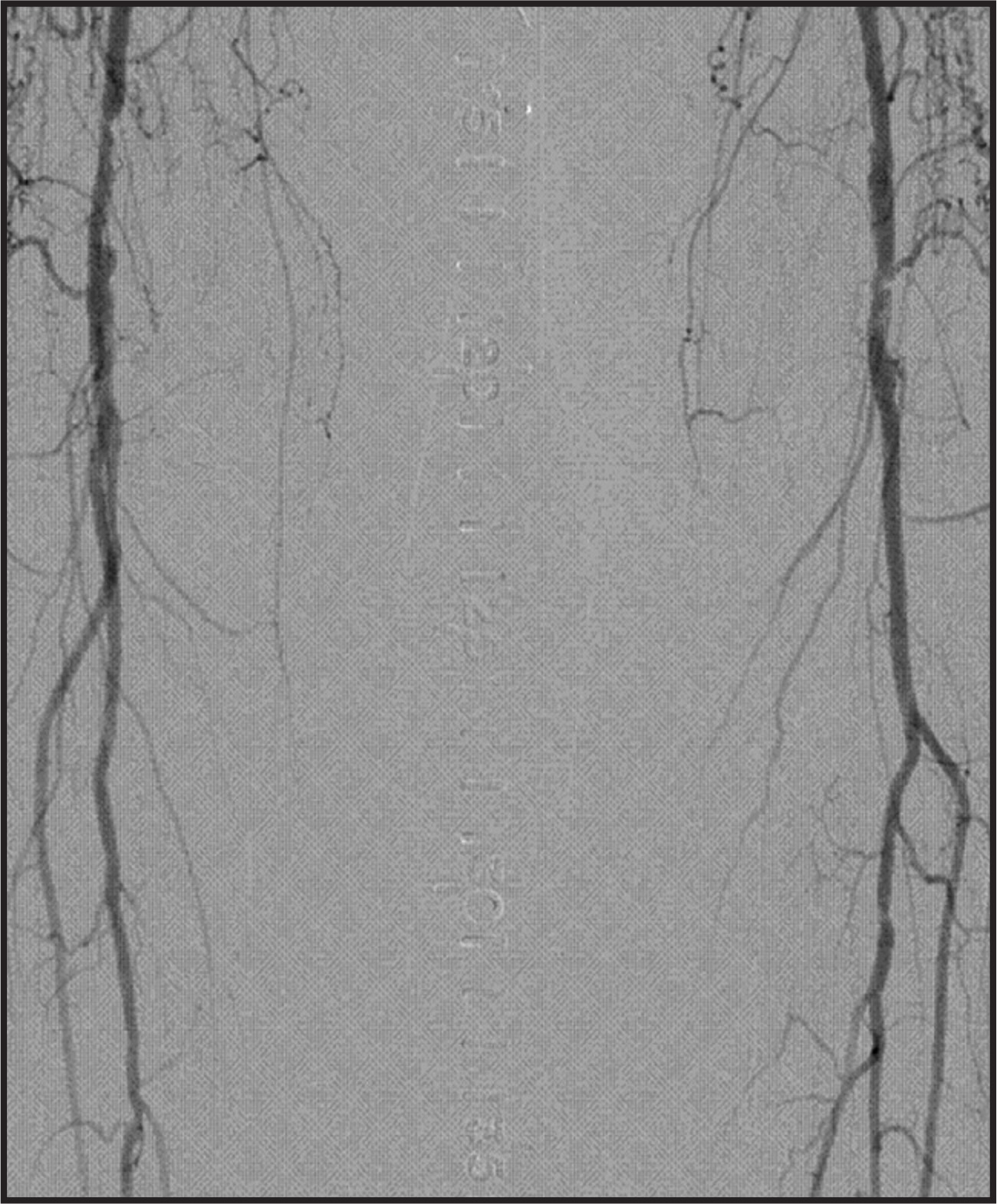
Although arterial complications during or after total knee arthroplasty (TKA) are rare; however, their sequelae can be disastrous. This case report describes the injury to an anomalous anterior tibial artery during total knee arthroplasty (TKA) and its successful surgical management. The operation was quite uneventful, but on release of the tourniquet at the end of the procedure, excessive bleeding was encountered. Further exploration to locate the source of the bleeding revealed injury to the anterior tibial artery, which was taking off quite higher off from the popliteal artery (Figure 1). The vessel was however successfully repaired with prolene sutures with no postoperative vascular complications and an uneventful recovery.
IMAGING FINDINGS
A digital subtraction angiogram showing high take-off of right anterior tibial artery, making it prone to iatrogenic injury along with popliteal artery during TKA.
DIAGNOSIS
Anomalous anterior tibial artery
DISCUSSION
Arterial injuries are twice common during total knee replacement than during total hip replacement.1 The most commonly affected arteries are popliteal artery and common femoral artery respectively. Literature search shows the incidence of popliteal artery injury to be 0.03% to 0.05%.2,3,4 However, abnormal location of arteries make them more prone to injury as happened in our case. Similarly the incidence of arterial injuries is much more in patients with peripheral vascular disease mostly related to tourniquet use.
Ninomiya5 et al has shown that use of posterior retractors during TKA make popliteal artery more prone to injury. Similarly hyper-flexion and hyperextension of the knee joint during TKA causes kinking of the popliteal artery with possible injury to it especially in the presence of atherosclerosis. In our case, because of the high take-off of the anterior tibial artery (Figure 1), one of the above factors may have contributed to the arterial injury.
CONCLUSION
To prevent arterial injuries, thorough preoperative assessment with emphasis on peripheral vascular system can identify at-riskpatients. Similarly, during operation, knowledge of the anatomic relationship between popliteal artery or other anomalous vessels (eg,anterior tibial artery in our case) and the tibial plateau can reduce the incidence of arterial injury during orthopedic surgery.
References
- Calligaro K, Dougherty M, Ryan S, Booth R. Acute arterial complications associated with total hip and knee arthroplasty Erratum Comments. J Vasc Surg J Vasc Surg J Vasc Surg J Vasc Surg.
- Calligaro K, DeLaurentis D, Booth R. Acute arterial thrombosis associated with total knee arthroplasty. J Vasc Surg. 1994;20(6).
- Rand J. Vascular complications of total knee arthroplasty. Report of three cases. J Arthroplasty. 1987;2(2):89-93.
- DeLaurentis D, Levitsky K, Booth R. Arterial and ischemic aspects of total knee arthroplasty. Am J Surg. 1992;164:237-240.
- Ninomiya J, Dean J, Goldberg V. Injury to the popliteal artery and its anatomic location in total knee arthroplasty. J Arthroplasty. 1999;14(7):803-809.
Citation
. Arterial injury to an anomalous anterior tibial artery during total knee arthroplasty. Applied Radiology. 2012;41(9):30A-30B. doi:10.37549/AR1933.