BI-RADS v2025: A Modern Framework for a Data-Driven Era
Applied Radiology — Vol. 55 , Issue 2
Published: March 1, 2026
Categories
A lot has changed in breast imaging since the American College of Radiology (ACR) released its 5th edition of the Breast Imaging Reporting and Data System (BI-RADS®) Atlas in 2013. Digital breast tomosynthesis is now routine. Contrast-enhanced mammography and advanced breast MRI techniques, including evolving diffusion-weighted imaging protocols, have expanded diagnostic capabilities.
Artificial intelligence (AI) applications are increasingly embedded in workflows, while multimodality treatments have become the norm and expectations for metrics reporting have significantly increased.
Given this progression, much excitement accompanies December’s BI-RADS v2025 manual release, updated to meet the complex needs of today’s practice.
“This is really a big deal for the breast imaging community,” says Dana H. Smetherman, MD, MPH, MBA, Chief Executive Officer of the ACR. While remaining true to the foundational principles of BI-RADS, the new edition incorporates “lots of new descriptors, including new modalities, new auditing and outcomes,” she notes.
The most comprehensive update to BI-RADS in over a decade, the atlas-turned-manual—900 pages complete with deeper guidance, illustrations, and structured terminology to help address day-to-day practice demands—has modernized breast imaging reporting standards. The guide’s transition from print to digital format also reflects a progressive approach to managing the continuously evolving field.
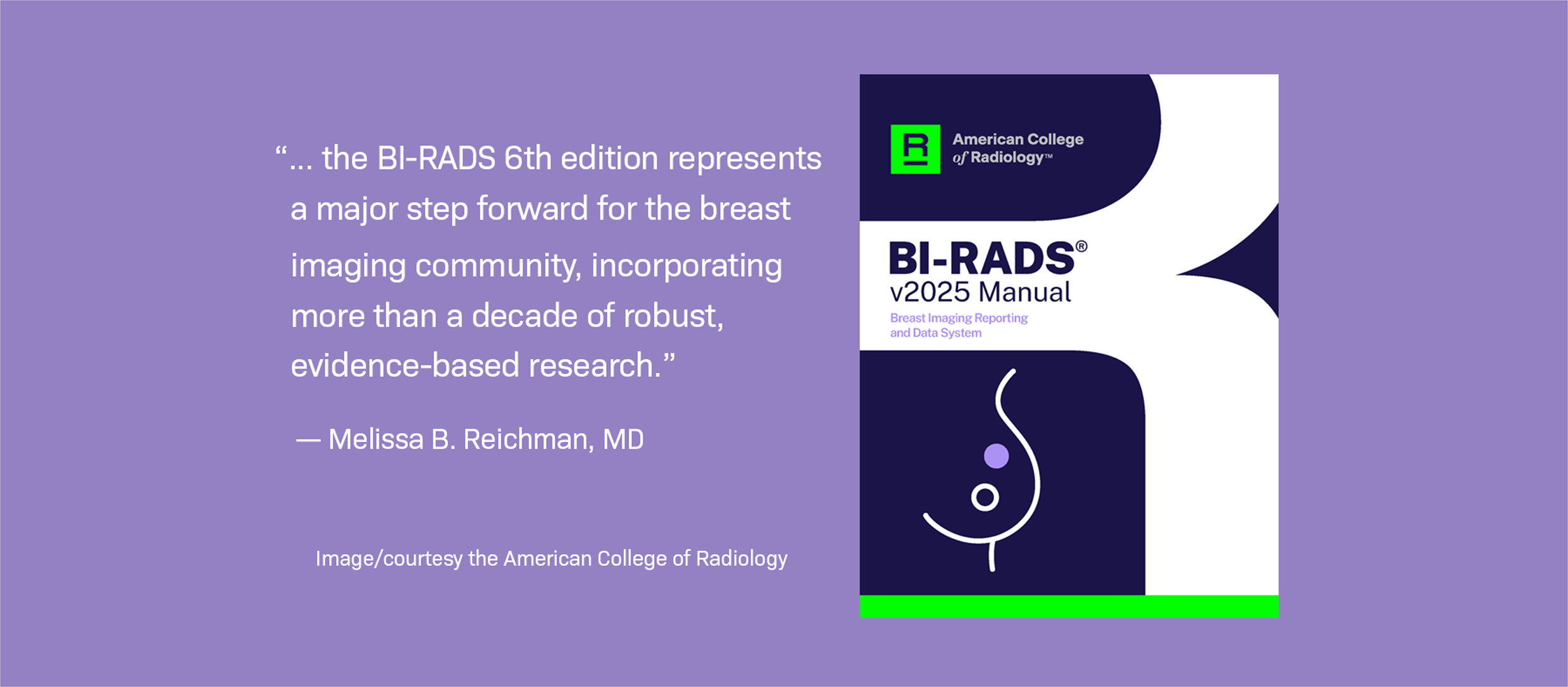
According to Melissa B. Reichman, MD, Associate Professor of Clinical Radiology at Weill Cornell Medicine in New York City, “the BI-RADS 6th edition represents a major step forward for the breast imaging community, incorporating more than a decade of robust, evidence-based research.”
The expanded lexicon reflects contemporary imaging techniques, while reducing ambiguity and improving communication across practices, notes Dr Reichman. Of equal importance, Reichman emphasizes, is the enhanced focus on performance metrics and targeted audits—particularly for BI-RADS 3 assessments, extent-of-disease evaluation, and the addition of method of detection. Together, these refinements represent a meaningful step forward in “improving diagnostic quality, radiologist performance, and patient-centered care.”
Clinical Clarity and Quality Measurement
The BI-RADS manual encompasses currently used methods of detection as well as clinically relevant terminology that help accomplish clear, consistent communication. The updates closely align with the ACR National Mammography Database, giving practices an “easy and very standardized way that they look at the outcomes of the work that they are doing,” which, in turn, impacts daily reporting, Dr Smetherman says.
New auditing guidance and outcomes measures are designed to support accountability and longitudinal benchmarking. For example, the manual expands the use of BI-RADS Category 6 to better account for patients who may have completed neoadjuvant chemotherapy, aligning reporting with today’s common care pathways. It “provides clearer direction for reporting additional ipsilateral findings in patients with biopsy-proven cancer, improving communication with breast surgeons and helping determine when findings will change [disease] management,” explains Dr Reichman.
Dr Smetherman says these improvements are a direct result of the ACR’s stakeholder review efforts. “We have really tried to listen to the feedback of our members of the breast imaging community to make these updates and to incorporate the way they’re practicing breast imaging today.”
A Digital Framework for an Evolving Field
The format of BI-RADS v2025 supports timely updates for continued evolution of imaging technologies and clinical practice.
“In the past, updates meant mailed inserts that you had to physically add to the book,” Dr Smetherman recalls. “Now, those changes can happen much more easily.”
Not only does the digital format enable streamlined updating, it supports data consistency and change implementation amid rapid technological development. The ACR’s broad oversight across the radiology ecosystem—from clinical practice to coding, regulation to technology development—makes this possible, allowing the organization to “be thoughtful about what gets added [to BI-RADS] and when,” Dr Smetherman reports.
For example, use of AI will continue to expand in breast imaging for detection, triage, and risk prediction, among other applications. The format of BI-RADS v2025 facilitates integration of AI applications based on ACR clinical validation processes, not simply in response to market trends.
“Our role [is] to make sure that it is implemented in ways that are safe, effective, and responsible for our patients and for radiologists and their practices,” she says, noting that ongoing technological updates must be anchored in the commitment to reporting and delivery of patient-centered care.
Setting a Global Standard
As new breast imaging technologies become standard of care, the need for consistent, internationally recognized reporting standards becomes even more essential.
“Enthusiasm for the new version [of BI-RADS] is most assuredly not confined to the United States,” Dr Smetherman says, noting there were immediate requests for translated versions, particularly from regions with limited resources. “At a certain level, having that standardization helps everyone.”
As breast imaging continues to advance, consistent terminology and measurable quality standards across borders will continue to ensure safe, harmonized, optimal clinical practice management worldwide.
“Alongside the many exciting and meaningful advancements in breast imaging, grounded in more than a decade of evidence-based medicine, BI-RADS remains a strong and enduring framework. It has withstood the test of time and continues to provide a solid foundation for future progress,” Dr Reichman concludes. “As technology advances and research generates new data, including AI and emerging breast imaging modalities, BI-RADS will continue to evolve, and the breast imaging community will be well prepared to move forward with it.”
Citation
. BI-RADS v2025: A Modern Framework for a Data-Driven Era. Applied Radiology. 2026;55(2). doi:10.37549/AR-D-26-0019.