Breast Arterial Calcifications on Mammography: AI Assessment and Cardiovascular Risk
Applied Radiology — Vol. 55 , Issue 5
Published: September 1, 2026
Categories
Cardiovascular disease (CVD), not breast cancer, is the leading cause of death in women, who are more likely than men to be diagnosed at later stages of CVD and to experience poorer outcomes following myocardial infarction. Because mammography is performed worldwide for breast cancer screening, it also provides an opportunity to identify breast arterial calcification (BAC), a known cardiovascular risk marker, thereby serving the dual purpose of screening for breast cancer while providing potentially important information about cardiovascular risk. Despite this opportunity, radiologists infrequently report BAC when it is detected.
In 2023, the Canadian Society of Breast Imaging issued a position statement recommending BAC reporting, along with severity grading.1 The recently released BI-RADS v2025 Manual (previously referred to as BI-RADS 6th Edition) now explicitly acknowledges the association between BAC and CVD, although BAC reporting remains optional.2 On April 11, 2026, Maryland House Bill 1364 was unanimously passed, mandating that the presence of BAC on all screening mammograms be reported to patients in lay-language result letters, effective October 1, 2026.3 Other states may follow.
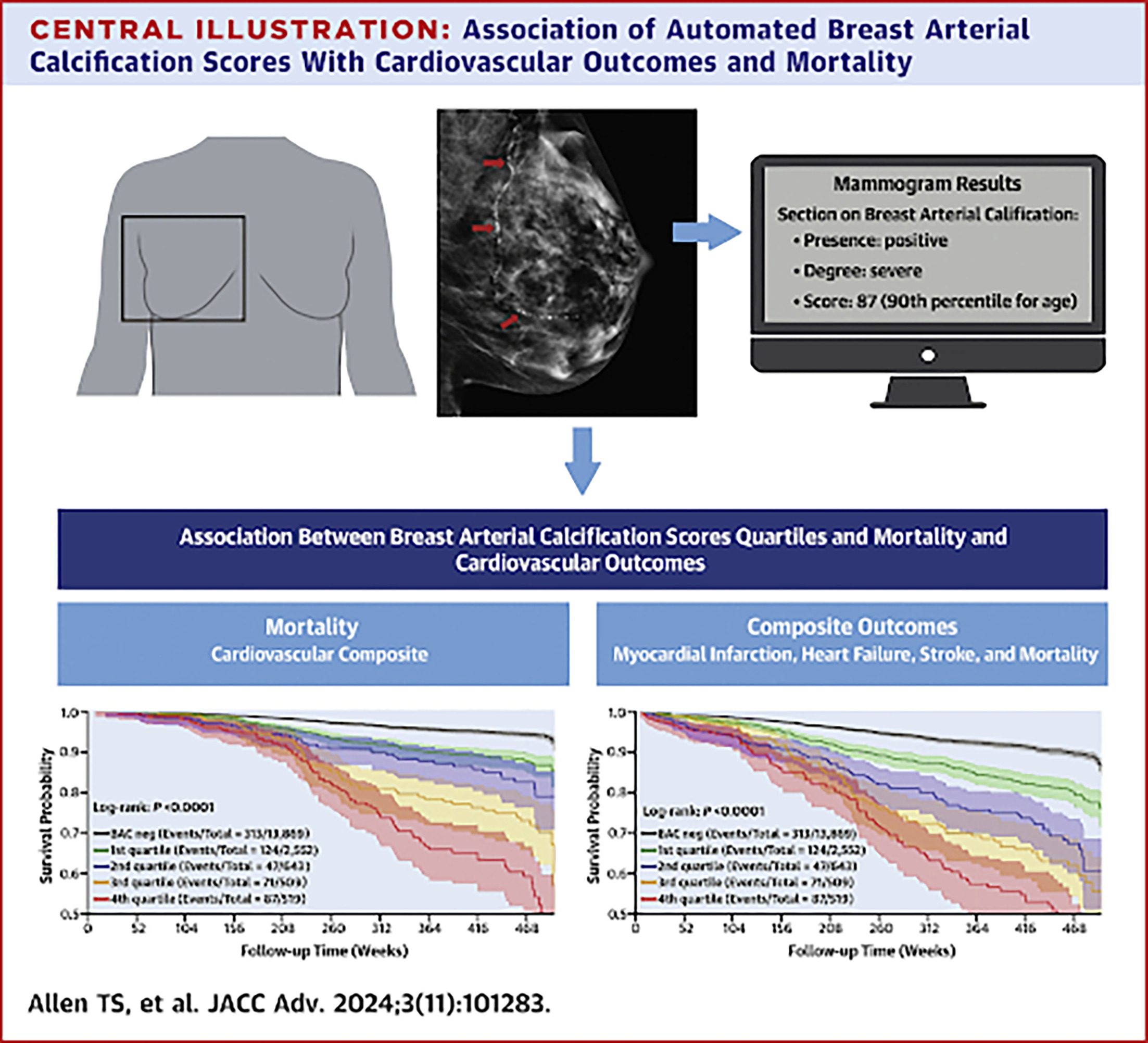
Artificial intelligence (AI) can assist with quantification of BAC severity and age-based percentile scoring on mammography, allowing for further stratification of cardiovascular risk.4 A large-scale University of California San Diego study5 of more than 18,000 women using an experimental AI model demonstrated that each 10-point increase in BAC score was associated with a higher risk of mortality (HR 1.08; 95% CI 1.06-1.11) and the composite of mortality and major adverse cardiovascular events (MACE) (HR 1.08; 95% CI 1.06-1.10) (Figure 1).
BAC progression on serial mammography is also tied to a further elevation of cardiovascular risk. A study of over 10,000 women presented at the Radiological Society of North America in December 20256 showed that BAC can progress in as little as 1 year. The faster the progression, the greater the risk of cardiovascular events, especially for women under age 65. The risk of MACE and death in women who were BAC-negative and converted to BAC-positive was 41% higher, and 59% higher in those who transitioned from a lower to a higher category of BAC. Those who started in the intermediate category and transitioned to the highest severity category had a 93% higher risk of MACE. Women in the highest BAC percentile category had up to twice the risk of MACE compared with women who did not have BAC.6
AI is widely used as an aid in mammography interpretation, with many products available to assist with breast cancer detection, density categorization, and risk scoring. Only 2 AI software vendors have commercially available products for binary reporting (presence/absence) of BAC: CureMetrix cmAngio version 1.0 (CureMetrix, San Diego, California) and DeepHealth BAC Assessment (Radnet, Cambridge, Massachusetts).
A newer version of CureMetrix’s software (2.0), cleared in July 2026, also provides AI-based quantitative measurement of BAC based on BAC length and generates an age-based percentile score for comparison with reference data. The Deep Health and CureMetrix BAC detection products are cleared for both full-field digital mammography and digital breast tomosynthesis and show high performance across all tissue densities.7,8
Reimbursement remains a barrier to clinical implementation of AI-based BAC assessment. Coverage varies, and some facilities offer AI-assisted services on a self-pay basis. As of January 2025, BAC reporting is again included as a quality measure under Medicare’s Merit-based Incentive Payment System (MIPS), designated QMM28.8 Under the MIPS measure, the presence or absence of BAC must be reported for screening mammograms performed in women aged 40 years and older. When BAC is present, the report must include either a statement addressing its clinical relevance—for example, noting the association between BAC and CVD and/or coronary artery disease independent of other known risk factors—or a recommendation for appropriate follow-up.
Current CVD risk assessment tools may underestimate risk in women. Mammography provides a simple, opportunistic means of identifying CVD risk without additional radiation exposure or a separate patient encounter. Unlike BAC assessment on an existing mammogram, coronary artery calcium scoring by CT requires a separate examination and involves additional radiation exposure, procedural time, and potentially additional patient expense, depending on insurance coverage. A published survey found that most clinicians would prefer BAC to be reported, including the severity of calcification. Most physicians also indicated that the presence of BAC could prompt further evaluation for CVD and associated risk factors.9
Reporting of BAC severity and progression on sequential mammograms may aid in identifying subgroups of women who are at the greatest cardiovascular risk. According to Matthew Nudy, MD, a cardiologist at Penn Health, “because BAC is already visible on routine screening mammograms, I see it evolving into a standardized, artificial intelligence-enabled ‘cardiovascular risk enhancer’ that can be reported consistently and used to trigger a focused cardiovascular risk-factor assessment and subsequently used to intensify guideline-based preventive therapies such as statins and intensive blood pressure control.”
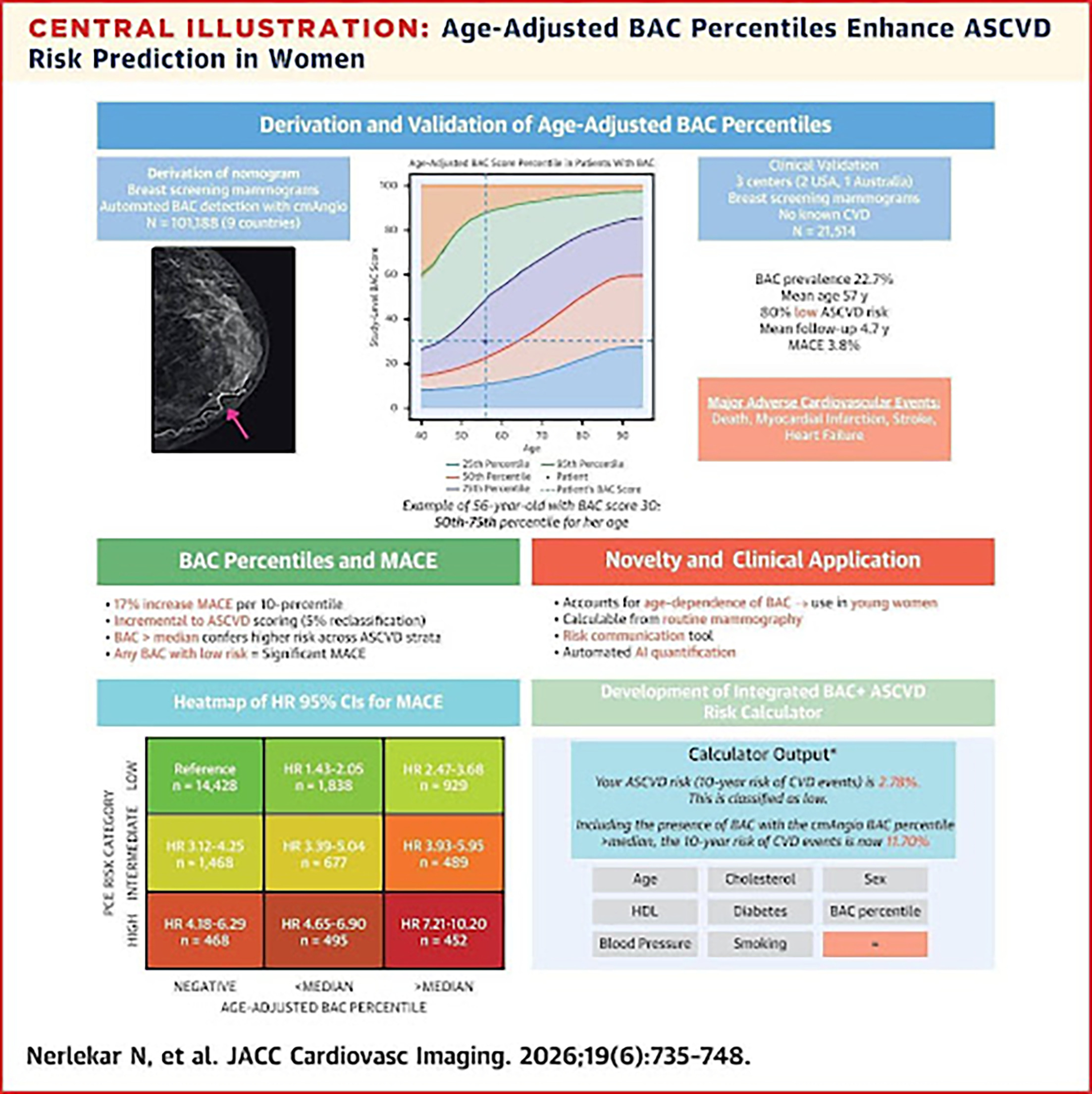
AI-based severity scoring of BAC may help to further improve the ability to predict risk and prevent cardiovascular mortality in women (Figure 2). The next step in building acceptance of this risk marker in clinical care is demonstrating that BAC-informed care can improve clinical outcomes, not just the prediction of risk.
References
- Canadian Society of Breast Imaging position statement on breast arterial calcification reporting on mammography. Published January 17, 2023.
- Newell M, Destounis S, Leung J. ACR BI-RADS® V2025 Manual. 2025.
- Public Health - Mammograms - Arterial Calcification Notice. HB 1364, Chapter 604 (2026).
- Nerlekar N, Soh C, Vasanthakumar S. A novel breast arterial calcification age-based percentile nomogram for the incremental prediction of incidental cardiovascular events. JACC Cardiovasc Imaging. 2026;19(6):735-748. doi:10.1016/j.jcmg.2026.03.008.
- Allen T, Bui Q, Petersen G. Automated breast arterial calcification score is associated with cardiovascular outcomes and mortality. JACC Adv. 2024;3(11). doi:10.1016/j.jacadv.2024.101283.
- Nudy M, Watanabe A, Mantey R, Wang J, Nerlekar N. Breast arterial calcification on mammograms: natural history analysis using artificial intelligence in over 10,000 women. . 2025.
- Watanabe A, Dib V, Wang J. Artificial intelligence-based software for breast arterial calcification detection on mammograms. J Breast Imaging. 2025;7(2):168-176. doi:10.1093/jbi/wbae064.
- BAC: 510(k) premarket notification K254131. DeepHealth, Inc. Decision date May 21, 2026.
- 2025 MIPS reporting includes five new ACR QCDR measures. Published January 15, 2025.
Disclosures
Dr Watanabe is a consultant for CureMetrix, Inc., manufacturer of cmAngio, which is discussed in this article. The other authors report no relevant financial relationships. The authors received no outside funding for the production of this article.
Citation
. Breast Arterial Calcifications on Mammography: AI Assessment and Cardiovascular Risk. Applied Radiology. 2026;55(5). doi:10.37549/AR-D-26-0066.