Breast cancer litigation involving pregnancy: Claims, injury, and awards
Applied Radiology — Vol. 6 , Issue 1 , pp. 19 -21
DOI: 10.37549/AR1003
Published: June 1, 2001
Categories
Pregnant patients in the process of being examined for possible breast cancer may require a higher degree of scrutiny from their physicians. In this study, in an effort to find ways to improve clinical decision-making by physicians in breast cancer diagnosis, the key medical and legal issues in breast cancer litigation involving pregnancy were identified.
While studying breast cancer litigation cases,1 it was found that one subset of claims varied from the major set. This article focuses on this subset of pregnancy and breast cancer litigation cases with attention to claims, injury, and awards.To our knowledge, there is little information on breast cancer litigation cases involving pregnancy. NORCAL Mutual Insurance Company presents a detailed description of a single pregnancy breast cancer litigation case.2 Other studies provide limited information such as the percent of patients with breast cancer who are pregnant, or a brief clinical review of the cases.3,4
Materials and methods
Breast cancer litigation cases involving pregnancy were acquired by searching a medical-legal database5 between 1985 and 1998, cross-matching the terms breast, cancer, and pregnancy. This computer search resulted in 26 cases, of which one case was irrelevant and was disqualified (since the breast cancer occurred more than 1 year postpartum), yielding a total of 25 cases for this project.
These 25 cases were categorized by: (1) case number, (2) the year the case was published in the database (usually within a year from the date the case closed), (3) the patient’s age at the time of the alleged negligence, (4) patient history (e.g., lump history), (5) the defendants by specialty, (6) the claims, (7) the time delay in the diagnosis of breast cancer, (8) patient injury, (9) patient treatment, (10) the method of resolution (verdict or settlement), and (11) plaintiff award/compensation. This information was compared to other breast cancer litigation data.1,3
Some variables, such as the patient's age, delay in diagnosis, and awards, were quantified. Other variables, such as defendants and claims, were coded for the presence or absence of the variable. Complete information was not available for all variables. Therefore, statistical calculations were applied to the available subset of data. Measures of central tendency, such as mean and median, were used to determine summary statistics for the data sets. Statistical comparative tests were not performed with the study data due to the small sample sizes.
Study limitations
The Medical Malpractice Verdicts, Settlements & Experts database contains information gathered from three main sources: (1) state jury verdict publishers, (2) miscellaneous sources including court records, and (3) attorneys. The state jury verdict publishers' data source favors verdict over settlement information. Also, the attorney data source affects the data and skews it in favor of the plaintiff. Hence, this data source should not be considered complete or perfectly balanced.
Statistical analysis was not performed with the study data because of the small sample sizes. The percentages or ratios calculated with the study data can be compared with findings from other similar studies in order to develop a working hypothesis for further study.
Results
Patient demographics
Patient history
In this study, a lump is defined to include: a lump, a mass, a thickening, fullness, swelling, or an enlarged breast. All 25 patients, or 100% of the study cases, alleged that a breast lump was not diagnosed correctly. Approximately 74% of all patients in the Hamer et al study1 claimed that a breast lump was not diagnosed correctly.
The patients discovered 72% of lumps, while 12% were discovered by physicians/nurses, and 16% were not specified. In both the Hamer et al1 and the PIAA3 studies, lumps were found by the patient in 60% of cases.
Reasons the patient claimed that physicians did not follow up on breast lumps, or followed them up incorrectly, included: (1) lump was assigned a benign diagnosis (56%), (2) breast lump was not acknowledged by the doctor (12%), (3) failure to ensure follow-up (12%), (4) reliance on negative imaging tests (12%), and (5) miscellaneous reasons (8%).
In the Hamer et al1/PIAA2 studies, dismissing the lump as benign was reported in 58% and 35% of the cases, respectively.
Breast imaging
A mammogram was performed in 7 of the 25 (28%) cases, of which there were no known cases of failure to read a mammogram correctly. Plaintiffs claimed failure to order a mammogram in 3 of the 25 (12%) cases. In one case, a radiologist refused a mammogram due to lactation. Ultrasound (US) was performed in only one known case. There was only one claim of failure to order a US exam.
Claims
All 25 plaintiffs in this study alleged failure to diagnose a breast lump correctly. Common claim subcategories include failure to: (1) biopsy a lump (32%), (2) obtain a second opinion (16%), and (3) order a mammogram (12%). There were no claims of failure to properly treat breast cancer.
Treatment
The more common types of treatment included (1) mastectomy (83%), (2) chemotherapy (60%), (3) radiation therapy (24%), and (4) bone marrow transplant (8%).
Delay
Injury
The most common types of alleged injury include: (1) terminal condition/ death (67%), (2) metastases (to sites including axillary lymph nodes) (55%), and (3) abortion (16%). The terminal condition/death rate of 67% is more than double the corresponding rate of 31% for cases in the Hamer et al1 study.
Defendants
Defendant information was not specified for about half of the cases in this study, but it appears that obstetricians and gynecologists are more likely to be involved than other specialty groups.
Methods of resolution
The cases were adjudicated as follows: 52% by verdict, 44% by settlement, and 4% were dismissed.
Awards
The mean/median award for these breast cancer litigation subcategories were: pregnancy (25 cases) $1,136,000/$675,000; death (16 cases) $1,608,000/$1,000,000; and abortion (3 cases) $1,167,000/$600,000.
The pregnancy award amounts are approximately three times greater than the corresponding award amounts in the Hamer et al1 study.
Discussion
Policy for follow-up of palable findings
For all cases in this study, patients claimed failure to diagnose a breast lump correctly. Hence, it is important that medical personnel have a policy for follow-up of breast lumps and a comprehensive system of communication to ensure the follow-up of these patients.
Guidelines and risk management suggestions regarding breast issues are provided by several authors.4,6,7 Cady8 notes the unusual presentation of some breast cancers in his litigation population; he emphasizes that obscure physical findings frequently led to a failure to appreciate the real problem.
Age and injury
Overall, the plaintiffs in these breast cancer litigation cases involving pregnancy were young, with a high percentage of death cases. In his study of failure to diagnose breast cancer, Cady8 also found that patients were young and had advanced disease.
Injury and awards
Breast imaging in pregnant patients
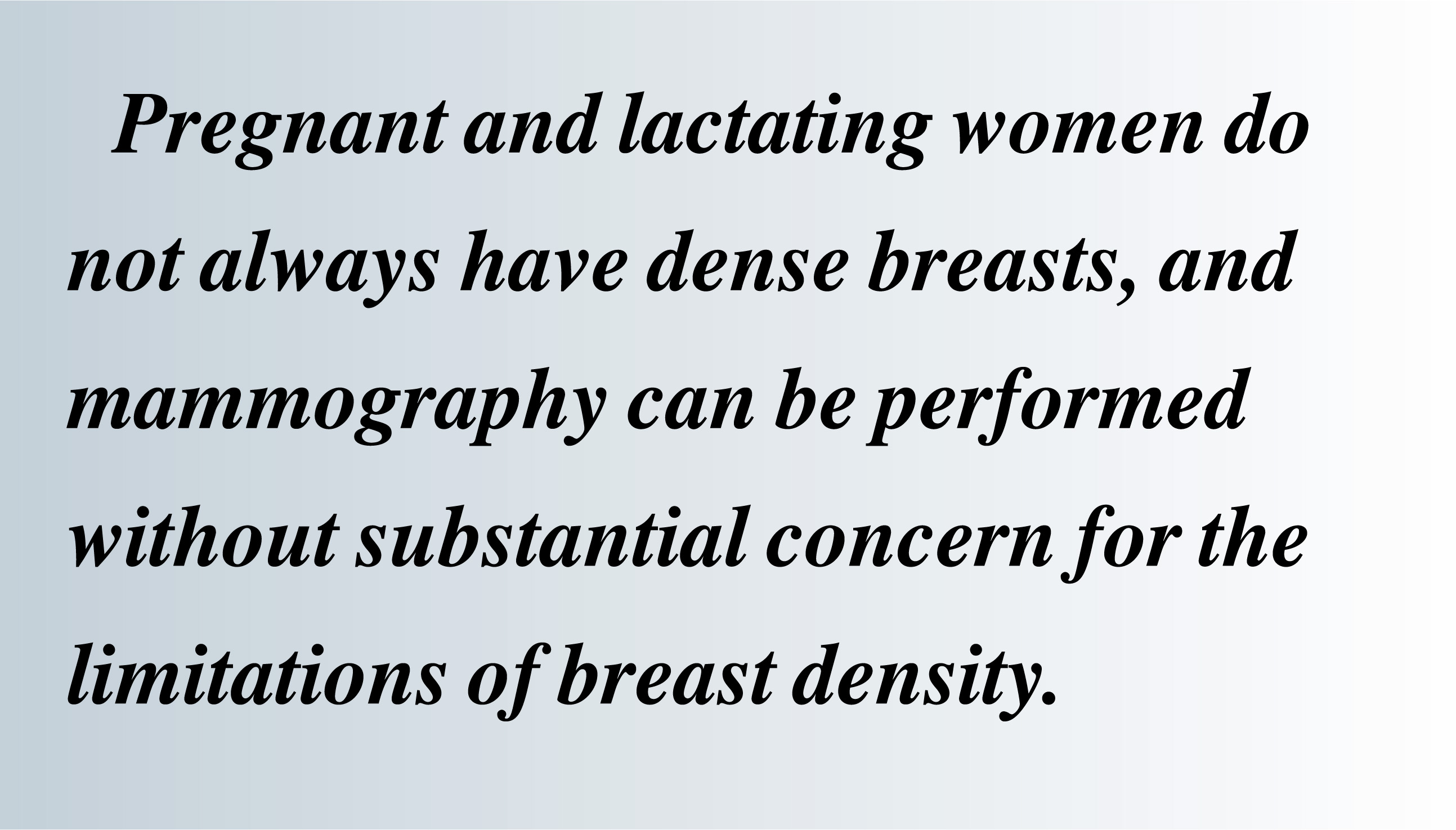
Breast imaging can help in the care of pregnant patients with breast lumps. Pregnant and lactating women do not always have dense breasts, and mammography can be performed without substantial concern for the limitations of breast density. Mammography can be as useful in these women as it is in other women with breast signs and symptoms.10 For example, Liberman et al11 reported that mammographic findings were present in 78% (18 of 23) of the cases.
Also, clinicians appear to be reluctant to use breast imaging in pregnant patients; however, this can lead to a delay in diagnosis. Ultrasound is the modality of choice for initial analysis of such a breast mass in younger pregnant patients. Mammography with shielding of the abdomen is recommended if there is suspicion of cancer.12
Presentation of breast cancer in pregnant patients
Clinical data shows that comparing pregnant patients with breast cancer with nonpregnant patients with breast cancer reveals no difference in survival.13 Pregnancy does not worsen the prognosis of breast cancer; rather, it is hypothesized that it obscures the disease and allows it to progress to a more advanced stage at presentation.14 This hypothesis14 coupled with Cady’s study8 prompts medical personnel to have a higher index of concern when dealing with pregnant patients who have obscure or vague findings.
Conclusion
Breast cancer litigation cases involving pregnancy, when compared with breast cancer litigation cases in general, are more likely to: (1) claim failure to diagnosis a lump correctly, (2) involve younger patients, (3) result in a terminal condition or death, and (4) have higher award amounts.
The finding that pregnancy does not worsen the prognosis of breast cancer and the hypothesis that it may obscure the disease and allow it to progress to a more advanced stage at presentation14 coupled with the results of Dr. Cady’s study8 and other similar findings8,13,14 should encourage medical personnel to approach the pregnant patient with a breast lump with a higher index of concern. AR
Acknowledgment
The authors would like to thank Charles Kaufman, JD for his legal advice in the preparation of this article.
References
- Hamer M, Hamer B. Breast cancer litigation: claims, defendants, and awards. Appl Radiol. 1999;28(8):15-21.
- Delayed diagnosis of breast cancer resulting in brain metastasis and diminished prognosis.
- Breast cancer study. 1995.
- Schaefer M. Overview of CRICO’s breast cancer claims. Forum: Harvard Risk Management Foundation. 1998;19(2):1-4.
- Laska L. Medical malpractice verdicts, settlements & experts.
- The palpable breast lump: Information and recommendations to assist decision-making when a breast lump is detected. Can Med Assoc J. 1998;158:53-58.
- Osuch J, Bonham V. The timely diagnosis of breast cancer. Cancer. 1994;74:271-278.
- Cady B. Common factors in claims of failure to diagnose breast cancer. 1992.
- Brennan T, Sox C, Burstin H. Relations between negligent adverse events and the outcome of medical malpractice litigation. N Engl J Med. 1996;335:1963-1967.
- Liberman L, Giess C, Dershaw D. Imaging of pregnancy-associated breast cancer. Radiology. 1994;191:245-248.
- Swinford A, Adler D, Garver K. Mammographic appearance of the breasts during pregnancy and lactation: False assumptions. Acad Radiol. 1998;5:467-472.
- Samuels T, Liu F, Yaffe M, Haider M. Breast imaging: gestational breast cancer. J Assoc Can Radiol. 1998;49:172-180.
- Zemlicks D, Lishner M, Degendarfer M. Maternal & fetal outcome after breast cancer in pregnancy. Am J Obstet Gynecol. 1992;166:781-787.
- Difronzo L, O’Connell T. Breast cancer in pregnancy and lactation. Surg Clin North Am. 1996;76:267-278.
Citation
. Breast cancer litigation involving pregnancy: Claims, injury, and awards. Applied Radiology. 2001;6(1):19-21. doi:10.37549/AR1003.