Colorectal Adenocarcinoma in an Adolescent with Lynch Syndrome
Journal of Pediatric Case Reports — Vol. 1 , Issue 7
Published: October 1, 2026
1 Department of Radiology, Cincinnati Children’s Hospital, University of Cincinnati College of Medicine, Cincinnati, Ohio
2 Department of Radiology, Phoenix Children’s Hospital, Phoenix, Arizona
Abstract
Abstract: Hereditary nonpolyposis colorectal cancer (HNPCC) is a heritable disease that significantly increases the risk of colorectal cancer. Risk assessment should be considered in pediatric patients with a family history of colorectal cancer, followed by appropriate screening with routine colonoscopies. Cross-sectional imaging is a valuable adjunct to colonoscopy, helping to identify complications and stage disease. Thanks to surgical advances and rigorous screening programs, colorectal cancer associated with HNPCC often carries a favorable prognosis.
Keywords
gastrointestinal, intestine, neoplasm, syndrome
Categories
Case Summary
A teenage male with a family history of colon cancer originally presented with anemia and weight loss. A colonoscopy was performed, which revealed a large fungating mass of the right colon.
Imaging Findings
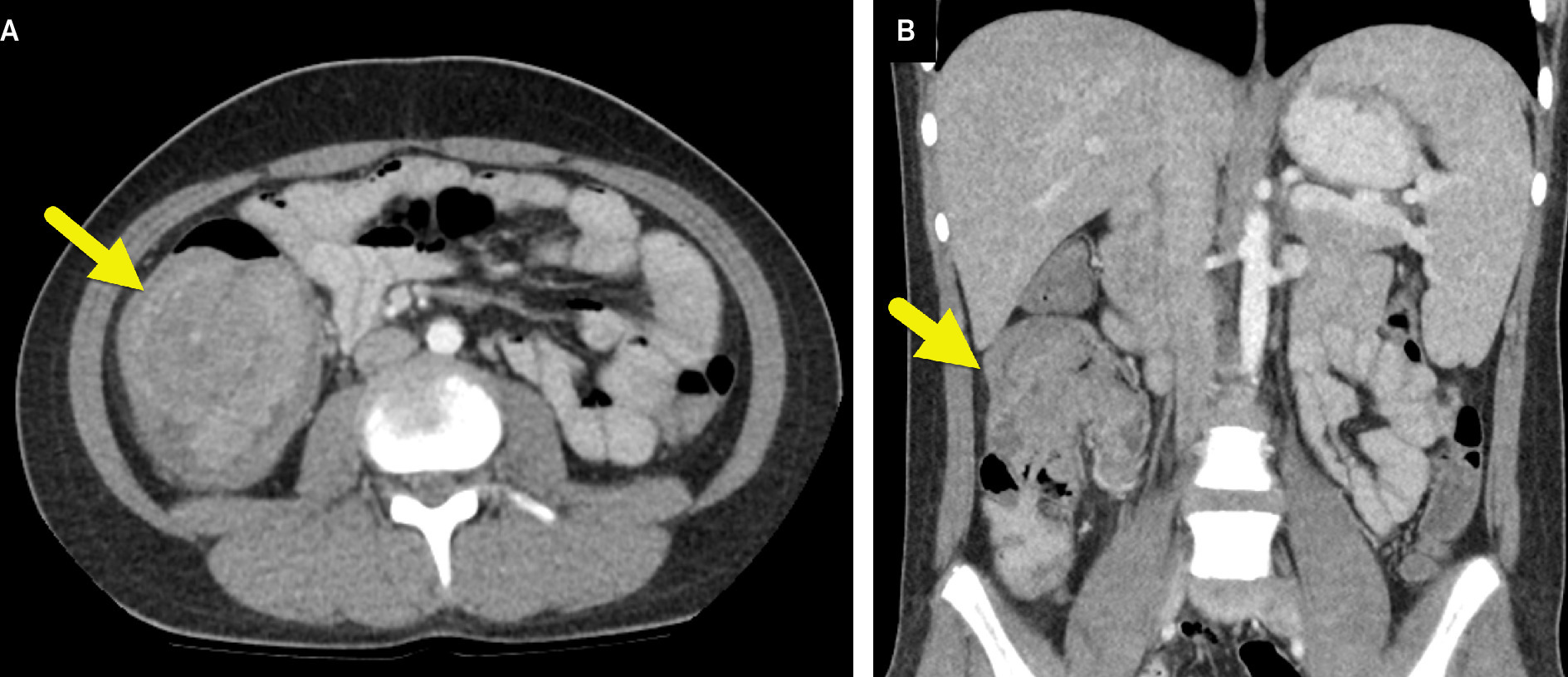
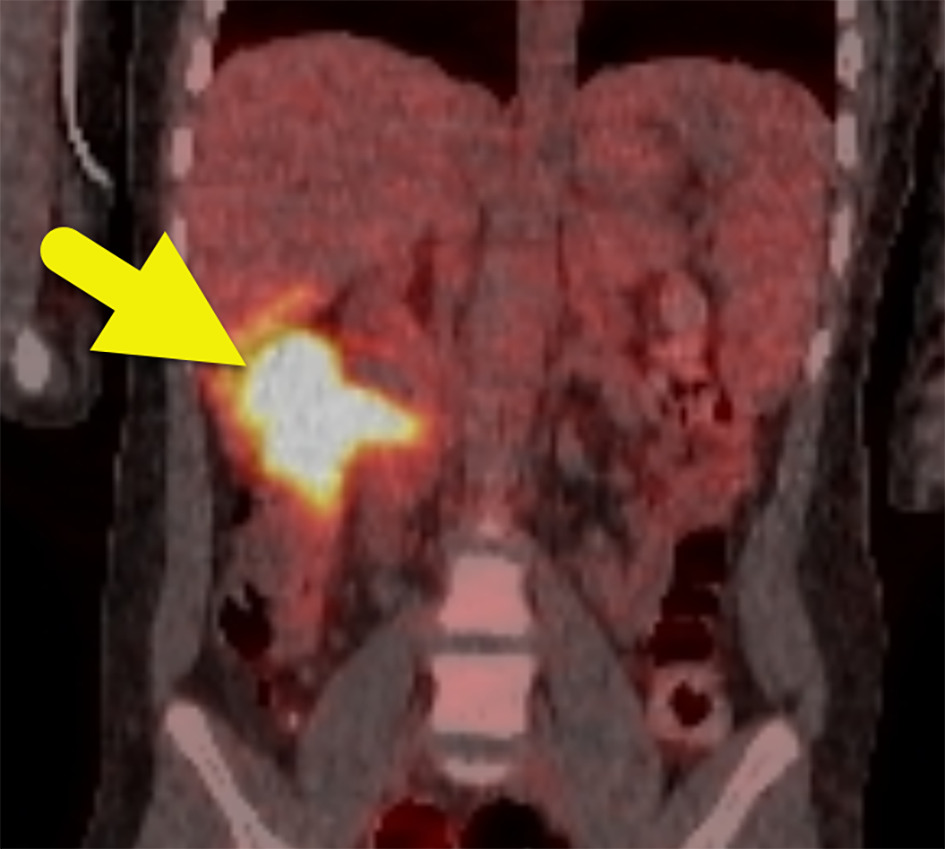
Contrast-enhanced CT of the abdomen (Figure 1) showed a large enhancing intraluminal mass within the mid-ascending colon. There was no appreciable colonic wall thickening. However, the mass was acting as a lead point, causing a colocolonic intussusception. Subsequent F18 fluorodeoxyglucose PET/CT (Figure 2) showed uptake within the colonic mass.
Diagnosis
Colonic adenocarcinoma in the setting of Lynch syndrome.
The differential diagnosis of a colonic mass in an adolescent includes Burkitt lymphoma, adenocarcinoma, gastrointestinal stromal tumor, and carcinoid tumor. Due to the patient’s family history of colon cancer, colorectal adenocarcinoma in the setting of a cancer predisposition syndrome was suspected.
Discussion
Lynch syndrome, or hereditary nonpolyposis colorectal cancer (HNPCC), is the most common inherited cause of colorectal cancer. It follows an autosomal-dominant inheritance pattern and results from mutations in DNA mismatch repair genes, which are responsible for correcting base-pairing errors during DNA replication. Deficiency in these genes leads to microsatellite instability and the accumulation of genetic errors, thereby increasing cancer risk.1 While colorectal cancer is the most common malignancy associated with HNPCC, affected individuals also have elevated risks for endometrial, ovarian, upper urinary tract, upper gastrointestinal, brain, and prostate cancers.2
Individuals at high risk for HNPCC, including those with a positive family history, are advised to follow specific screening guidelines. Colorectal cancer screening typically begins with colonoscopy between 20 and 25 years of age, or 2–5 years earlier than the youngest age of colorectal cancer diagnosis in the family. Colonoscopy should then be repeated every 1-2 years. Although there are currently no formal surveillance protocols for other associated malignancies, high-risk individuals may benefit from additional screening for endometrial and upper gastrointestinal cancers.3
In pediatric patients, HNPCC is typically diagnosed only after the development of malignancy. While colorectal adenocarcinoma is the most common presentation, other associated cancers such as renal cell carcinoma and cerebral malignancies have also been reported. Although HNPCC-associated colorectal cancer is rare in children, these patients are often diagnosed at advanced stages.4,5 Given the increased cancer risk in pediatric patients with HNPCC, it is essential to obtain a thorough family history in children with potential hereditary cancer risk.
Current staging of colorectal cancer includes colonoscopy and biopsy. Cross-sectional imaging modalities play a complementary role in determining disease extent and staging. On CT, colorectal cancer typically appears as a soft-tissue mass that causes luminal narrowing or colonic wall thickening. Complications such as obstruction, perforation, or fistula formation may also be identified. Tumor extension beyond the colon may present as an extra colic mass. This finding is often associated with infiltration and thickening of the pericolic fat or loss of the normal fat plane.6
Treatment guidelines for colorectal cancer in patients with HNPCC typically involve segmental resection or subtotal colectomy, depending on tumor extent and degree of invasion. Available chemotherapeutic agents for colorectal cancer include 5-fluorouracil, oxaliplatin, and irinotecan; however, their effectiveness in tumors associated with HNPCC remains uncertain.7,8
Although colorectal cancer has a high recurrence rate in patients with HNPCC, overall survival rates remain favorable, with approximately 90% at 5 years, 80% at 10 years, and 70% at 15 years following diagnosis. These positive outcomes have been attributed to the use of extended colectomies and rigorous surveillance protocols.9
Conclusion
HNPCC is a heritable disease that significantly increases the risk of colorectal cancer. Risk assessment should be considered in pediatric patients with a family history of colorectal cancer, followed by appropriate screening with routine colonoscopies. Cross-sectional imaging is a valuable adjunct to colonoscopy, helping to identify complications and stage disease. Thanks to surgical advances and rigorous screening programs, colorectal cancer associated with HNPCC often carries a favorable prognosis.
References
- Bhattacharya P, Leslie S, McHugh T. StatPearls. June 8, 2024.
- Dominguez-Valentin M, Sampson J, Seppälä T. Cancer risks by gene, age, and gender in 6350 carriers of pathogenic mismatch repair variants: findings from the prospective lynch syndrome database. Genet Med. 2020;22(1):15-25. doi:10.1038/s41436-019-0596-9.
- Idos G, Valle L, Adam M, Feldman J, Mirzaa G. GeneReviews®, Eds. February 5, 2004.
- Self C, Suttman A, Wolfe Schneider K, Hoffman L. Lynch syndrome: further defining the pediatric spectrum. Cancer Genet. 2021;258-259:37-40. doi:10.1016/j.cancergen.2021.07.002.
- MacArthur T, Ongie L, Lanpher B, Ishitani M. Pediatric manifestations of lynch syndrome: a single center experience. J Pediatr Surg Case Rep. 2022;86. doi:10.1016/j.epsc.2022.102431.
- Horton K, Abrams R, Fishman E. Spiral CT of colon cancer: imaging features and role in management. Radiographics. 2000;20(2):419-430. doi:10.1148/radiographics.20.2.g00mc14419.
- Fleming M, Ravula S, Tatishchev S, Wang H. Colorectal carcinoma: pathologic aspects. J Gastrointest Oncol. 2012;3(3):153-173. doi:10.3978/j.issn.2078-6891.2012.030.
- Vasen H, Möslein G, Alonso A. Guidelines for the clinical management of lynch syndrome (hereditary non-polyposis cancer). J Med Genet. 2007;44(6):353-362. doi:10.1136/jmg.2007.048991.
- Toh J, Hui N, Collins G, Phan K. Survival outcomes associated with lynch syndrome colorectal cancer and metachronous rate after subtotal/total versus segmental colectomy: meta-analysis. Surgery. 2022;172(5):1315-1322. doi:10.1016/j.surg.2022.06.013.
Disclosures
The authors have no conflicts of interest to disclose. None of the authors received outside funding for the production of this original manuscript, and no part of this article has been previously published elsewhere.
Citation
. Colorectal Adenocarcinoma in an Adolescent with Lynch Syndrome. Journal of Pediatric Case Reports. 2026;1(7). doi:10.37549/JPCR-26-0116.