Current controversies in prostate brachytherapy for prostate cancer
Applied Radiation Oncology — Vol. 6 , Issue 3 , pp. 6 -11
DOI: 10.37549/ARO1128
Published: September 1, 2017
Categories
Prostate cancer remains the most commonly diagnosed malignancy in men. An estimated 161,360 new cases will be diagnosed in 2017 in the United States, accounting for 19% of male cancer diagnoses and 8% of cancer mortality in men. 1 Localized prostate cancer management represents a challenge for clinicians as several definitive treatment options exist including surgical resection, external-beam radiation therapy (EBRT) +/- brachytherapy boost, high dose rate brachytherapy (HDR-BT), and low dose rate brachytherapy (LDR-BT). Treatment recommendations and decisions are often based on patient age, comorbidities, risk stratification, as well as patient preference. LDR-BT is an attractive option for many patients, either as monotherapy or in combination with EBRT. Brachytherapy techniques have continued to evolve over the past several decades with new data supporting technical innovation and revised treatment indications. The purpose of this review is to summarize the role of LDR-BT in managing prostate cancer and to discuss patient selection in a contemporary context.
History of Brachytherapy and Modern Techniques
Prostate LDR-BT dates back approximately 100 years, when radium was used to deliver radiation for enlarged prostates and prostate cancer. 2,3 Given the poor efficacy and significant toxicity associated with radium, this isotope was abandoned in favor of radioactive gold isotopes (198Au). 4 Iodine-125 (125I) and other isotopes largely replaced 198Au due to radiobiological and physical advantages. 5 Modern techniques with template and transrectal ultrasound (TRUS) guidance have been used for 30 years with excellent treatment tolerance and long-term control. 5-7 The two most widely used radioactive sources in prostate LDR-BT are 125I and palladium-103 (103Pd) ( Table 1 ). Peschel et al studied 272 patients treated with 125I or 103Pd and found no difference in biochemical disease-free survival. 8 However, complication rates appeared to be higher for 125I, which is consistent with its radiobiological characteristics. 8 Given their excellent disease control rates, 125I, 103Pd and, more recently, radioactive cesium (cesium-131) are now preferred options for LDR-BT in patients who meet modern eligibility and indications criteria. 9-11
| Iodine-125 | Palladium-103 | |
|---|---|---|
| Half Life | 60 days | 17 days |
| Dose Rate | Slower | Faster |
| Half Value Layer in Lead (mm) | 0.02 | 0.01 |
| Average Photon Energy (MeV) | 0.028 | 0.021 |
| Dose-Monotherapy (Gy) | 145 | 125 |
| Dose-Boost (Gy) | 110 | 90-100 |
Classic Selection Guidelines
Indications for prostate LDR-BT have been continuously evolving over the past decade. The 1999 American Brachytherapy Society (ABS) recommendations by Nag et al initially suggested prostate brachytherapy as a monotherapy only for patients with low-risk disease defined per the D’Amico criteria 12 as T1-T2a, Gleason sum < 6, and PSA < 10 ng/ml, 13 respectively. The ABS guidelines were subsequently updated to include prostate LDR monotherapy as an option for both low-risk and selected patients with intermediate-risk prostate cancer. 14 Currently, the National Comprehensive Cancer Network (NCCN) recommends brachytherapy monotherapy for very low, low, and low-volume-intermediate-risk prostate cancer patients. 15 Contraindications for brachytherapy have also been changing; previous ABS guidelines used a prostate volume of > 60 cc as a cutoff to recommend against brachytherapy, 13,14 while more recent NCCN guidelines consider only “very large” gland size as a relative contraindication for brachytherapy without specifying a cutoff value. 15 A summary of the current guidelines is provided in Table 2 . Use of brachytherapy monotherapy or in combination with androgen deprivation therapy (ADT) for high-volume-intermediate-risk or high-risk prostate cancer patients remains an area of debate. Despite the absence of level-I evidence or randomized trials in this patient population, unfavorable intermediate-risk and high-risk men are generally not offered brachytherapy as monotherapy.
| Nag 1999 ABS 13 | Davis 2012 ABS 14 | NCCN 2017 v2 15 | ||
|---|---|---|---|---|
| Monotherapy | < T2a Gleason sum < 6 PSA < 10 ng/ml | Low risk Int risk (optional) | Very low risk Low risk Int risk (low volume) | |
| with EBRT | T2b, T2c Gleason sum 8–10 PSA > 20 ng/ml | Int risk (optional) High risk | Int risk High risk Very High risk | |
|
Other relative indications
PNI Multiple positive biopsies Bilateral disease Capsular penetration | ||||
| Other indications | Not applicable | Not applicable | Salvage post definitive RT | |
| With ADT | Patients with large prostate (> 60 cc) High risk | Int risk (optional) Very High risk | High risk | |
| Contraindications to BT |
Relative
Large median lobes History of pelvic RT High AUA score History of multiple pelvic surgeries Severe diabetes / healing problems Expected technical difficulties TURP Gland size > 60 cc Seminal vesicles involved Absolute Life expectancy < 5 years Large/unhealed TURP defect Unacceptable operative risks Metastatic disease |
Relative
IPSS scores > 20 Small TURP defects History of pelvic RT IBD Large median lobes Gland size > 60cm3 Absolute Limited life expectancy Ataxia-telangiectasia Distant metastases Unacceptable operative risks Absence of rectum Large TURP defects |
Only Relative (“not ideal”)
Very Large gland Very Small gland Bladder outlet obstruction/High IPSS score Previous TURP |
Modern Outcomes with Prostate LDR Brachytherapy
The initial report of the Nuclear Research and Consultancy Group (NRG) Oncology/Radiation Therapy Oncology Group (RTOG) 0232 comparing LDR-BT monotherapy to combined EBRT followed by an LDR-BT boost for intermediate-risk prostate cancer patients showed no difference in progression-free survival and overall survival with a median follow-up of 6.7 years. Moreover, there was no overall acute grade 3+ toxicity difference in both groups, but rather an overall grade 3+ late and grade 3+ GU toxicity profile favoring LDR monotherapy alone. 16 Another recent randomized trial, Androgen Suppression Combined with Elective Nodal and Dose Escalated Radiation Therapy (ASCENDE-RT), evaluated the role of LDR-BT in the management of intermediate- and high-risk prostate cancer and revealed a biochemical progression-free survival (bPFS) advantage favoring the addition of LDR-BT to EBRT for intermediate- and high-risk groups. 17 This trial did indicate a higher grade 3 GU toxicity at 5 years in the LDR-BT group, with half of those attributed to urethral strictures, while no other statistically significant differences in toxicity were found ( Table 3 ). 18 These two trials, in addition to two previous prospective trials comparing EBRT alone to EBRT in combination with HDR-BT, 19,20 formed the basis for updated American Society of Clinical Oncology (ASCO) guidelines in 2017. 11 These guidelines support LDR-BT monotherapy as an option for low-intermediate-risk patients, and recommend a brachytherapy boost for intermediate- and high-risk patients treated with EBRT, conceding that there may be increased GU toxicity compared to EBRT alone. 11
| Trial | Risk Category | Treatment Arm | N= | Primary Endpoint | Significance | Grade III Toxicity | |||
|---|---|---|---|---|---|---|---|---|---|
| bPFS | |||||||||
| 5 yr | 7 yr | 9 yr | |||||||
| ASCENDE RT 17,18 | 398 | Late | |||||||
| Intermediate (30.7%) High (69.3%) | GU | GI | |||||||
| EBRT+ LDR-BT | 198 | 88.7 ±4.8 | 86.2 ± 5.4 | 83.3 ± 6.6 | Log-rank P < 0.001 | 18% | 8% | ||
| DE-EBRT | 200 | 83.8 ± 5.6 | 75.0 ± 7.2 | 62.4 ± 9.8 | 5% | 3% | |||
| SS | NSSD | ||||||||
| RTOG 0232 16 | 588 | 5 yr PFS | Overall Acute: 8% NSSD | ||||||
| Low-intermediate | Late GU | Late GI | |||||||
| LDR-BT | 292 | 86 (81,90) | P < 0.001 for futility | 3% | 2% | ||||
| EBRT +LDR-BT | 287 | 85 (80,90) | 7% | 3% | |||||
| USSR | |||||||||
It is important to note that the recent ASCO guidelines did not address the impact of the interim analysis of the NRG oncology/RTOG 0232 study, which was originally designed to test for a 10% increase in the 5-year PFS for EBRT with LDR-BT boost. 16 The RTOG 0232 findings suggest LDR-BT monotherapy is at least as effective for patients with favorable intermediate-risk prostate cancer when compared to combined modality treatment. 16 Moreover, absent from the guidelines is an acknowledgement of the important finding that LDR-BT monotherapy had a better toxicity profile compared to combined modality therapy. 11,16 Similarly for high-risk prostate cancer patients, in the absence of randomized data comparing brachytherapy monotherapy (with or without ADT) against other treatment modalities, it seems worthwhile for the guidelines to incorporate two recent large retrospective series from the Cleveland Clinic and from the National Cancer Database. 21,22 These studies demonstrated a biochemical relapse-free survival (bRFS) and prostate-cancer-specific mortality (PCSM) advantage to LDR-BT monotherapy over radical prostatectomy and EBRT, respectively, in patients with high-risk prostate cancer. 21,22 Importantly, the toxicity profile in these retrospective studies again favored LDR-BT over EBRT or surgery when comparing an 125I LDR-BT dose of 144 Gray (Gy) to an EBRT dose of at least 78 Gy or 70 Gy in 2 or 2.5 Gy per fraction, respectively, both with or without ADT, and radical prostatectomy followed by adjuvant or salvage EBRT to a median dose of 70 Gy in 2 Gy per fraction. 21 Finally, we believe that LDR-BT monotherapy is a sufficient treatment option for patients with localized intermediate-risk or high-risk prostate cancer. If combined modality radiation therapy was offered for these patients, we favor brachytherapy after EBRT. One reason is the uncertainty of calculating cumulative dose with external beam after the implant was placed and the potential for increased toxicity of delivering EBRT on top of an active implant. That said, we believe either could be reasonable depending on physician and institutional experience.
Dosimetric Differences Between Brachytherapy and EBRT
While available guidelines provide indications, outcome, toxicity, and, more recently, cost-effectiveness for prostate brachytherapy, 11-13 these guidelines seldom address the radiobiological and dosimetric advantage of brachytherapy. With EBRT it is necessary to account for setup error, patient (external) movement and organ (internal) movement, which are used to generate a planning target volume (PTV). The PTV typically ranges from 0.5 - 1 cm around the clinical target volume (CTV) depending on the method of immobilization and use of image-guided radiation therapy (IGRT). 23 Kneebone et al showed a reduction in the average deviations to 2.9 mm, 2.1 mm and 3.9 mm in the anteroposterior, right-left, and superoinferior directions, respectively, with the incorporation of rigid external immobilization. 24 Internal immobilization with endorectal balloon or spacers are used to further maximize treatment reproducibility, but may result in tissue deformation, increased anterior rectal wall contact to target, diminished patient compliance, increased costs, and possibly increased treatment failure. 25-28 Another challenge sometimes faced during EBRT treatment planning involves imaging artifacts associated with a hip prosthesis that can obscure pelvic anatomy and impair the ability of the treatment-planning system to accurately determine densities for dose modeling. 29 Finally, obese patients tend to be at a higher risk of interfraction setup errors resulting in a higher risk of relapse post EBRT. 30,31 Despite that, adequate EBRT coverage mandates that 3D-CRT or IMRT doses be normalized so that 98% of the PTV receive the prescription dose as per the current ongoing RTOG 0924 trial protocol. 32 For stereotactic body radiation therapy (SBRT) or hypofractionated radiation therapy cases, the dose is prescribed to cover at least 95% of the PTV 33 ( Figure 1A-C ).
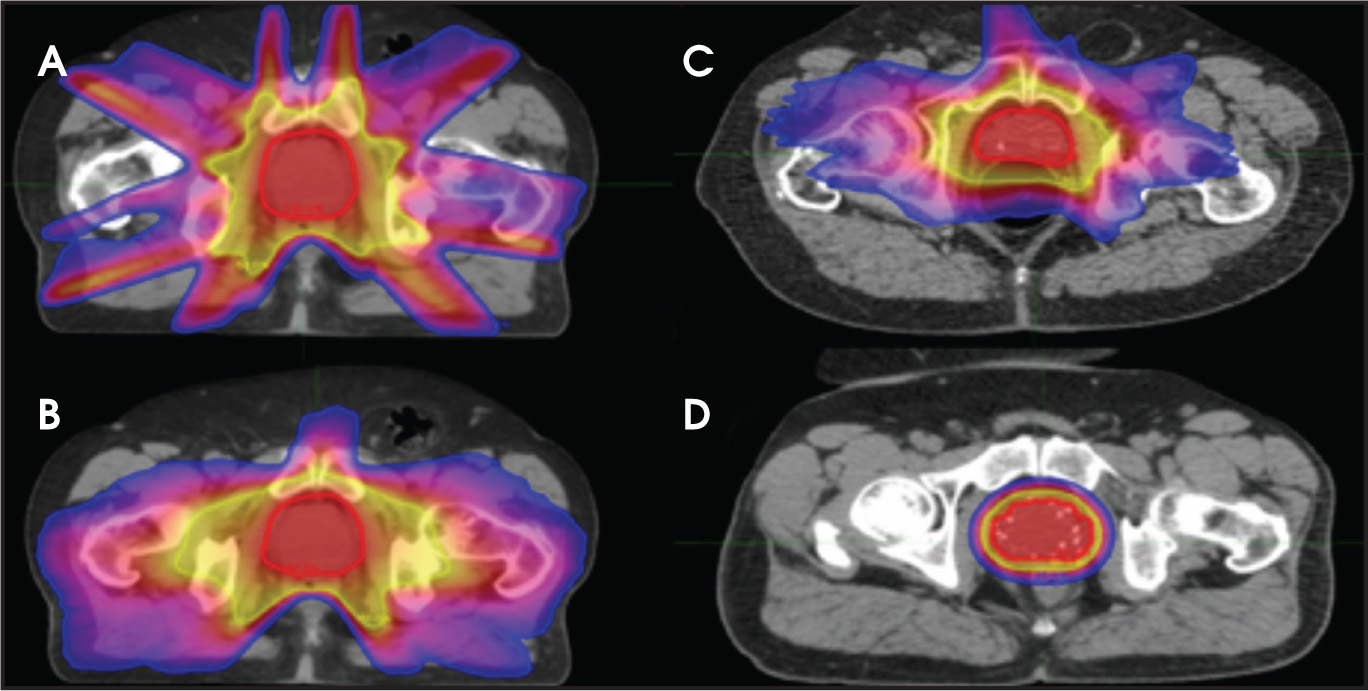
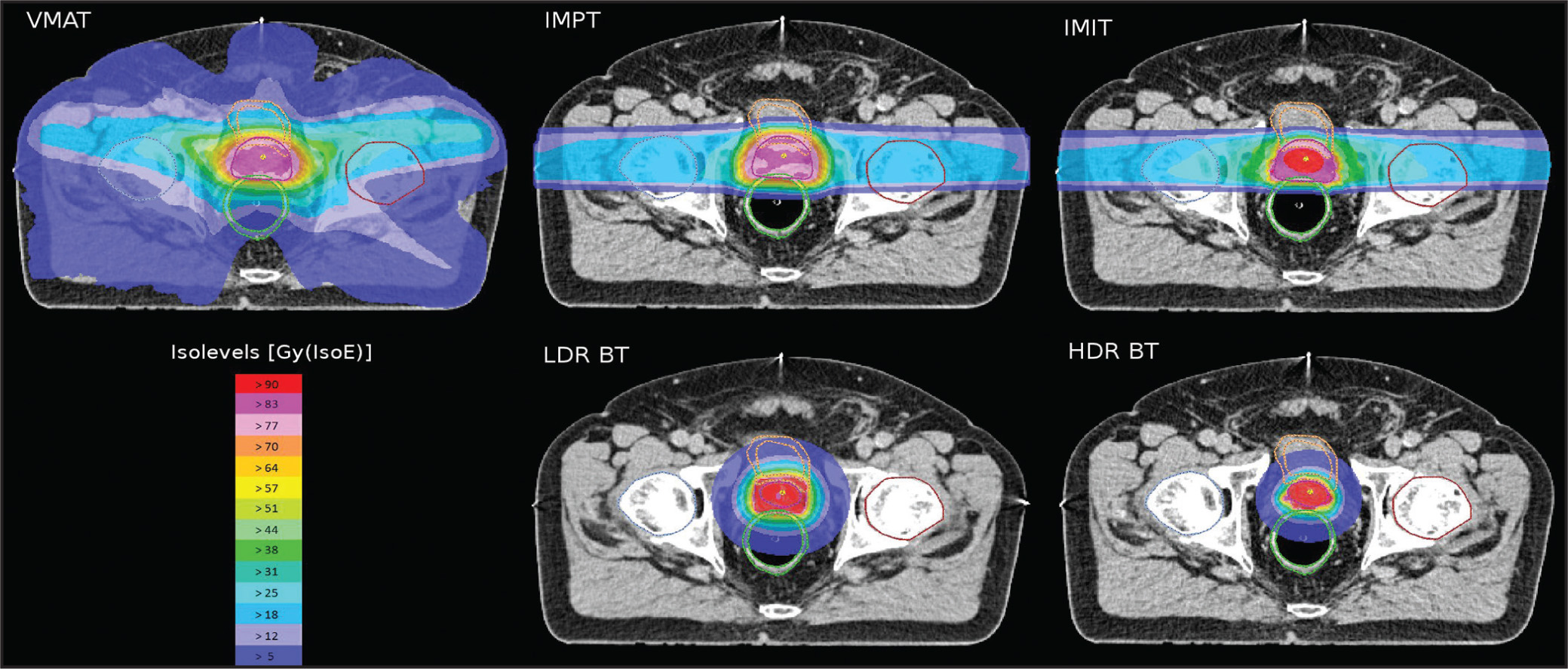
On the other hand, for LDR-BT, optimal placement of sources is the key to achieving adequate dose to the prostate while minimizing toxicity to normal tissues ( Figure 1D ). 34 The photon decay characteristics of modern prostate brachytherapy sources result in highly local energy deposition, and generally yield a more conformal dose distribution. 35 Georg et al studied the dosimetric differences among modern radiation therapy techniques including volumetric-modulated arc therapy (VMAT), intensity-modulated proton therapy (IMPT), intensity-modulated carbon-ion therapy (IMIT), LDR-BT, and HDR-BT. All doses were clinically appropriate and were normalized to biologically equivalent fractionations. Brachytherapy was found to be superior in sparing normal tissues ( Figure 2 ). 36 Moreover, despite modern EBRT and IGRT techniques, given brachytherapy’s significant inverse-square dose falloff advantage, intraprostate doses remain significantly higher with brachytherapy compared to EBRT. 37 This allows for dose escalation and increased biological effective dose, hence possibly explaining the improvement in PFS and PCSM, even in men with high-risk prostate cancer. 17,21,22
Conclusion
In summary, prostate LDR-BT is a well-established treatment modality with excellent long-term outcomes for patients with localized prostate cancer, with similar outcomes between different radionuclides. 10,7 Appropriate patient selection remains a moving target in the modern era, and eligibility guidelines continue to evolve accordingly. 11-13 While brachytherapy as monotherapy is accepted as a standard for low-risk and low-volume-intermediate-risk prostate cancer patients, no randomized data show inferiority to combined treatment modalities in high-volume-intermediate-risk or high-risk prostate cancer patients. Recent multicenter randomized studies (RTOG 0232) have shown similar outcomes and favorable toxicity profiles for LDR-BT monotherapy compared to combined therapy with EBRT for patients with favorable intermediate-risk prostate cancer. 16 Retrospective data from the Cleveland Clinic and National Cancer Database have shown similar efficacy and toxicity results in high-risk patients. 21,22 These outcomes data are underpinned by the dosimetric advantage of brachytherapy over EBRT. 36 Prospective trials to evaluate the role of brachytherapy monotherapy in well-selected high-risk patients are needed to address gaps and shape future guidelines.
References
- Siegel R, Miller K, Jemal A. Cancer Statistics, 2017. CA Cancer J Clin. 2017;67(1):7-30. doi:10.3322/caac.21387.
- Hugh B, Young H. Desperate cases of enlarged prostate.
- Deming C. L. Results in one hundred cases of cancer of prostate and seminal vesicles treated with radium. Surg. Gynecol. Obstet. 1922.
- Flocks R. Interstitial Irradiation Therapy With a Solution of Au198 As Part of Combination Therapy for Prostatic Carcinoma. J Nucl Med.. 1964;5:691-705.
- Holm H. The history of interstitial brachytherapy of prostatic cancer. Semin Surg Oncol.. 1997;13(6):431-437. doi:10.1002/(SICI)1098-2388(199711/12)13:6<431::AID-SSU7>3.0.CO;2-B.
- Charyulu K. Transperineal interstitial implantation of prostate cancer: a new method. Int J Radiat Oncol Biol Phys.. 1980;6(4):1261-1266.
- Kittel J, Reddy C, Smith K. Long-Term Efficacy and Toxicity of Low-Dose-Rate (1)(2)(5)I Prostate Brachytherapy as Monotherapy in Low-, Intermediate-, and High-Risk Prostate Cancer. Int J Radiat Oncol Biol Phys. 2015;92(4):884-893. doi:10.1016/j.ijrobp.2015.02.047.
- Peschel R, Colberg J, Chen Z, Nath R, Wilson L. Iodine 125 Versus Palladium 103 Implants for Prostate Cancer. Cancer J. 2004;10(3):170-174. doi:10.1097/00130404-200405000-00006.
- Benoit R, Smith R, Beriwal S. Five Year Prostate-specific Antigen Outcomes after Caesium Prostate Brachytherapy. Clin Oncol.. 2014;26(12):776-780. doi:10.1016/j.clon.2014.08.002.
- Glaser S, Chen K, Benoit R, Smith R, Beriwal S. Long-Term Quality of Life in Prostate Cancer Patients Treated With Cesium-131. Int J Radiat Oncol. 2017;98(5):1053-1058. doi:10.1016/j.ijrobp.2017.03.046.
- Chin J, Rumble R, Kollmeier M. Brachytherapy for Patients With Prostate Cancer: American Society of Clinical Oncology/Cancer Care Ontario Joint Guideline Update. J Clin Oncol.. 2017;13(6):JCO.2016.72.046. doi:10.1200/JCO.2016.72.0466.
- D’Amico A V, Whittington R, Bruce Malkowicz S. Biochemical outcome after radical prostatectomy, external beam radiation therapy, or interstitial radiation therapy for clinically localized prostate cancer. J Am Med Assoc. 1998;280(11):969-974.
- Nag S, Beyer D, Friedland J, Grimm P, Nath R. American brachytherapy society (ABS) recommendations for transperineal permanent brachytherapy of prostate cancer. Int J Radiat Oncol Biol Phys.. 1999;44(4):789-799. doi:10.1016/S0360-3016(99)00069-3.
- Davis B, Horwitz E, Lee W. American Brachytherapy Society consensus guidelines for transrectal ultrasound-guided permanent prostate brachytherapy. Brachytherapy. 2012;11(1):6-19. doi:10.1016/j.brachy.2011.07.005.
- Prostate Cancer (Version 2.2017).
- Prestidge B, Winter K, Sanda M. Initial Report of NRG Oncology/RTOG 0232: A Phase 3 Study Comparing Combined External Beam Radiation and Transperineal Interstitial Permanent Brachytherapy With Brachytherapy Alone for Selected Patients With Intermediate-Risk Prostatic Carcinoma. Int J Radiat Oncol.. 2016;96(2):S4. doi:10.1016/j.ijrobp.2016.06.026.
- Morris W, Tyldesley S, Rodda S. Androgen Suppression Combined with Elective Nodal and Dose Escalated Radiation Therapy (the ASCENDE-RT Trial): An Analysis of Survival Endpoints for a Randomized Trial Comparing a Low-Dose-Rate Brachytherapy Boost to a Dose-Escalated External Beam Boost f. Int. J Radiat Oncol Biol Phys.. 2017;98(2):275-285. doi:10.1016/j.ijrobp.2016.11.026.
- Rodda S, Tyldesley S, Morris W. ASCENDE-RT: An Analysis of Treatment-Related Morbidity for a Randomized Trial Comparing a Low-Dose-Rate Brachytherapy Boost with a Dose-Escalated External Beam Boost for High- and Intermediate-Risk Prostate Cancer. Int J Radiat Oncol Biol Phys.. 2017;98(2):286-295. doi:10.1016/j.ijrobp.2017.01.008.
- Hoskin P, Motohashi K, Bownes P, Bryant L, Ostler P. High dose rate brachytherapy in combination with external beam radiotherapy in the radical treatment of prostate cancer: initial results of a randomised phase three trial. Radiother Oncol. 2007;84(2):114-120. doi:10.1016/j.radonc.2007.04.011.
- Sathya J, Davis I, Julian J. Randomized trial comparing iridium implant plus external-beam radiation therapy with external-beam radiation therapy alone in node-negative locally advanced cancer of the prostate. J Clin Oncol. 2005;23(6):1192-1199. doi:10.1200/JCO.2005.06.154.
- Ciezki J, Weller M, Reddy C. A Comparison Between Low-Dose-Rate Brachytherapy With or Without Androgen Deprivation, External Beam Radiation Therapy With or Without Androgen Deprivation, and Radical Prostatectomy With or Without Adjuvant or Salvage Radiation Therapy for High-Risk Pros. Int J Radiat Oncol Biol Phys.. 2017;97(5):962-975. doi:10.1016/j.ijrobp.2016.12.014.
- Jackson M, Amini A, Jones B. Prostate brachytherapy, either alone or in combination with external beam radiation, is associated with longer overall survival in men with favorable pathologic Group 4 (Gleason score 8) prostate cancer. Brachytherapy. 2016;16(4):790-796. doi:10.1016/j.brachy.2017.03.007.
- Litzenberg D, Balter J, Hadley S. Influence of intrafraction motion on margins for prostate radiotherapy. Int J Radiat Oncol Biol Phys. 2006;65(2):548-553. doi:10.1016/j.ijrobp.2005.12.033.
- Kneebone A, Gebski V, Hogendoorn N, Turner S. A randomized trial evaluating rigid immobilization for pelvic irradiation. Int J Radiat Oncol Biol Phys.. 2003;56(4):1105-1111. doi:10.1016/S0360-3016(03)00222-0.
- Jones R, Hassan Rezaeian N, Desai N. Dosimetric comparison of rectal-sparing capabilities of rectal balloon vs injectable spacer gel in stereotactic body radiation therapy for prostate cancer: Lessons learned from prospective trials. Med Dosim.. 2017. doi:10.1016/j.meddos.2017.07.002.
- Bastasch M, Teh B, Mai W, McGary J, Grant W, Butler E. Tolerance of endorectal balloon in 396 patients treated with intensity-modulated radiation therapy (IMRT) for prostate cancer. Am J Clin Oncol.. 2006;29(1):8-11. doi:10.1097/01.coc.0000195099.26957.63.
- Susil R, McNutt T, DeWeese T, Song D. Effects of Prostate-Rectum Separation on Rectal Dose From External Beam Radiotherapy. Int J Radiat Oncol Biol Phys.. 2010;76(4):1251-1258. doi:10.1016/j.ijrobp.2009.07.1679.
- Hutchinson R, Sundaram V, Folkert M, Lotan Y. Decision analysis model evaluating the cost of a temporary hydrogel rectal spacer before prostate radiation therapy to reduce the incidence of rectal complications. Urol Oncol Semin Orig Investig.. 2016;34(7):291.e19-291.e26. doi:10.1016/j.urolonc.2016.02.024.
- Han S, Chung Y, Lee Y, Park K, Kim M, Kim K. Metal artifact reduction software used with abdominopelvic dual-energy CT of patients with metal hip prostheses: Assessment of image quality and clinical feasibility. Am J Roentgenol.. 2014;203(4):788-795. doi:10.2214/AJR.13.10980.
- Den R, Nowak K, Buzurovic I. Implanted dosimeters identify radiation overdoses during IMRT for prostate cancer. Int J Radiat Oncol Biol Phys.. 2012;83(3). doi:10.1016/j.ijrobp.2011.12.094.
- Strom S, Kamat A, Gruschkus S. Influence of obesity on biochemical and clinical failure after external-beam radiotherapy for localized prostate cancer. Cancer.. 2006;107(3):631-639. doi:10.1002/cncr.22025.
- NRG Oncology RTOG 0924 Androgen Deprivation Therapy and High Dose Radiotherapy with or without whole-pelvic radiotherapy in unfavorable intermediate or favorable high risk prostate cancer: a phase III randomized Trial Protocol.
- Boike T, Lotan Y, Cho L. Phase I dose-escalation study of stereotactic body radiation therapy for low- and intermediate-risk prostate cancer. J Clin Oncol.. 2011;29(15):2020-2026. doi:10.1200/JCO.2010.31.4377.
- Potters L, Huang D, Calugaru E, Fearn P, Lee L, Kattan M. Importance of implant dosimetry for patients undergoing prostate brachytherapy. Urology. 2003;62(6):1073-1077. doi:10.1016/j.urology.2003.07.004.
- Rivard M, Coursey B, DeWerd L. Update of AAPM Task Group No. 43 Report: A revised AAPM protocol for brachytherapy dose calculations. Med Phys.. 2004;31(3):633-674. doi:10.1118/1.1905824.
- Georg D, Hopfgartner J, G??ra J. Dosimetric considerations to determine the optimal technique for localized prostate cancer among external photon, proton, or carbon-ion therapy and high-dose-rate or low-dose-rate brachytherapy. Int J Radiat Oncol Biol Phys. 2014;88(3):715-722. doi:10.1016/j.ijrobp.2013.11.241.
- Spratt D, Scala L, Folkert M. A comparative dosimetric analysis of virtual stereotactic body radiotherapy to high-dose-rate monotherapy for intermediate-risk prostate cancer. Brachytherapy.. 2013;12(5):428-433. doi:10.1016/j.brachy.2013.03.003.
Citation
. Current controversies in prostate brachytherapy for prostate cancer. Applied Radiation Oncology. 2017;6(3):6-11. doi:10.37549/ARO1128.