Growth and Gains in Remote Diagnostic Mammography
Applied Radiology — Vol. 55 , Issue 5
Published: September 1, 2026
Categories
Remote interpretation is well established in screening mammography, helping health systems achieve timely reads and provide patient access to specialty expertise. As the radiologist shortage persists amid increasing breast imaging volumes, many systems now use a remote model for diagnostic reads, which presents new opportunities and challenges.
“Several factors are driving the growth of remote breast imaging, one of the biggest being the nationwide shortage of breast imaging radiologists,” says Rajshri N. Shah, MD, Medical Director of Breast Imaging, Radiology Care Division at Prisma Health, Greenville, South Carolina. “At the same time, demand for services continues to increase as screening programs expand, awareness improves, and more women undergo supplemental and high-risk screening.”
Diagnostic interpretations require more than quality image transmission; they demand continuity for timely clinical decision-making. As practices face the workflow, staffing, and technology complexities of maintaining this continuity, market forces continue to shift in support of this growing remote model.
“Remote diagnostic mammography is being driven by the convergence of several needs,” Dr Shah says, “addressing workforce shortages, improving access to specialized breast imaging expertise, supporting radiologist well-being, and ensuring that patients continue to receive timely, high-quality care.”
The Demand for Remote Reading
A shortage of breast radiologists is hindering timely access to diagnostic breast imaging services—especially in rural and underserved areas—while radiologist burnout is adding to workforce challenges.1 A recent study found that remote diagnostic breast imaging offers a practical, forward-looking solution for practices to expand service capacity, reach geographically distant populations, or mitigate burnout.1
Factors contributing to growth include expanded patient awareness of mammography, supplemental screening, and risk factors. As a health system grows its screening volumes, diagnostic reads also go up, increasing wait times, explains Julie A. Ritner, MD, staff radiologist at the Cleveland Clinic.
“We saw that if patients couldn’t get in here, they would go to a different hospital system to get in sooner,” which Dr Ritner says is “understandable.”
For hospitals, breast imaging is “a big pull to bring women in,” says Dr Shah, noting that “every hospital wants robust breast imaging—diagnostic mammography, interventional procedures, MRI—they want the full spectrum of breast imaging and intervention we can offer.”
This demand creates patient access challenges and delays that come at a cost. Remote diagnostic reading can help expand access to high-quality care, particularly in rural areas and satellite clinics, while freeing on-site breast imagers to focus on procedures including biopsies and pre-surgical localizations, Dr Shah adds.
From the physician perspective, flexibility has also become an important consideration. “Remote and hybrid work models can improve work-life balance and reduce burnout, which helps with retention of experienced breast imagers,” explains Dr Shah, particularly for highly specialized radiologists who may not live near the facilities they serve. “Given the workforce challenges facing our specialty, retaining skilled radiologists is just as important as recruiting new ones.”
Remote Setup Requirements
Remote breast imaging reads commonly occur at home workstations, while some practices leverage centralized remote reading hubs. While the pandemic normalized the practice, the technology has also become much more accessible, Dr Shah reports, noting that most radiology groups can easily implement remote reading with strong IT support. FDA-cleared high-resolution diagnostic monitors—typically two 5-megapixel monitors or one 10-12-megapixel monitor—which have dropped in price over the last several years, must be FDA-approved to achieve high brightness levels and calibrated to Digital Imaging and Communications in Medicine standards to ensure radiologists can distinguish subtle tissue density differences, Dr Shah explains. Secure virtual private network access, reliable high-speed internet, voice recognition software, and robust reporting and picture archiving and communication systems are standard for remote mammography.
Quality assurance is typically performed annually by a trained physicist, or can be automated remotely to verify monitor performance and calibration. Remote diagnostic mammography requires compliance with the Mammography Quality Standards Act and applicable state licensure requirements, including quality-control and annual-survey requirements for remote review workstations, as well as facility accreditation.
Hardware aside, systems for real-time communication with technologists and patients are particularly critical, says Dr Shah.
“The [workstation] technology is increasingly accessible, but successful implementation depends just as much on communication, workflow integration, and collaboration.”
Diagnostic exams are dynamic in a way that screening isn’t: radiologists may have to review images, direct technologists with additional instructions, integrate prior patient data, and communicate with clinical team members, all to determine next care steps for a patient who’s at the imaging center.
“Communication is the most critical component. When the technology is in place and communication channels are strong, remote breast imaging can provide the same high-quality interpretation and patient-focused care as on-site reading,” Dr Shah asserts. “The goal is not simply to move the reading location; it’s to maintain the same level of expertise, collaboration, and responsiveness regardless of the radiologist’s location.”
Dr Shah messages with patients through Epic and uses videoconferencing tools or her iPhone to communicate with both the care team and patients. “Make sure that you make it very easy … [for them] not to feel that lapse of face-to-face interaction,” Dr Shah advises radiologists. “Be open to the different types of workflows people feel comfortable with.”
Staffing highly trained mammography and US technologists is also critical, Drs Shah and Ritner agree, noting that strong relationships built on trust are paramount. Ongoing education, mentorship, and standardization of communication regarding exams facilitate quality diagnostic interpretation. Emerging real-time collaboration technologies are also making it possible for remote radiologists to view US exams and provide live direction to sonographers.
Efficient Workflow Considerations
At the Cleveland Clinic, where at one point wait times from an abnormal screening mammogram to a diagnostic appointment had exceeded 40 days, remote diagnostic mammography became a means to achieve smarter breast imaging coverage.
Increasing volumes and growing system inefficiencies meant that radiologists were being underutilized, Dr Ritner says, and experiencing “chaos and exhaustion.”
“There was a lot of […] inefficiency for the radiologists traveling across our [12] sites.”
With the framing of breast care as a value stream and a plan to consolidate diagnostic cases in a central queue, Dr Ritner worked with Cleveland Clinic’s Continuous Improvement team on Lean principles to eliminate waste.
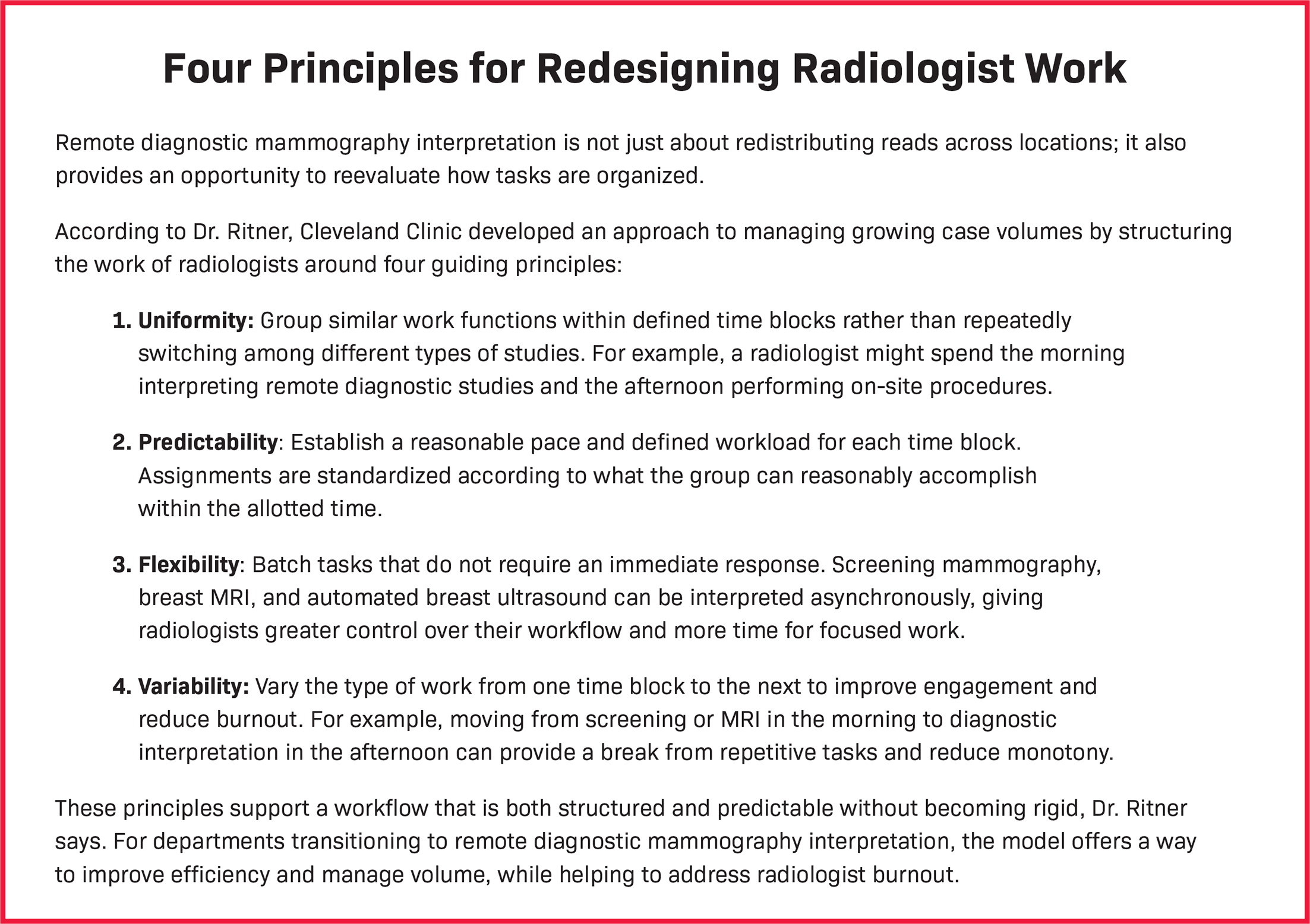
Dr Ritner explains that diagnostic imaging work is typically riddled with interruptive tasks, or “pushes” whenever a need arises. By transforming tasks into “pulls” that radiologists can perform during designated timeframes via a shared worklist, they are able to work with greater focus and efficiency. Using principles of uniformity, predictability, flexibility, and variability, the department determined a goal pace for remote diagnostic reads and batched them together, standardized processes, and dedicated other tasks to separate time blocks.
“The result was that you can see more patients, and that you can do more work.”
After optimizing diagnostic reads remotely, the clinic has consistently reduced the wait time to 10 days or less, with next-day availability at some sites.
“We always knew we had inefficiencies in our workdays, and our workflow restructuring has produced results that are even more dramatic than we ever expected,” Dr Ritner says of the improvements, noting the remote program has also become a tremendous recruitment advantage.
The department has hired 3 radiologists this year with more on the horizon, bringing their physician total to 25.
“Restructuring our work model has allowed us to offer more remote scheduling options, which has resulted in recruiting experienced remote radiologists while also providing local radiologists with greater flexibility in their schedules. This flexibility has allowed us to expand our capacity and improve access, enabling us to serve up to 14% more patients this year than in the past,” Dr Ritner concludes.
“This model allows you to provide the same level of expert care system wide. It’s really been transformative.”
References
- Chikarmane S, Thimm E, Plaxco J. Remote diagnostic breast imaging: An implementation guide. AJR Am J Roentgenol. 2026 Jan;226(1). doi:10.2214/AJR.25.33537.
Citation
. Growth and Gains in Remote Diagnostic Mammography. Applied Radiology. 2026;55(5). doi:10.37549/AR-D-26-0064.