Impact of Hematuria Risk-Stratification Guidelines on CT Urography Detection of Upper Urinary Tract Malignancy
Applied Radiology — Vol. 55 , Issue 1
Published: December 16, 2025
1 Department of Radiology, Medical College of Wisconsin, Milwaukee, Wisconsin
2 Department of Research Navigation, Gundersen Medical Foundation, La Crosse, Wisconsin
3 Department of Radiology, Emplify Health by Gundersen, La Crosse, Wisconsin
* Corresponding author: Ian Rumball (rumballian@gmail.com)
Abstract
Objectives and Hypothesis:: CT urography (CTU) is a preferred diagnostic modality in hematuria evaluation and has the highest sensitivity and specificity for upper urinary tract malignancy, including renal cell carcinoma and upper tract urothelial carcinoma. Recent guidelines offer differing approaches to risk stratification of patients with hematuria, which may affect malignancy detection and CTU use. We hypothesize that among CTUs obtained for hematuria, there will be increased diagnostic yield for upper tract malignancy for imaging obtained in accordance with recent risk-stratification guidelines.
Materials and Methods:: This retrospective observational study assessed patients who underwent primary CTU for hematuria at a rural health system between January 1, 2021, and July 31, 2023. Cases were divided into microscopic and gross hematuria, and risk-stratified according to the 2020 American Urologic Association (AUA), 2023 Dutch Urological Association (DUA), and 2025 AUA guidelines. CTU, cystoscopy, and pathology reports were reviewed. Prevalence and diagnostic yield between subgroups were compared with appropriate statistical analyses.
Results:: Among 969 patients (mean age 65 years), CTU detected pathologically confirmed upper tract malignancy in 28 (2.9%). Diagnostic yield was not significantly higher among CTUs performed in concordance with the 2020 AUA (3.2% vs 0%; P = .4), 2023 DUA (3.4% vs 2.2%; P = .4), and 2025 AUA (3.4% vs 0%; P = .1) guidelines. Of the 274 patients for whom CTU was not recommended by the DUA guidelines, 6 had pathologically confirmed upper tract malignancy, contrasted with none for the AUA 2020 and 2025 guidelines.
Conclusions:: Application of risk-stratification guidelines did not significantly improve diagnostic yield of CTU detection for upper tract malignancy among patients presenting with hematuria. Despite this, risk-stratification approaches are likely warranted given poor yield in low-risk populations. Guidelines differed in the rate of recommended CTU use and the number of cases of potentially nonimaged upper tract malignancies.
Keywords
hematuria, urography, upper, tract, yield
Categories
Introduction
Hematuria is a common manifestation of a wide spectrum of processes affecting the kidneys, urinary tract, and reproductive organs, accounting for up to one-fifth of urologic assessments. 1 The condition may be characterized as macroscopically visible hematuria, also known as gross hematuria (GH) or microscopic hematuria (MH), defined as ≥3 red blood cells per high-power field. While it can be caused by a range of benign conditions, hematuria may signal urologic malignancy in up to 5% of patients with MH and 19% with GH. 2 CT urography (CTU) is often used to assess hematuria with its capability to characterize upper urinary tract malignancy, as well as urolithiasis, and is frequently performed alongside cystoscopy for evaluation of the lower urinary tract. 3,4 Relative to other diagnostic modalities such as renal ultrasonography, CTU is the most sensitive for detection of renal cell carcinoma (RCC) and upper tract urothelial carcinoma (UTUC). 5
Given the broad array of pathologies causing hematuria, societal guidelines have evolved to balance detection of aggressive or intervenable conditions with the harms of diagnostic evaluation and imaging. While American Urologic Association (AUA) guidelines from 2012 recommended that all individuals with GH and those aged ≥35 years with MH receive CTU and cystoscopy evaluation to minimize missed cases of genitourinary malignancy, other contemporaneous diagnostic algorithms promoted further risk stratification for patients with MH, as well as broader use of renal ultrasonography. 6-10
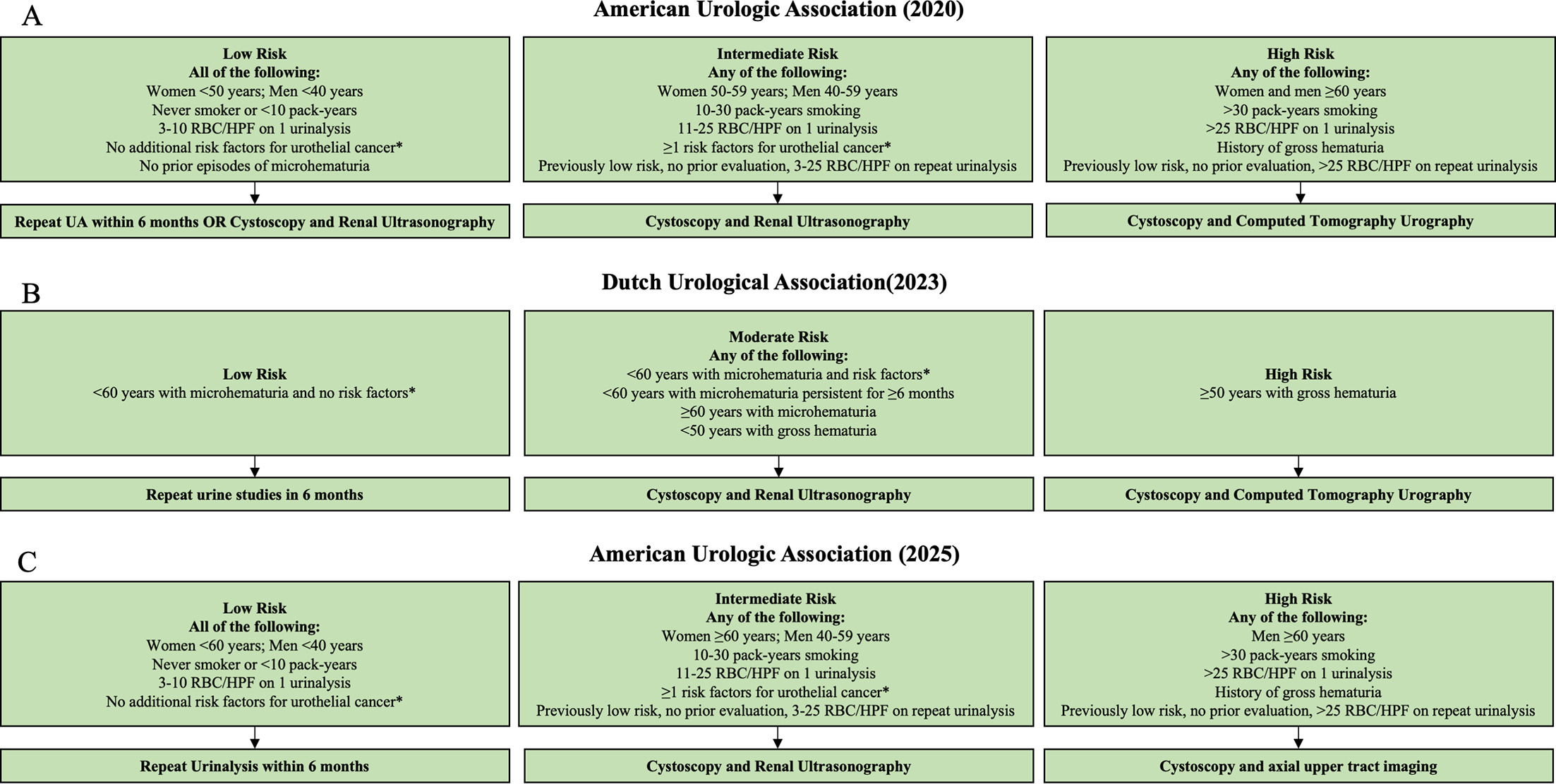
More recent urologic society guidelines have continued this trend. The AUA’s 2020 guidelines and 2025 amended guidelines suggest comprehensive evaluation with cystoscopy and upper urinary tract imaging only in cases of GH and high-risk MH, per their published criteria, which align with radiologic society recommendations. 4,11,12 Notably, the 2023 Dutch Urological Association (DUA) guidelines reserve recommendation of CTU for cases of GH in patients aged ≥50 years. 13
Optimizing CTU use in hematuria evaluation may affect yield, cost, and adverse effects. In low-risk cohorts, existing literature has shown poor diagnostic yield of CTU, increased costs with broader CTU utilization, and limited benefit over alternative modalities while causing increased rates of secondary malignancy, false positives, and procedural complications. 5,14-18 Conversely, increased selectivity of CTU use has demonstrated improvements in diagnostic yield and cost savings. 14,19
Given recent changes to diagnostic guidelines, and in the pursuit of high-value care, we sought to investigate the impact of recent societal recommendations on CTU’s performance in detecting upper urinary tract malignancy. Existing literature has demonstrated higher diagnostic yield in stratification by risk factors such as age or smoking history. We hypothesize that among recent hematuria diagnostic guidelines, including the 2020 AUA, the 2023 DUA, and 2025 AUA guidelines, increased selectivity in CTU utilization will correspond with improved diagnostic yield for upper tract malignancy with minimal impact on the rate of nonimaged or missed malignancies.
Materials and Methods
Study Design and Patients
The Institutional Review Board approved the study and granted a waiver of informed consent. The study was conducted in compliance with the Health Insurance Portability and Accountability Act. We retrospectively reviewed electronic health records (EHRs) of all adult patients (≥18 years) who underwent CTU for hematuria in our health system from January 1, 2021, through July 31, 2023. A total of 1136 consecutive CTUs for hematuria were performed during this period. For patients with multiple CTUs in the study interval, only the primary study was assessed. Patients whose EHR contained insufficient data for risk stratification, whose CTU was performed for an indication other than hematuria, and who had a prior known urologic malignancy were excluded from the study.
Pre-CTU Risk Assessment
Patient records were reviewed for demographic, clinical, and laboratory factors. Hematuria was classified as MH or GH based on listed indication, clinical documentation, and urine microscopy results. Patients were stratified into risk categories according to the 2020 AUA, 2023 DUA, 2025 AUA guidelines using age, smoking history, prior hematuria, urinalysis/urine microscopy features, and other urologic malignancy risk factors (Figure 1). For determining the presence of persistent MH for risk stratification, the initial urine study with MH obtained within the year preceding CTU was considered the primary sample, while subsequent urine studies obtained prior to CTU were considered repeat samples. Guideline familiarity or adherence by ordering providers was not accounted for, and guideline criteria were solely applied retrospectively.
CTU Protocol
Imaging was performed without oral contrast or bowel preparation using 128-multidetector CT scanner Siemens Somatom X.cite or 144-multidetector CT scanner (Siemens Naeotom Alpha). Patients were instructed to drink 1000 mL of water before arriving for their examination. A 3-scan CT protocol was used that consisted of: an unenhanced scan of the abdomen and pelvis; a nephrographic phase scan of the kidneys 90 seconds after intravenous administration of 150 mL nonionic iopamidol 300 mgI/mL (Isovue, Bracco Diagnostics) at 3 mL/s with a 30 mL normal saline flush; and an excretory phase scan of the abdomen and pelvis 10 minutes after contrast medium injection.
The parameters for scanning were 120 kVp, 0.6 mm collimation, 0.8 pitch, and tube current based on patient size. Images were acquired on inspiration, and patients were scanned in the supine position. If the ureters were incompletely visualized, then a prone scan was performed at the discretion of a radiologist. Axial, coronal, and sagittal reconstructions were obtained at 3 mm slice thickness. Excretory phase scans were also reconstructed in a maximum intensity projection of 3 mm slice thickness at 3 mm intervals. A 2-scan protocol was used in patients younger than 60 years. This protocol consists of an unenhanced scan of the abdomen and pelvis, followed by intravenous administration of 75 mL Isovue. After an 8-minute delay, a second dose of 75 mL Isovue was given. CT of the abdomen and pelvis was then performed with a 90-second scan delay. All images were forwarded to the Picture Archiving and Communication System and subsequently interpreted by certified radiologists.
Report Review
CTU reports were assessed for mention of potential etiologies of hematuria using a methodology similar to that described by Fenwick et al. 15 CTU results were assigned to 1 of 5 groups: (1) explicit mention of likely genitourinary malignancy, (2) other findings suggestive of malignancy as per Fenwick et al, (3) urolithiasis, (4) benign prostatic hyperplasia, and (5) all other benign genitourinary abnormalities potentially causing hematuria. Patients with more than one hematuria etiology were assigned to the numerically lowest category, as it likely represented the most relevant finding. Patients with findings suggestive of malignancy were also grouped by location—that is, whether findings were in the upper or lower urinary tract. We reviewed the health records of the study cohort for renal ultrasonography and cystoscopy performed within 1 year of the CTU; if present, these reports were reviewed. Cystoscopy reports were reviewed for presence of (1) explicit mention of likely malignancy, (2) urolithiasis, (3) prostatic hyperplasia, and (4) other benign genitourinary abnormalities causing hematuria. For all patients, we reviewed pathology reports published within 1 year after CTU of the genitourinary system. Pathology results were classified as malignant or benign.
Statistical Analysis
The prevalence of CTU findings was calculated as the number of findings divided by the size of the study cohort or subgroup. Diagnostic yield and false referral rates were calculated according to the methodology described by Park et al. 20 Categorical variables were summarized using frequencies and percentages, while numeric variables were summarized using mean and standard deviation. Associations of patient diagnosis (GH or MH), ordering provider (urology or nonurology), and risk classification (AUA and DUA risk classifications) with CTU results were assessed using Pearson χ2 or Fisher exact tests, as appropriate. A Bonferroni-adjusted significance level of 0.05/16 = 0.003 was used for all statistical testing to control for the error of multiple comparisons. All analyses were completed using R statistical software. 21
Results
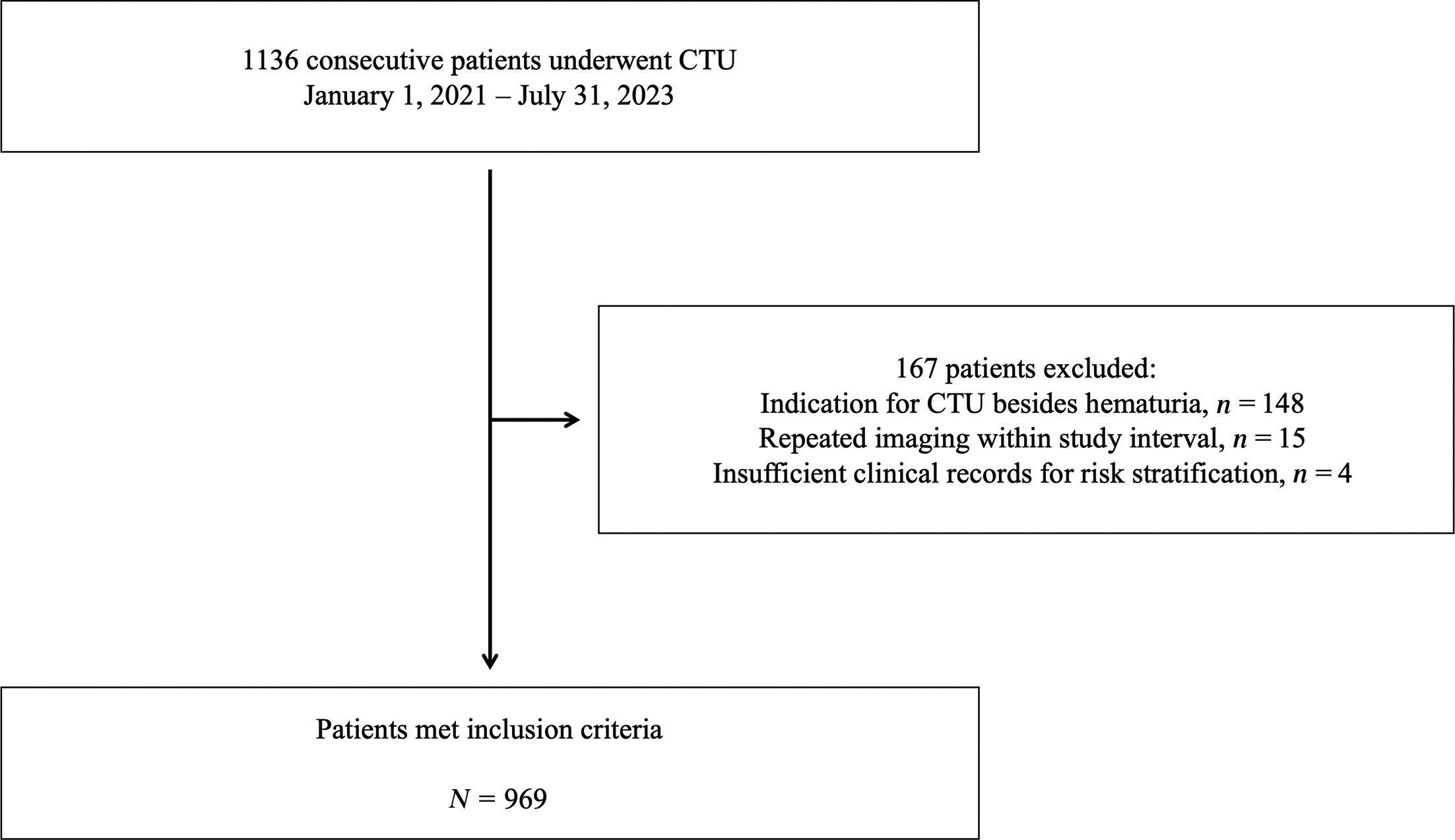
A total of 969 patients met inclusion criteria (Figure 2), 600 (62%) of whom were men and 948 (98%) of whom were White. The mean age was 65±15 years (Table 1). GH was present in 778 (80%) of patients (Table 2). Per AUA 2020 and 2025 guidelines, MH was classified as high risk in 139 (14%) patients and 95 (9.8%) patients, respectively. Among CTUs obtained, 95% (917/969) would have been considered appropriate under the 2020 AUA guidelines compared with 90% (873/969) for the 2025 AUA guidelines and 71% (687/969) for the DUA guidelines. Within 1 year of CTU, cystoscopy was performed in 654 (68%) patients, and renal ultrasonography was obtained for 58 (6.0%).
| Characteristic | Value a |
|---|---|
| Sex | |
| Women | 369 (38.1) |
| Men | 600 (61.9) |
| Race | |
| American Indian and Alaska Native | 5 (0.5) |
| Asian | 8 (0.8) |
| Black | 6 (0.6) |
| Refused | 2 (0.2) |
| White | 948 (97.8) |
| Ethnicity | |
| Hispanic | 12 (1.2) |
| Non-Hispanic/Non-Latino | 952 (98.2) |
| Refused | 5 (0.5) |
| Body mass index b : mean ± SD; median [IQR] | 30±8; 29 [26–34] |
| Age, years: mean (SD); median [IQR] | 65 (15); 67 [57–76] |
| Characteristic | No. of Patients (%) |
|---|---|
| Hematuria diagnosis | |
| MH | 191 (19.7) |
| GH | 778 (80.3) |
| 2020 AUA risk class (MH) | |
| Low | 11 (1.1) |
| Intermediate | 41 (4.2) |
| High | 139 (14.3) |
| 2025 AUA risk class (MH) | |
| Low | 12 (1.2) |
| Moderate | 84 (8.7) |
| High | 95 (9.8) |
| DUA risk class | |
| Low | 16 (1.7) |
| Moderate | 266 (27.5) |
| High | 687 (70.9) |
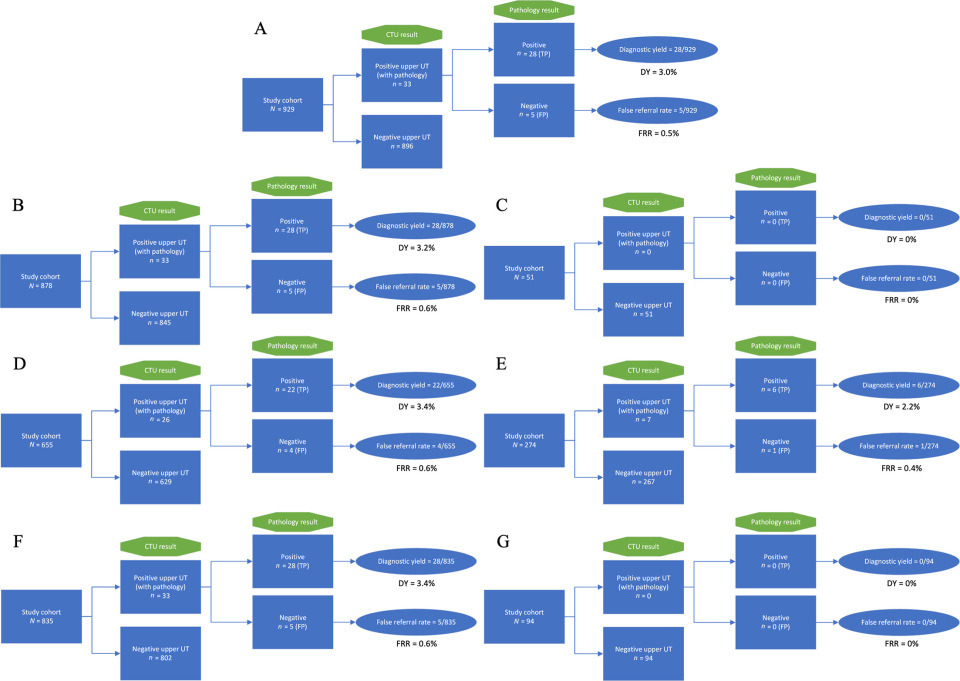
CTU showed findings suggestive of upper tract malignancy in 73 (7.5%) patients (Table 3). Among patients with these findings, 33 (3.4%) had pathologic sampling, which confirmed malignancy in 28 (2.9%) patients: 23 (2.4%) cases of RCC and 5 (0.5%) cases of UTUC (Table 4). The diagnostic yield of CTU for upper tract malignancy was 3.0% (Figure 3). Comparing cases in which CTU was or was not recommended by risk-stratification algorithms, diagnostic yield was not significantly different for the 2020 AUA (3.2% vs 0%; P = .4), 2023 DUA (3.4% vs 2.2%; P = .4), and 2025 AUA (3.4% vs 0%; P = .1) guidelines. Of the 282 patients for whom CTU was not recommended by the DUA guidelines, 6 had pathologically confirmed upper tract malignancy compared with zero such cases for the 2020 and 2025 AUA guidelines.
| CTU Result | Overall | Hematuria Type | AUA Risk Group (MH) | DUA Risk Group | ||||||||
|---|---|---|---|---|---|---|---|---|---|---|---|---|
| 2020 | 2025 | |||||||||||
| GH | MH | Low | Intermediate | High | Low | Intermediate | High | Low | Moderate | High | ||
| N = 969 | N = 778 | N = 191 | N = 11 | N = 41 | N = 139 | N = 12 | N = 84 | N = 95 | N = 16 | N = 266 | N = 687 | |
| Probable malignancy | 102 (10.5) | 96 (12.3) | 6 (3.1) | 0 (0) | 0 (0) | 6 (4.3) | 0 (0) | 0 (0) | 6 (6.3) | 1 (6.3) | 13 (4.9) | 88 (12.8) |
| Other findings suggestive of malignancy | 90 (9.3) | 74 (9.5) | 16 (8.4) | 0 (0) | 2 (4.9) | 14 (10.1) | 0 (0) | 4 (4.8) | 12 (13.0) | 1 (6.3) | 17 (6.4) | 72 (10.5) |
| Urolithiasis | 269 (27.8) | 229 (29.4) | 40 (20.9) | 1 (9.1) | 8 (19.5) | 31 (22.3) | 1 (8.3) | 14 (17.0) | 25 (26.0) | 3 (18.8) | 75 (28.2) | 191 (27.8) |
| BPH | 119 (12.3) | 106 (13.6) | 13 (6.8) | 0 (0) | 2 (4.9) | 11 (7.9) | 0 (0) | 2 (2.4) | 11 (12.0) | 0 (0) | 15 (5.6) | 104 (15.1) |
| Other GU tract abnormalities | 78 (8.0) | 64 (8.2) | 14 (7.3) | 1 (9.1) | 4 (9.8) | 9 (6.5) | 1 (8.3) | 8 (9.5) | 5 (5.3) | 0 (0) | 17 (6.4) | 61 (8.9) |
| Normal | 311 (32.1) | 209 (26.9) | 102 (53.4) | 9 (81.8) | 25 (61.0) | 68 (49.0) | 10 (83.0) | 56 (67.0) | 36 (38.0) | 11 (68.8) | 129 (48.5) | 171 (24.9) |
| Suspicious for upper urinary tract malignancy | 73 (7.5) | 63 (8.1) | 10 (5.2) | 0 (0) | 1 (2.4) | 9 (6.5) | 0 (0) | 2 (2.4) | 8 (8.4) | 1 (6.3) | 14 (5.3) | 58 (8.4) |
| Diagnosis | No. of Patients (%) |
|---|---|
| Bladder cancer | |
| Urothelial carcinoma | 73 (7.5) |
| Adenocarcinoma (urachal) | 2 (0.2) |
| Small cell carcinoma | 1 (0.1) |
| Urothelial carcinoma in situ | 1 (0.1) |
| Upper urinary tract cancer | |
| Renal cell carcinoma | 23 (2.4) |
| Upper tract urothelial carcinoma | 5 (0.5) |
| Other | |
| Prostatic adenocarcinoma | 5 (0.5) |
| Colorectal adenocarcinoma | 1 (0.1) |
| Penile squamous cell carcinoma | 1 (0.1) |
No hematuria etiology was detected for 32% (n = 311) of patients. The rate of normal CTU findings was 53% (n = 102) in cases of MH and 27% (n = 209) for GH. Increasing AUA and DUA risk categories were associated with increasing detection of a hematuria etiology (Figure 4). 192 (20%) studies were considered suggestive of any malignancy. Of the 134 patients for whom pathology was available, 112 had confirmed malignancies, with the most prevalent being urothelial carcinoma of the bladder (7.5%, n = 73). Benign hematuria etiologies, namely urolithiasis, benign prostatic hyperplasia, and all other genitourinary abnormalities, were found in 307 (32%), 190 (20%), and 258 (26.6%) cases, respectively.
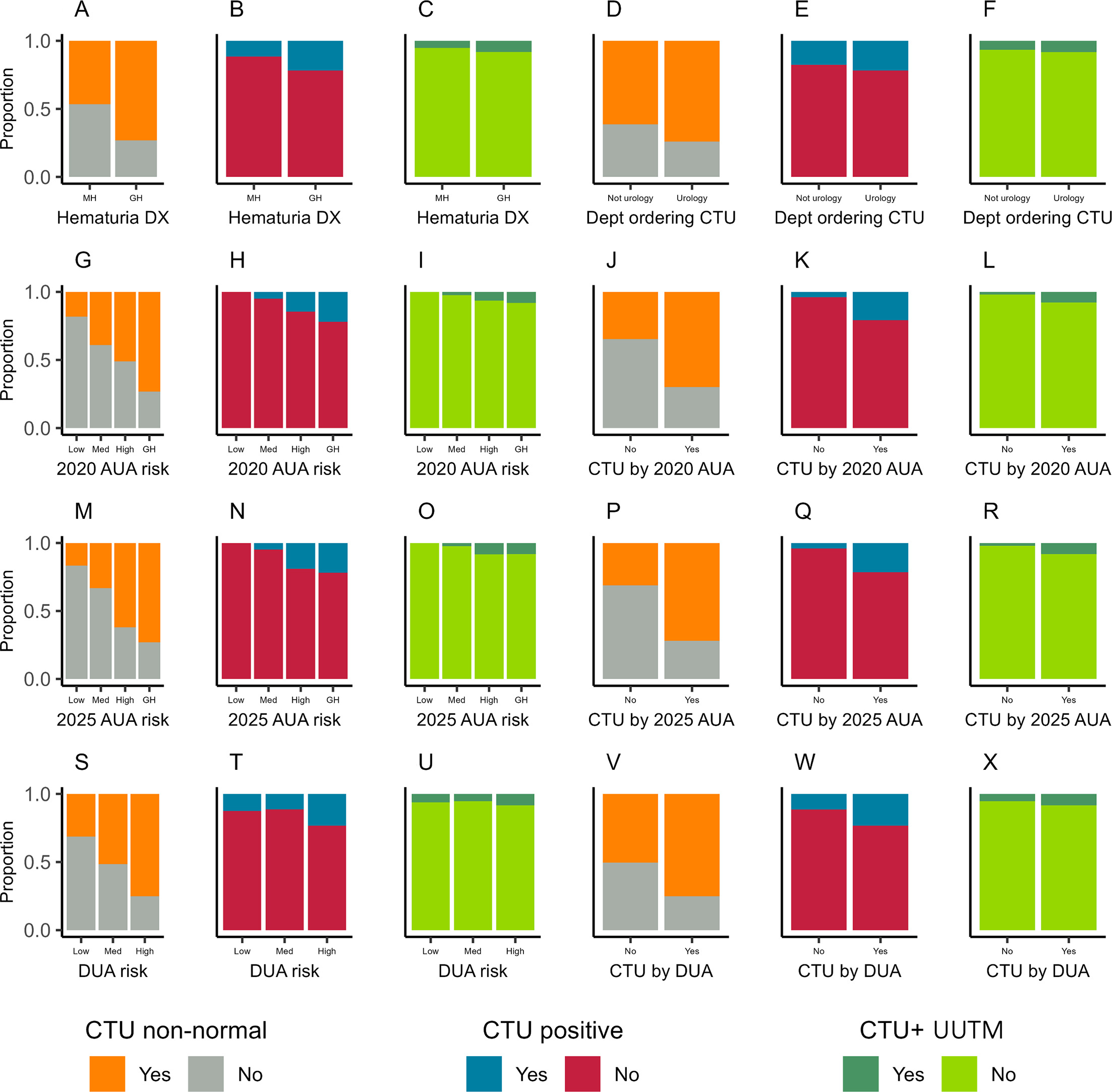
Imaging performed for GH detected more abnormal findings (73%, n = 569 vs 47%, n = 89; P < .001) and findings suggestive of urologic malignancies (22%, n = 170 vs 12%, n = 22; P = .001) than CTU obtained for MH. CTUs ordered by a urology provider had a higher rate of detection for all hematuria etiologies (74%, n = 373 vs 61%, n = 285; P < .001), although not for malignant findings (22%, n = 110 vs 18%, n = 82; P = .10). Cases in which CTU was appropriate per diagnostic criteria had increased detection of all hematuria etiologies and findings suggestive of malignancy, which was seen for the 2020 AUA (70%, n = 640 vs 35%, n = 18; P < .001 | 21%, n = 190 vs 2.8%, n = 2; P < .003), 2023 DUA (75%, n = 516 vs 50%, n = 142; P < .001 | 23%, n = 160 vs 11%, n = 32; P = .001), and 2025 AUA (72%, n = 628 vs 31%, n = 30; P < .001 | 22%, n = 188 vs 4.2%, n = 4; P = .001) guidelines.
Diagnostic yield for any urologic malignancy was increased with adherence to the DUA guidelines [14% vs 4.2%; odds ratio (OR) = 3.8, P < .001] and 2025 AUA guidelines (12% vs 1.1%; OR = 24.0, P < .001), but not with the 2020 AUA guidelines (12% vs 2.0%; OR = 6.7, P = .04). Applying this analysis to assess diagnostic characteristics of CTU for bladder cancer, CTU was found to have a diagnostic yield of 7.3% compared with 12% for cystoscopy.
Discussion
In this retrospective analysis of 969 patients undergoing CTU for hematuria, application of recent hematuria risk-stratification guidelines did not significantly affect the diagnostic yield for upper urinary tract malignancy. While risk stratification would have averted 52, 96, and 282 CTUs for the 2020 AUA, 2025 AUA, and DUA guidelines, respectively, 6 patients with confirmed upper tract malignancy would not have undergone cross-sectional imaging under the DUA recommendations, which reserve the procedure for GH patients over age 50 years. This is contrasted with no missed cases with either AUA guideline. The 2023 DUA and 2025 AUA recommendations both increased yield for detection of any urologic malignancy, though this includes bladder cancers likely to be found via cystoscopy.
All risk-stratification guidelines assessed offered similar diagnostic recommendations for low-, intermediate-, and high-risk patients but differed in their definition of these risk categories. While the 2020 AUA guidelines recommend cystoscopy plus CTU for the evaluation of GH and MH patients with age ≥60 years, smoking history of ≥30 pack-years, or ≥25 red blood cells on urine microscopy, the 2025 amended guidelines consider age ≥60 years a high-risk factor only in men. This change reflects lower rates of upper tract malignancy among women, particularly younger women. 17,22
The 2023 DUA guidelines recommend CTU only in GH patients ≥50 years of age; this even more conservative recommendation led to 6 instances of upper tract malignancy that would not have received cross-sectional imaging in this cohort. All guidelines recommend that intermediate-risk patients undergo renal ultrasonography and cystoscopy, though renal ultrasonography was performed in only 58 patients and was not performed in the 6 patients referenced, limiting comparison with CTU in this cohort. Prior studies have shown highly variable results regarding the performance of renal ultrasonography in detecting upper tract malignancy, and future studies comparing these modalities may be useful. 17,23-27
Risk-stratifying hematuria patients prior to CTU may improve diagnostic performance and reduce costs and adverse effects. This study showed 95% concordance between ordered CTUs and the contemporaneous 2020 AUA guidelines, and an overall diagnostic yield of 3.0% for upper tract malignancy, higher than has been reported in the literature. For example, a yield of 0.6% was observed in a comparable Canadian cohort of 1046 patients, with similar findings reported in other studies. 15,16,18,28 While our study did not demonstrate significantly increased diagnostic yield for CTU in upper urinary tract malignancy based on societal risk-stratification guidelines, a meta-analysis of 24,366 patients with MH found that retrospective application of simplified risk criteria (cohorts with median age ≥60 years, > 50% male sex, > 50% smoking history) resulted in increased diagnostic yield for CTU in UTUC from 0.1% to 0.5%. 14 Regarding cost savings, an assessment comparing more selective use of CTU under the 2020 versus 2012 AUA guidelines led to a savings of $40,000 per cancer detected in the workup of MH. 18 Even for patients with GH, among lower-risk cohorts the risk of CTU-induced secondary malignancy from ionizing radiation may be up to 5 times greater than that of missing malignancy by using renal ultrasonography. This emphasizes the possible utility of pre-CTU risk stratification, CT protocols with reduced radiation dose (eg, unenhanced CT or CTU with omission of unenhanced phase), or alternative imaging studies. 17 Implementing any recommendation requires buy-in and participation of ordering providers, which has been shown to be limited in studies of prior guidelines. 29,30
Our study had several limitations. The retrospective and observational study design inherently fails to control for biases or failures that may be introduced in clinical documentation, image or procedure ordering or performance, and imaging or procedural documentation. Follow-up was limited to 12 months following primary CTU, potentially limiting detection of indolent malignancies. Use of renal ultrasonography was limited, as described. Our small sample of studies discordant with the AUA guidelines limited detection of differences in diagnostic yield for this guideline. Diagnostic yield assessment was limited to patients for whom pathology was available, which is a source of selection bias. Further, because CTU patients without findings suggestive of disease generally would not receive pathologic sampling, our results do not lend themselves to assessing other test characteristics and would be affected by verification bias. Finally, while the false referral rate was calculated, our study considered neither cost nor adverse effects of CTU, such as secondary malignancy, procedural or contrast-related complications, or other consequences of workup of false-positive results.
Conclusion
Applying risk-stratification guidelines did not significantly increase the CTU yield for upper urinary tract malignancy. Despite this finding, risk-stratification approaches are likely warranted given poor yield in low-risk populations. Guidelines differ in the rate of recommended CTU use and the number of cases of potentially non-imaged upper tract malignancies. Future research should include large-cohort, prospective comparisons of the currently proposed risk-stratification criteria and their impact on the performance, cost, and harms of CTU, renal ultrasonography, and cystoscopy within their diagnostic frameworks.
References
- Mariani A, Mariani M, Macchioni C. The significance of adult hematuria: 1,000 hematuria evaluations including a risk-benefit and cost-effectiveness analysis. J Urol. 1989;141(2):350-355. doi:10.1016/s0022-5347(17)40763-4.
- Edwards T, Dickinson A, Natale S, Gosling J, McGrath J. A prospective analysis of the diagnostic yield resulting from the attendance of 4020 patients at a protocol-driven haematuria clinic. BJU Int. 2006;97(2):301-305. doi:10.1111/j.1464-410X.2006.05976.x.
- Cowan N. CT urography for hematuria. Nat Rev Urol. 2012;9(4):218-226. doi:10.1038/nrurol.2012.32.
- Barocas D, Boorjian S, Alvarez R. Microhematuria: AUA/SUFU guideline. J Urol. 2020;204(4):778-786. doi:10.1097/JU.0000000000001297.
- Georgieva M, Wheeler S, Erim D. Comparison of the harms, advantages, and costs associated with alternative guidelines for the evaluation of hematuria. JAMA Intern Med. 2019;179(10):1352-1362. doi:10.1001/jamainternmed.2019.2280.
- Davis R, Jones J, Barocas D. Diagnosis, evaluation and follow-up of Asymptomatic Microhematuria (AMH) in adults: AUA guideline. J Urol. 2012;188(6 suppl):2473-2481. doi:10.1016/j.juro.2012.09.078.
- Wollin T, Laroche B, Psooy K. Canadian guidelines for the management of asymptomatic microscopic hematuria in adults. Can Urol Assoc J. 2009;3(1):77-80. doi:10.5489/cuaj.1029.
- Loo R, Whittaker J, Rabrenivich V. National practice recommendations for hematuria: how to evaluate in the absence of strong evidence?. Perm J. 2009;13(1):37-46. doi:10.7812/TPP/08-083.
- Hovius M, Beckers G, Bex A. Guideline Hematuria [in Dutch]. 2010.
- Loo R, Lieberman S, Slezak J. Stratifying risk of urinary tract malignant tumors in patients with asymptomatic microscopic hematuria. Mayo Clin Proc. 2013;88(2):129-138. doi:10.1016/j.mayocp.2012.10.004.
- Barocas D, Lotan Y, Matulewicz R. Updates to microhematuria: AUA/SUFU guideline (2025). J Urol. 2025;213(5):547-557. doi:10.1097/JU.0000000000004490.
- Wolfman D, Marko J, Nikolaidis P. ACR appropriateness criteria® hematuria. J Am Coll Radiol. 2020;17(5s):S138-S147. doi:10.1016/j.jacr.2020.01.028.
- Hematuria [in Dutch]. 2023.
- Waisbrod S, Natsos A, Wettstein M. Assessment of diagnostic yield of cystoscopy and computed tomographic urography for urinary tract cancers in patients evaluated for microhematuria: a systematic review and meta-analysis. JAMA Netw Open. 2021;4(5). doi:10.1001/jamanetworkopen.2021.8409.
- Fenwick A, Sala E, Canales D. Prevalence of urologic disease among patients investigated for hematuria with CT urography. Can Assoc Radiol J. 2021;72(2):228-233. doi:10.1177/0846537120902134.
- Mace L, Galloway T, Ma A. Diagnostic yield of CT urography in the evaluation of hematuria in young patients in a military population. Abdom Radiol. 2017;42(7):1906-1910. doi:10.1007/s00261-017-1084-9.
- Yecies T, Bandari J, Macleod L. Evaluation of the risks and benefits of computed tomography urography for assessment of gross hematuria. Urology. 2019;133:40-45. doi:10.1016/j.urology.2019.04.055.
- Common J, Ramonas M, Alabousi A. The diagnostic yield of CT urography in the workup of hematuria with negative cystoscopy. Can Assoc Radiol J. 2021;72(4):728-735. doi:10.1177/0846537120933952.
- Gold S, Kenigsberg A, Lotan Y. Diagnostic and cost implications of the 2020 AUA microhematuria guidelines: modeling impact in a large public health care system. J Urol. 2022;207(1):52-60. doi:10.1097/JU.0000000000002175.
- Park H, Suh C, Kim S. Use of “diagnostic yield” in imaging research reports: results from articles published in two general radiology journals. Korean J Radiol. 2022;23(12):1290-1300. doi:10.3348/kjr.2022.0741.
- R: A Language and Environment for Statistical Computing.
- Saxon G, Patil D, Hammett J. Microhematuria in women: prevalence of malignancy and risk score evaluation. Urology. 2022;160:34-39. doi:10.1016/j.urology.2021.11.003.
- Tan W, Sarpong R, Khetrapal P. Can renal and bladder ultrasound replace computerized tomography urogram in patients investigated for microscopic hematuria?. J Urol. 2018;200(5):973-980. doi:10.1016/j.juro.2018.04.065.
- Fankhauser C, Waisbrod S, Fierz C. Diagnostic accuracy of ultrasonography, computed tomography, cystoscopy and cytology to detect urinary tract malignancies in patients with asymptomatic hematuria. World J Urol. 2021;39(1):97-103. doi:10.1007/s00345-020-03171-6.
- Cauberg E, Nio C, de la Rosette J, Laguna M, de Reijke T. Computed tomography-urography for upper urinary tract imaging: is it required for all patients who present with hematuria?. J Endourol. 2011;25(11):1733-1740. doi:10.1089/end.2011.0225.
- Rhéaume-Lanoie J, Lepanto L, Fradet V, Billiard J, Tang A. Diagnostic performance of ultrasound for macroscopic hematuria in the era of multidetector computed tomography urography. Can Assoc Radiol J. 2014;65(3):253-259. doi:10.1016/j.carj.2013.08.001.
- Smith M, Read K, Stegman M, Kroll N, Van Every M. Evaluation of asymptomatic microscopic hematuria by renal ultrasound to detect upper tract malignancy: a 20-year experience in a community hospital. Urology. 2019;133:34-39. doi:10.1016/j.urology.2019.07.009.
- Bretlau T, Hansen R, Thomsen H. CT urography and hematuria: a retrospective analysis of 771 patients undergoing CT urography over a 1-year period. Acta Radiol. 2015;56(7):890-896. doi:10.1177/0284185114538250.
- Elias K, Svatek R, Gupta S, Ho R, Lotan Y. High-risk patients with hematuria are not evaluated according to guideline recommendations. Cancer. 2010;116(12):2954-2959. doi:10.1002/cncr.25048.
- Skaggs A, Loehfelm T, Fananapazir G, Dall’Era M, Corwin M. Utilization and yield of CT urography: are the American Urological Association guidelines for imaging of patients with asymptomatic microscopic hematuria being followed?. AJR Am J Roentgenol. 2021;216(1):106-110. doi:10.2214/AJR.20.22998.
Disclosures
The authors have no conflicts of interest to disclose. None of the authors received outside funding for the production of this original manuscript and no part of this article has been previously published elsewhere.
Acknowledgments
Presented at RSNA 2024. Rumball I, Arenz A, Bennie B, Riherd J. CT Urography for Hematuria: Impacts of Risk-Stratification. Poster presented at Radiological Society of North America Annual Meeting, December 2024, Chicago, IL.
Citation
. Impact of Hematuria Risk-Stratification Guidelines on CT Urography Detection of Upper Urinary Tract Malignancy. Applied Radiology. 2025;55(1). doi:10.37549/AR-D-25-0148.