Categories
For decades, radiologists were tethered to workstations in hospital and imaging center reading rooms, and later, remote reading environments. The number of teleradiologists in the United States has doubled in recent years, with more than a quarter of radiologists reporting that teleradiology makes up more than half of their annual imaging volume. 1 A national survey by the American College of Radiology that included 731 non-teleradiologist respondents revealed that 90% had interpreted a teleradiology image in the past year; 24% of them said teleradiology accounted for more than 50% of their yearly reading volume, with 46.2% being offsite rural exams and 37.2% being offsite critical care exams. 1
While teleradiology interpretations are typically performed on advanced workstations, radiologists can now interpret and manage images on a Mac or other Apple device with the Falcon suite of technologies.
“What is so critical about the [Falcon] is that it allows us to be professional radiologists anywhere,” says Emanuel Kanal, MD, chief of the division of emergency radiology, director of magnetic resonance services, and professor of radiology and neuroradiology at the University of Pittsburgh Medical Center. “If someone has an emergent case for me, they can get it to me and I can interpret it reliably, comfortably, from anywhere.”
Dr Kanal, who views complex cases from around the United States and globally, recently received an important case just before boarding an airplane, which he downloaded and reviewed in flight, sharing and reviewing the prepared report with the referring physician after landing. “I can’t do that with any other app,” Dr Kanal says.
Falcon MD is a software device from iCat Solutions that enables trained health care professionals to view images acquired from CT, computed radiography, MR, US, and other DICOM-compliant medical imaging systems—except for mammography—when installed on suitable commercial standard hardware. Users are responsible for operating the device in accordance with software and hardware requirements listed in the instructions for use, particularly ensuring that monitor quality, ambient light conditions, and image compression ratios are consistent with the clinical application, according to the iCat Solutions Web site .
Apple Integration with Image Rendering
The FDA-cleared DICOM viewer integrates to 90% of existing radiology software and hardware in US hospitals, according to George Michalopoulos, CEO of iCat Solutions. After a user’s personal device is set up with Apple ID and credentials, the technology relies on Apple’s stringent security environment for reviewing and interpreting functionality that integrates across the user’s devices with visual clarity enabled by Apple’s M-series chips.
“You can start viewing your study on your iPhone, put it next to your Mac, and it automatically transfers that study onto [that device],” explains Michalopoulos, making it automatically part of the Apple ecosystem.
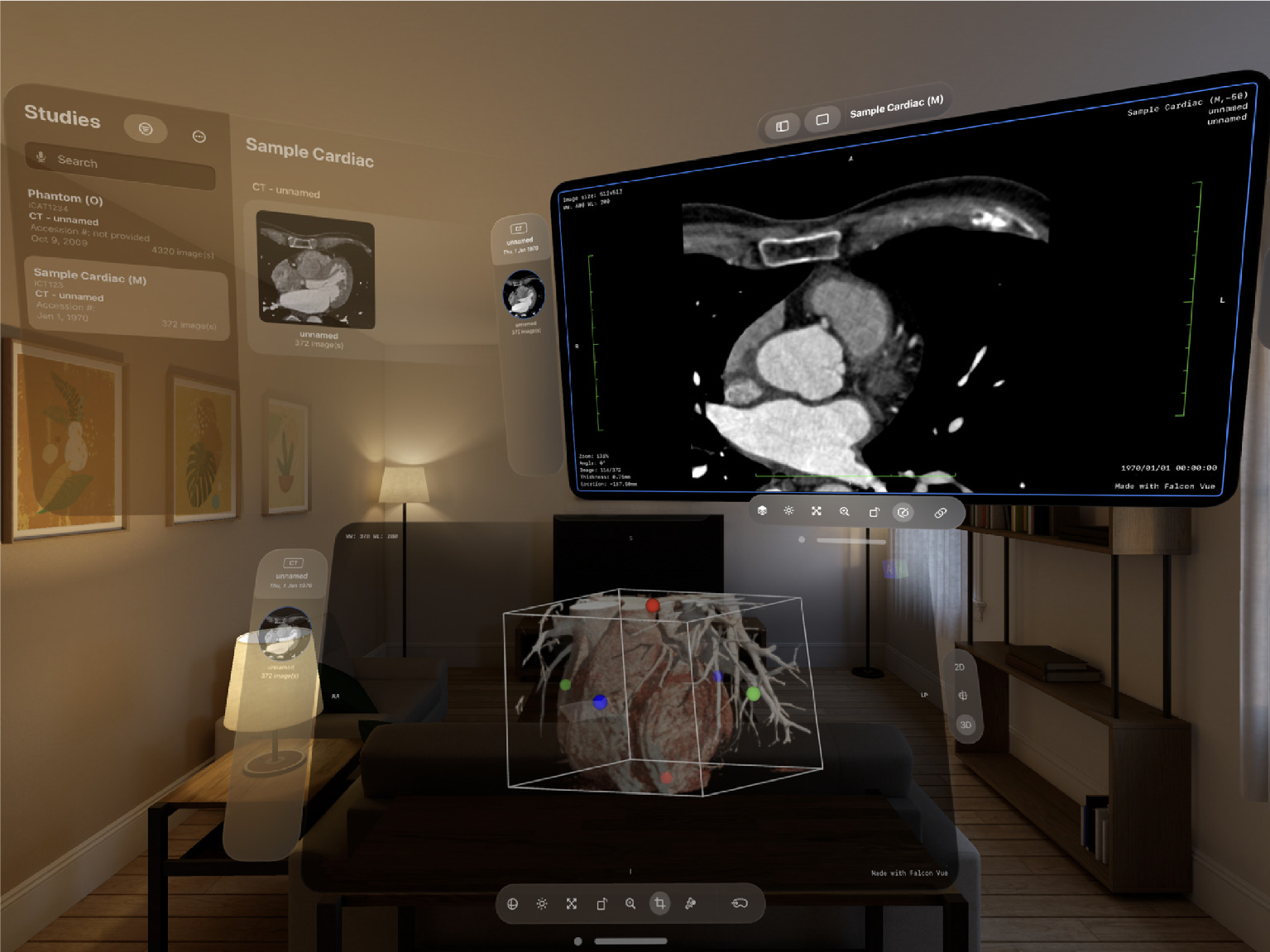
Included in the ecosystem is the Apple Vision Pro, a spatial computing environment achieved with user goggles. Falcon Vue enables users to project a limitless number of images and windows to “float” in the user’s view, including 3-D renderings.
“In this [spatial] environment, the sky is the limit,” says Dr Kanal. “Your real estate is not one screen, it’s whatever the eye can see.”
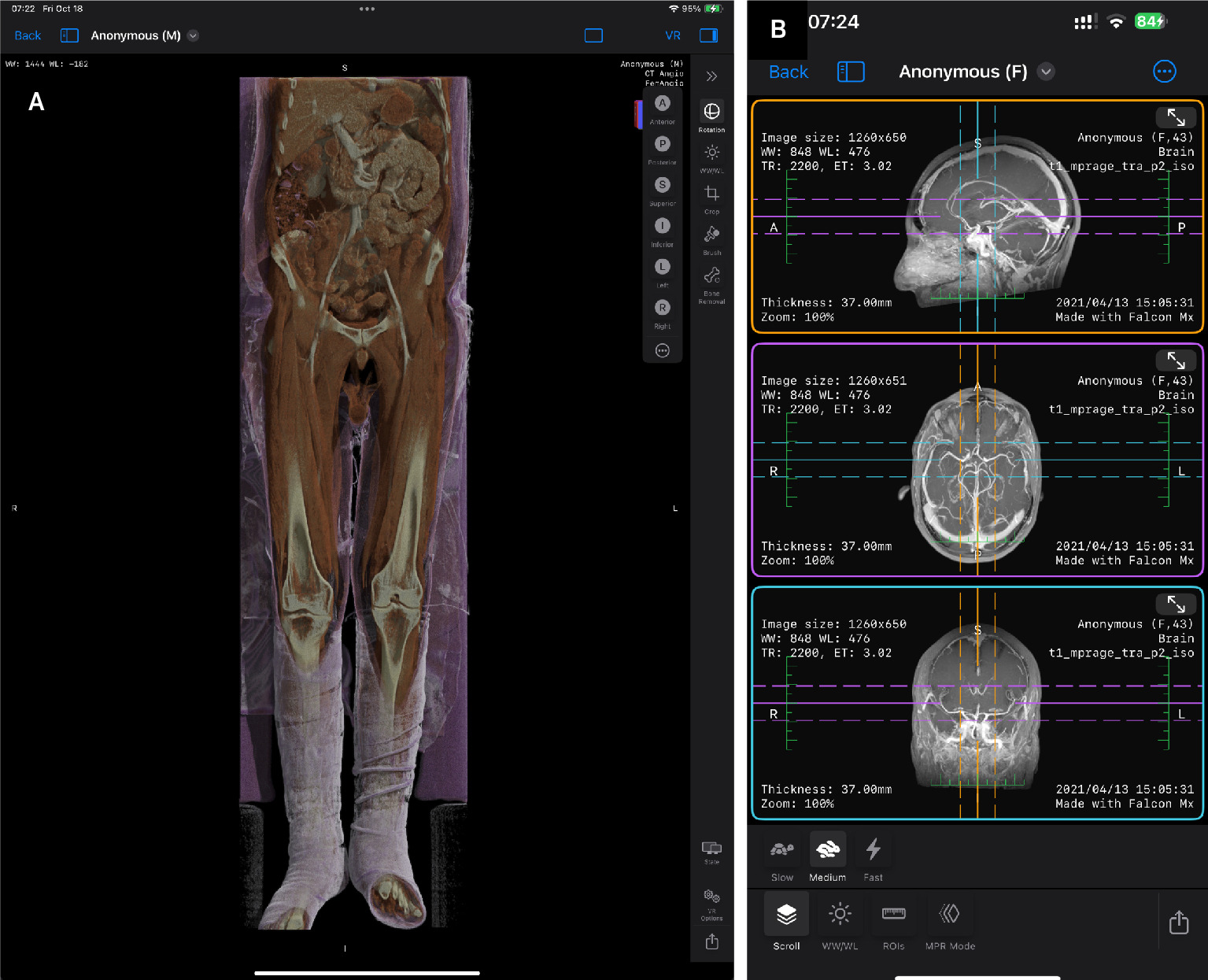
Spatial computing on a mainframe or powerful dedicated desktop computer is not required for post-processing; Apple’s computationally powerful chips make 2-D and 3-D manipulation of images possible on any device (Figures 1 & 2)—not just the main computer—explains Dr Kanal.
“I can do all computations and all 3-D analyses on this platform on my iPad, which really frees me up,” Dr Kanal says, noting that the reformations he waits for from hospitals are now instantaneously available on his iPad.
“All computations are done 100% inside my iPad. I am completely … independent from having to wait for a server or internet connection. If I have the patient’s data on this handheld device, I am 100% independently a fully functional diagnostic neuroradiologist and I can do anything I need to do without having to wait for an internet connection,” Dr Kanal says.
Dr Vitor Ramos, consultant in adult congenital heart disease and cardiac MRI at Leeds Teaching Hospital NHS Trust in West Yorkshire, England, says that dynamic assessment gives greater insights both into the anatomy and physiology of numerous lesions.
“Cardiac CT can be acquired in a dynamic fashion; however, most DICOM viewers do not have or have limited capacity to run 3-D datasets through the entire cardiac cycle,” Dr Ramos says. “Traditional 2-D cardiac MRI plans are recreated easily ‘offline’ by using the Falcon app. The application also doubles the temporal resolution of any native 4-D sequence (both CT and MRI) that further improves our workflow.”
Dr Ramos’s use of DICOM viewers for volume-rendered models has traditionally been limited. Photo or “rotation cine” in a specific axis were the only options previously available for saving.
“Falcon has the fantastic capacity to save several [virtual reality] VR states for each sequence, storing all the recons I wish to. This allows me to quickly open the several recons I did previously in just a couple of seconds. As a result, our need for specific 3-D modelling software has reduced with obvious savings in time and costs,” Dr Ramos explains.
Connectedness to Patients
The mobile viewing environment is built on technology to optimize workflow and improve patient care. Users receive a personalized, secure link to manage medical images, patient information, requestor inquiries, and image review. Referring physicians, insurance companies, and patients can send the user messages directly via the link, stored in an inbox format.
“I have the ability to connect directly with my patients and access their medical images instantly. If a patient sends me … a scan, I get a notification on my iPhone or iPad and can view it immediately,” says Dr Georgios Kesisis, a medical oncologist at Agios Loukas Clinic in Thessaloniki, Greece.
“I’m no longer tied to my desk when it comes to reviewing important images. I can check them on the go, which has made it easier to stay responsive,” Dr Kesisis continues. “It’s been a solid improvement in how I manage patient care, especially when quick access … is needed.”
Dr Kanal agrees, saying he uses the platform to receive images, make diagnoses, communicate with the patient, and send the report all in one place, with all information transferrable between Apple devices.
“This is patient care,” Dr Kanal says. “I don’t have to keep notes — these are my notes. This keeps me better organized than anything I have used regarding who’s looking for an opinion and how to get back to them. The direct connection makes my life easier. The busier you are, the more this will help you.”
Dr Kanal also says the technology has the ability to democratize access to medical imaging specialists, enabling patients and physicians to seamlessly reach radiologists regardless of location.
“If the specialist chooses to make their services available—be it in fetal imaging, pediatric radiology, cardiac imaging, or any relatively unique or scarce diagnostic capability—using Falcon.Link, their services can now be readily available to anyone, anywhere,” Dr Kanal states. “I receive over a dozen cases a month sent to me from around the world from patients and physicians asking me to provide an opinion or second opinion on cases involving my own particular areas of specialization and expertise. I can now be diagnostically and professionally productive even when I am offline, which has proved to be a game-changer not only for me, but also for my patients,” he concludes.
References
- Sinah R. The pros and cons of teleradiology. 2020.
Citation
. No-Boundaries Radiology. Applied Radiology. 2025. doi:10.37549/AR-D-25-0124.