Outcomes of Stereotactic vs Conventional Radiation Therapy in Unresectable Pancreatic Cancer: A Real-World Retrospective Analysis
Applied Radiation Oncology — Vol. 15 , Issue 2
Published: July 1, 2026
1 The Ottawa Hospital Cancer Centre, University of Ottawa, Ottawa, Canada
2 Ottawa Hospital Research Institute, The Ottawa Hospital, Ottawa, Canada
* Corresponding author: Jeanne Seguin (jeanneseguin@toh.ca)
Abstract
Objectives:: Unresectable pancreatic cancer (UPC) has poor outcomes, and the role of radiation therapy (RT) remains incompletely defined. This retrospective study evaluated real-world outcomes following primary tumor-directed RT in UPC and compared outcomes across different RT approaches.
Materials and Methods:: We retrospectively identified 176 patients who underwent local RT for UPC between August 2007 and December 2022 at a single institution. 14 patients were excluded due to repeat RT, incomplete RT, or lack of follow-up, leaving 162 patients. Patients were stratified into cohorts by RT technique: conventionally fractionated RT (CFRT; >15 fractions) (n = 22, 14%), hypofractionated RT (HypoRT; ≤15 fractions and EQD2 <40 Gy for α/β = 3) (n = 50, 31%), and stereotactic body RT (SBRT; ≤5 fractions and EQD2 ≥40 Gy for α/β = 3) (n = 27, 17%). Patients presenting with de novo metastatic disease (n = 63) were analyzed separately irrespective of RT technique.
Results:: Mean patient age was 68.9 years, and 43% were female. Median follow-up was 12.4 months. Median overall survival (OS) and local control were 16.5 and 16.6 months, in the SBRT cohort, vs 21.8 and 26.2 months, in the CFRT cohort. All CFRT patients received chemotherapy, whereas only approximately half of the SBRT and HypoRT patients received systemic therapy. Median OS was lower among patients who did not receive chemotherapy, at 7.0 months in the SBRT cohort and 4.9 months in the HypoRT cohort. Patients presenting with metastatic disease who underwent RT had a median OS of 5.4 months, which decreased to 2.3 months in those who did not receive chemotherapy.
Conclusion:: Patients with good performance status who received chemotherapy appeared most likely to benefit from primary tumor-directed RT. Metastatic patients with poor performance status and inability to receive chemotherapy had limited survival and may derive less benefit from local RT. Further studies are needed to clarify the role of SBRT and optimal treatment volumes in UPC.
Keywords
unresectable pancreatic cancer, pancreatic SBRT, pancreatic radiation therapy​
Categories
Introduction
Pancreatic cancer is a deadly disease that ranks 3rd for cancer-related mortality in Canada, despite being only the 11th most common cancer by incidence.1 Morbidity and mortality rates become especially abysmal when focusing on the population of patients with medically or anatomically unresectable pancreatic cancer (UPC) with reported median survival in the range of 8 to 12 months.2 Benefit from chemotherapy in patients with UPC is consistent in multiple clinical trials, but literature defining the role of radiation therapy (RT) for patients with UPC remains sparse and controversial. Several clinical trials have investigated the effects of RT on UPC, but the results have been inconsistent and controversial. Some trials have suggested that RT may improve local control (LC) and overall survival (OS), while others have found no benefit or even harm from RT.3-7
In addition to the effect on patient outcomes being unclear in randomized trials, high-quality evidence for choosing the technique of RT remains limited. In Tchelebi et al.’s CRiSP meta-analysis looking at a combined 20 studies, they concluded that stereotactic body RT (SBRT) has improved OS without worse toxicity when compared to conventionally fractionated RT (CFRT).8 There has also recently been a publication looking at CFRT vs SBRT population of patients with UPC at a single center.9 The authors concluded SBRT improved LC and may even have benefit on OS; however, this study had many metastatic patients in their CFRT cohort and none in their SBRT cohort. A different retrospective study highlights in their recent publication on palliative RT for patients with pancreatic cancer of all stages, higher proportions of metastatic patients will negatively affect survival outcomes.10 Knowing this, we felt it crucial to examine techniques without metastatic disease as a confounder.
We present one of the largest retrospective series in patients with UPC studying the impact of RT on OS, treatment-specific survival (TSS), freedom from progression (FFP), and LC. We strive to provide a novel approach to analyzing our patient data by separating patients with CFRT, SBRT, and HypoRT from those who are metastatic at the time of RT (de novo M1).
Materials and Methods
This was a Research Ethics Board-approved, single-institution retrospective chart review conducted at a tertiary academic center. The Mosaiq radiation oncology information system was used to identify all patients treated using a pancreatic cancer RT care plan between August 2007 and December 2022. A total of 257 consecutive RT treatment plans were identified. Patients were excluded if they had undergone pancreatic tumor resection, received re-irradiation, did not complete RT, or had non-adenocarcinoma histology, resulting in a final cohort of 176 patients with UPC who received primary tumor-directed local RT (Figure 1).
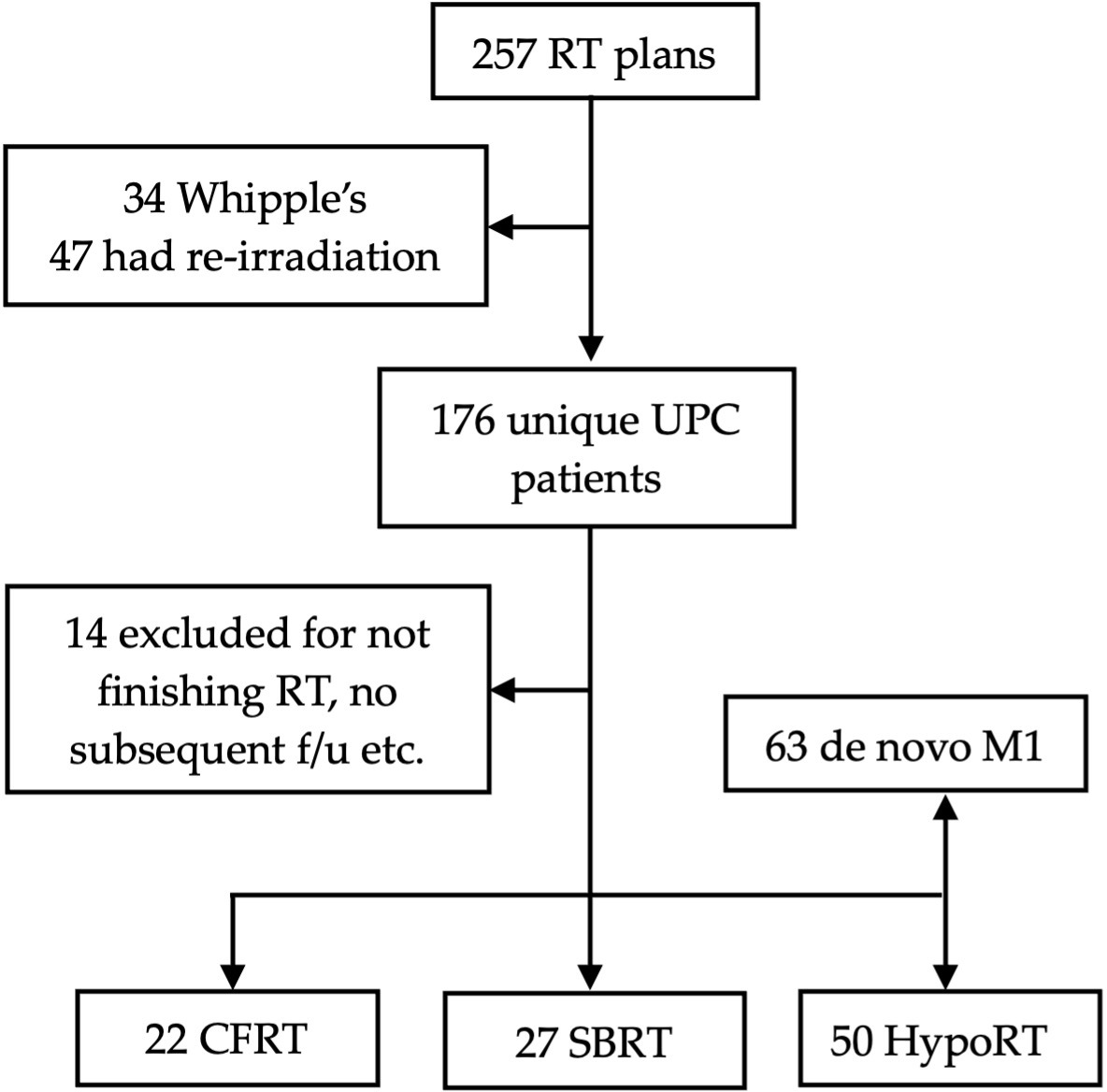
We divided the patients into 4 cohorts based on RT technique and metastatic status: CFRT, SBRT, HypoRT, and de novo M1. CFRT was defined as treatment delivered in >15 fractions. SBRT was defined as treatment delivered in ≤5 fractions with an equivalent dose in 2 Gy fractions (EQD2, α/β = 3)≥40 Gy, consistent with the Canadian Association of Radiation Oncology task force definition of SBRT as delivering doses biologically equivalent to a radical RT course.11 HypoRT was defined as treatment delivered in ≤15 fractions with EQD2 (α/β = 3) <40 Gy and therefore largely represented more palliative intent hypofractionated regimens. SBRT was delivered using linac or CyberKnife platforms with a 5 mm planning target volume (PTV) expansion from gross tumor volume (GTV), whereas CFRT typically included elective nodal coverage consistent with RTOG 0848 postoperative contouring guidelines. In some SBRT cases, PTV coverage was compromised to meet adjacent organ-at-risk constraints, particularly established gastrointestinal dose constraints described by Robert Timmerman and colleagues.
Outcomes of interest included OS, defined as time from diagnosis to death; FFP, defined as time from RT to radiographic evidence of disease progression; and LC, defined as time from RT to local progression. To better characterize outcomes following RT independent of prior chemotherapy duration, TSS was defined as the interval from initiation of RT to death or last follow-up. Time-to-event analyses were performed using the Kaplan-Meier method in R statistical software (version 4.3.1; R Core Team 2023). 95% confidence intervals (95% CIs) were calculated for all outcomes. When the upper confidence interval limit was not reached due to fewer than 50% cumulative events occurring, it was reported as not reached (NR).
Multivariable analyses were performed using Cox proportional hazards regression models with the same statistical software. Performance status was assessed using the Eastern Cooperative Oncology Group (ECOG) scale, with ECOG scores of 0 and 1 grouped together for statistical analyses.
Patients who received at least 3 cycles of chemotherapy during their disease course were identified. This included definitive chemotherapy administered either before or after RT for local disease control. The most commonly utilized systemic therapies at our institution included FOLinic acid (leucovorin), Fluorouracil (5-FU), IRINotecan, and OXaliplatin (FOLFIRINOX), as well as gemcitabine, paclitaxel, and 5-fluorouracil-based regimens.
The standard follow-up protocol included blood work and an initial CT scan approximately 3 months following RT, followed by surveillance CT imaging every 6 months thereafter unless earlier imaging was clinically indicated.
Results
A total of 162 patients with UPC were included in the final analysis, including 99 patients without metastatic disease at the time of RT (non-M1) and 63 patients with de novo metastatic disease (de novo M1). Among the non-M1 patients, 22 received CFRT, 27 received SBRT, and 50 received HypoRT.
Baseline characteristics differed between cohorts despite relatively balanced gender distributions. The CFRT cohort had the youngest mean age, the best mean performance status, and universal chemotherapy utilization, with 100% of patients receiving chemotherapy at some point during their treatment course (Table 1). In contrast, approximately half of the patients in the SBRT, HypoRT, and de novo M1 cohorts did not receive chemotherapy. Gemcitabine-based therapy was the most commonly utilized systemic treatment overall, although the distribution of chemotherapy regimens differed between cohorts (Table 2). Baseline CA 19-9 levels at the time of RT were lowest in the CFRT cohort and highest in the HypoRT and de novo M1 cohorts (Table 1).
| Cohorts (Mean Value Unless Otherwise Specified) | ||||
|---|---|---|---|---|
| Variables | CFRT | HypoRT | SBRT | De Novo M1 |
| No. of patients | 22 | 50 | 27 | 63 |
| Male (%) | 63.6 | 50 | 63 | 57.1 |
| CA 19-9 (U/mL) | 204.7 | 2321.8 | 819.4 | 6419.1 |
| Median PS (ECOG) | 1 | 2 | 2 | 3 |
| T4 status (%) | 91 | 74 | 63 | 84 |
| Age (years) | 65.4 | 70.4 | 71.5 | 67 |
| Biliary stenting rate (%) | 50 | 50 | 33.3 | 33.3 |
| No chemotherapy (%) | 0 | 48 | 51.9 | 46 |
| Total dose (Gy) | 36-50.4 | 25-40.05 | 21-40 | 8-40 |
| Fractions (range) | 18-28 | 1-15 | 3-5 | 1-14 |
| BED α/β = 3 (Gy) | 76.4 | 46.5 | 81.6 | 51.1 |
| EQD2 α/β = 3 (Gy) | 45.9 | 27.9 | 48.9 | 30.7 |
| Cohorts | ||||
|---|---|---|---|---|
| Variables | CFRT | HypoRT | SBRT | De Novo M1 |
| No. of patients | 22 | 50 | 27 | 63 |
| Gemcitabine (%) | 50 | 32 | 25.9 | 23.8 |
| FOLFOX (%) | 31.8 | 24 | 22.2 | 15.9 |
| Paclitaxel (%) | 9.1 | 10 | 18.5 | 19.1 |
| 5-Fluorouracil (%) | 22.7 | 2 | 0 | 1.6 |
| Capecitabine (%) | 22.7 | 0 | 7.4 | 3.2 |
| Other (%) | 9.1 | 2 | 3.7 | 9.5 |
| No chemotherapy (%) | 0 | 48 | 51.9 | 46 |
The CFRT cohort demonstrated the most favorable outcomes overall in terms of OS, FFP, TSS, and LC. Outcomes in the SBRT and HypoRT cohorts were generally similar and intermediate between the CFRT and de novo M1 cohorts, while the de novo M1 cohort demonstrated the poorest outcomes overall. The median OS for the CFRT group was 21.8 months (95% CI 14.5-39.1), for the SBRT group it was 16.5 months (95% CI 7.8-43.7), and for the HypoRT group it was 10.8 months (95% CI 6.1-14.6). It was lowest for the de novo M1 group at 5.4 months (95% CI 3.6-8.8). The median LC for the CFRT group was 26.2 months (95% CI 10.6-NR), for the SBRT group it was 16.6 months (95% CI 10.7-NR), for the HypoRT group it was 16.9 months (95% CI 12.2-NR), and for the de novo M1 group it was 25.3 months (95% CI 12.2-NR) (Figure 2).
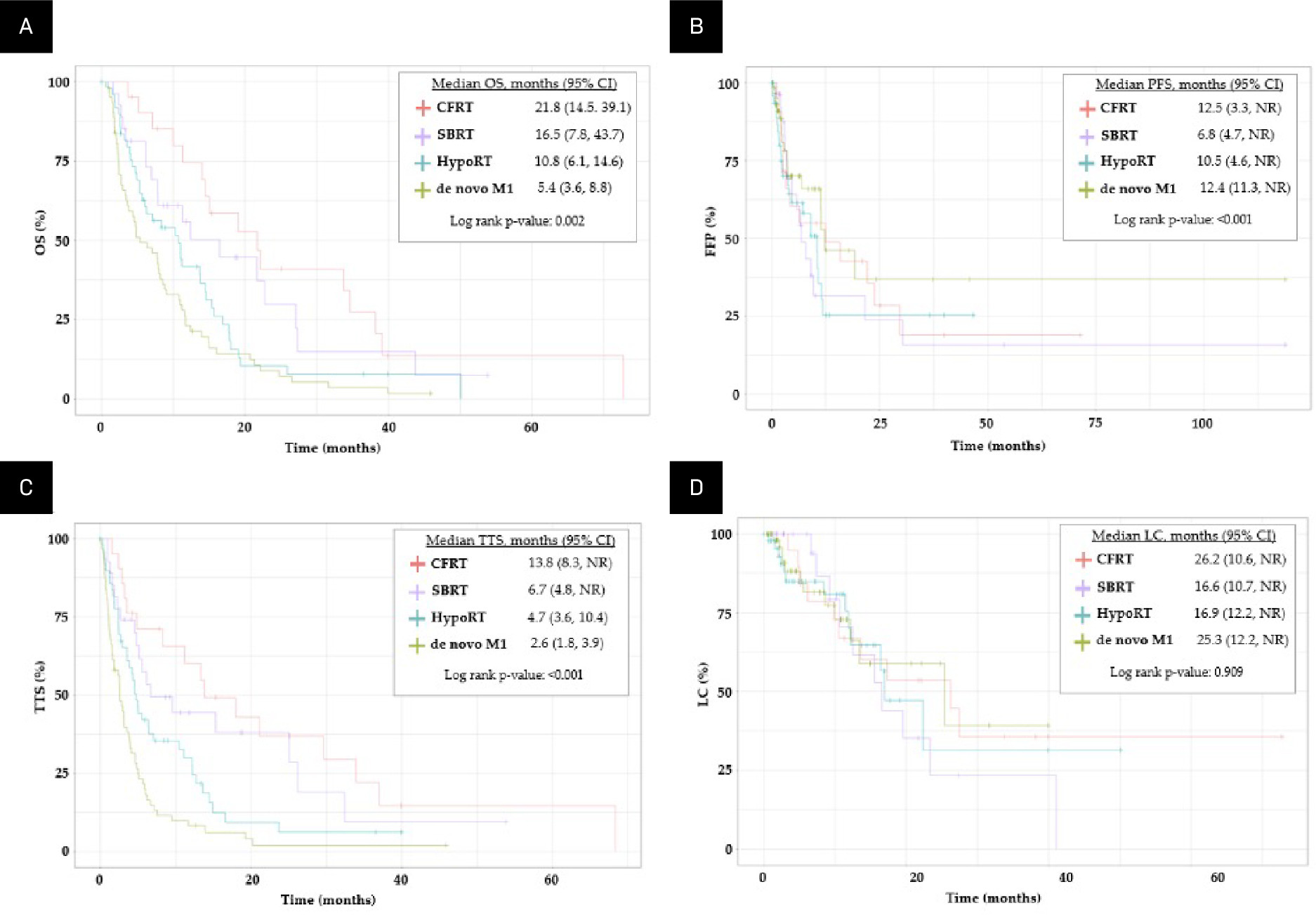
On multivariable Cox proportional hazards analysis, performance status (odds ratio [OR] 2.228, 95% CI 1.610-3.082, P < 0.001) and receipt of chemotherapy (OR 0.243, 95% CI 0.145-0.406, P < 0.001) were strongly associated with OS. In contrast, age, total bilirubin, CA 19-9 levels, and EQD2 were not statistically significant predictors of OS (Table 3).
| Variables | Hazards Ratio (95% CI) | P Value |
|---|---|---|
| Age at diagnosis | 1.028 (0.153-6.916) | 0.02 |
| Total bilirubin | 1.001 (0.995-1.006) | 0.81 |
| CA 19-9 | 1.000 (1.000-1.000) | 0.04 |
| ECOG performance status | 2.228 (1.610-3.082) | <.001 |
| EQD2 | 0.982 (0.964-0.999) | 0.04 |
| Chemotherapy | 0.243 (0.145-0.406) | <.001 |
Given the strong association between chemotherapy utilization and survival outcomes, subgroup analyses were performed for the SBRT, HypoRT, and de novo M1 cohorts stratified by receipt of chemotherapy. Median OS with and without chemotherapy was 22.7 vs 7.0 months, respectively, for SBRT patients (log-rank P = .02), 14.6 vs 4.9 months for HypoRT patients (log-rank P = .02), and 11.1 vs 2.3 months for de novo M1 patients (log-rank P < .001).
Median TSS with and without chemotherapy was 15.3 vs 5.1 months for SBRT patients (log-rank P = .09), 6.4 vs 3.6 months for HypoRT patients (log-rank P = .02), and 4.7 vs 1.3 months for de novo M1 patients (log-rank P < .001). Median FFP with and without chemotherapy was 8.5 vs 5.9 months for SBRT patients (log-rank P = .7), 10.5 vs 11.7 months for HypoRT patients (log-rank P = .4), and 12.4 months vs NR for de novo M1 patients (log-rank P = .7), respectively (Table 4).
| Variables (Months) | Chemotherapy | Cohorts (Median Months) | |||||
|---|---|---|---|---|---|---|---|
| SBRT | P Value | HypoRT | P Value | De Novo M1 | P Value | ||
| OS | Yes | 22.7 | 0.02 | 14.6 | 0.02 | 11.1 | <.001 |
| No | 7 | 4.9 | 2.3 | ||||
| TSS | Yes | 15.3 | 0.09 | 6.4 | 0.02 | 4.7 | <.001 |
| No | 5.1 | 3.6 | 1.3 | ||||
| FFP | Yes | 8.5 | 0.7 | 10.5 | 0.4 | 12.4 | 0.7 |
| No | 5.9 | 11.7 | NR | ||||
Discussion
This study adds to the growing literature on RT for UPC by representing one of the larger retrospective real-world analyses of this patient population and by evaluating patients with de novo metastatic (M1) disease separately. Interestingly, the CFRT cohort demonstrated superior OS, progression-free survival, TSS, and LC compared with the SBRT cohort. However, these findings must be interpreted cautiously given important baseline differences between groups. Patients treated with CFRT were generally younger, had better performance status, more favorable biochemical parameters (including CA 19-9 and bilirubin levels), and all received chemotherapy, compared with only approximately half of the patients in the SBRT and HypoRT cohorts. In addition, unlike other cohorts, the CFRT group did not include patients with metastatic disease at the time of RT.
Multivariable Cox proportional hazards analysis demonstrated that older age was associated with a modestly increased risk of death. More importantly, poor performance status and the absence of chemotherapy were strongly associated with worse OS. Interestingly, baseline CA 19-9 and total bilirubin levels were not significant predictors of mortality in our cohort. These findings likely help explain the improved OS observed in the CFRT cohort, whose patients generally had better performance status and universal chemotherapy utilization.
Given the known importance of systemic therapy in UPC, subgroup analyses were performed based on chemotherapy utilization. Patients who received chemotherapy before or after RT demonstrated improved OS compared with those who did not receive systemic therapy. Notably, SBRT patients who also received definitive chemotherapy appeared to have OS approaching that of the CFRT cohort. These findings reinforce the critical role of chemotherapy in improving survival in UPC and suggest that patients able to tolerate multiagent chemotherapy may represent the subgroup most likely to benefit from aggressive local RT approaches. In these patients, improved LC may be clinically meaningful given the impact of local progression on symptoms and quality of life.
LC also appeared lower in the SBRT cohort receiving chemotherapy compared with the CFRT cohort. This may in part relate to differences in treatment volumes, as SBRT generally targets only the gross disease without elective nodal coverage, whereas CFRT typically encompasses regional nodal drainage areas using larger treatment volumes. A small phase II study comparing focal SBRT (33 Gy in 5 fractions to the tumor and involved vasculature) with a larger elective treatment volume that additionally encompassed the pancreatic head/body, adjacent vasculature, superior mesenteric artery origin, and celiac artery origin demonstrated improved 1-year progression-free survival (60% vs 25%), suggesting that elective nodal coverage may reduce local-regional failures without excessive toxicity.12
Conversely, Fogaroli et al. demonstrated a relatively low local failure rate of 23.3% using involved-field CFRT, arguing that reduced elective treatment volumes may be feasible in selected patients and could potentially decrease toxicity.13 As such, the optimal treatment volumes for both SBRT and CFRT remain controversial and incompletely defined.
Importantly, the SBRT data in this study were collected prior to the implementation of MR-Linac-based adaptive RT and contemporary dose-escalation strategies at our institution. These newer approaches are increasingly associated with improved LC and potentially superior clinical outcomes, and therefore the present SBRT results may not fully reflect modern practice.
Another important observation from our study relates to patients presenting with de novo metastatic (M1) disease and those treated with lower-dose HypoRT regimens. The de novo M1 cohort likely reflects a real-world clinical scenario in which selected patients with metastatic disease and preserved performance status undergo primary tumor-directed RT for symptom palliation and improved local disease control despite the presence of systemic disease. As expected, these patients demonstrated poorer outcomes across all endpoints compared with the CFRT and SBRT cohorts, raising questions regarding the degree of benefit provided by local RT in certain subsets of patients. Survival outcomes appeared to be strongly influenced by receipt of chemotherapy, likely reflecting the importance of underlying performance status and systemic disease burden. For example, de novo M1 patients who received chemotherapy had a median OS of 11.1 months compared with only 2.3 months in those who did not receive chemotherapy (log-rank P < .001).
These findings suggest that metastatic patients who are not candidates for systemic therapy may not live long enough to derive meaningful benefit from primary tumor-directed RT and may be better managed with best supportive care measures alone. Conversely, metastatic patients with good performance status who are able to receive chemotherapy may still benefit from local RT despite presenting with metastatic disease. Additionally, patients without metastatic disease but with poor performance status appeared to derive symptomatic and clinical benefit from lower-dose HypoRT approaches, supporting a potential role for palliative RT in carefully selected patients.
Our study is limited by its retrospective design. The sample size for each treatment cohort was relatively small, particularly for subgroup analyses. In addition, patients were treated over a prolonged period (2007-2022), during which there were substantial changes in systemic therapy regimens, imaging quality, supportive care, and RT techniques. In particular, SBRT was implemented only in more recent years, which may introduce temporal treatment bias and influence outcomes over time.
Routine follow-up imaging was also not consistently performed in metastatic or poor performance status patients, particularly in de novo M1 patients who were not candidates for chemotherapy due to poor functional status and limited expected survival. As a result, local failure rates may be underreported in this subgroup. This likely contributes to the apparently higher LC observed in de novo M1 patients compared with the SBRT cohort, although this difference was not statistically significant. Importantly, this subgroup may also reflect a more “real-world” population of patients receiving palliative RT outside the setting of clinical trials. Finally, none of the patients in this study were treated using newer technologies such as proton therapy or adaptive MR-guided RT, which may allow for improved target coverage, dose escalation, and reduced toxicity compared with conventional treatment platforms.14,15
Conclusions
RT for UPC using CFRT was associated with encouraging OS and LC outcomes in this retrospective cohort. While outcomes appeared favorable compared with historical SBRT series, this study was not designed as a comparative analysis and should be considered hypothesis-generating only. Differences in outcomes may reflect important baseline imbalances and patient selection factors, including younger age, better performance status, higher rates of chemotherapy receipt (100% vs approximately 50%), more favorable biochemical parameters (including CA 19-9 and bilirubin at the time of RT), and the absence of metastatic (M1) disease at the time of RT in the CFRT cohort. These findings suggest that carefully selected patients with UPC may derive meaningful benefit from aggressive local therapy, warranting further prospective evaluation of modern CFRT approaches, particularly in the MR-Linac and dose-escalation era.
Furthermore, patients with de novo metastatic (M1) disease who are not candidates for systemic therapy appeared to have limited survival, suggesting that primary tumor-directed RT alone may provide minimal clinical benefit in this setting.
References
- Brenner D, Poirier A, Woods R. Projected estimates of cancer in Canada in 2022. Can Med Assoc J. 2022;194(17). doi:10.1503/cmaj.212097.
- Golden D, Novak C, Minsky B, Liauw S. Radiation dose ≥54 gy and CA 19-9 response are associated with improved survival for unresectable, non-metastatic pancreatic cancer treated with chemoradiation. Radiat Oncol. 2012;7(1):156. doi:10.1186/1748-717X-7-156.
- Katz M, Shi Q, Meyers J. Efficacy of preoperative mFOLFIRINOX vs mFOLFIRINOX plus hypofractionated radiotherapy for borderline resectable adenocarcinoma of the pancreas: the A021501 phase 2 randomized clinical trial. JAMA Oncol. 2022;8(9):1263-1270. doi:10.1001/jamaoncol.2022.2319.
- Hammel P, Huguet F, van Laethem J. Effect of chemoradiotherapy vs chemotherapy on survival in patients with locally advanced pancreatic cancer controlled after 4 months of gemcitabine with or without erlotinib: the LAP07 randomized clinical trial. JAMA. 2016;315(17):1844-1853. doi:10.1001/jama.2016.4324.
- Chauffert B, Mornex F, Bonnetain F. Phase III trial comparing intensive induction chemoradiotherapy (60 gy, infusional 5-FU and intermittent cisplatin) followed by maintenance gemcitabine with gemcitabine alone for locally advanced unresectable pancreatic cancer. Definitive results of the 2000-01 FFCD/SFRO study. Ann Oncol. 2008;19(9):1592-1599. doi:10.1093/annonc/mdn281.
- Loehrer P, Feng Y, Cardenes H. Gemcitabine alone versus gemcitabine plus radiotherapy in patients with locally advanced pancreatic cancer: an eastern cooperative oncology group trial. J Clin Oncol. 2011;29(31):4105-4112. doi:10.1200/JCO.2011.34.8904.
- Fietkau R, Ghadimi M, Grützmann R. Randomized phase III trial of induction chemotherapy followed by chemoradiotherapy or chemotherapy alone for nonresectable locally advanced pancreatic cancer: first results of the CONKO-007 trial. JCO. 2022;40(16_suppl):4008-4008. doi:10.1200/JCO.2022.40.16_suppl.4008.
- Tchelebi L, Lehrer E, Trifiletti D. Conventionally fractionated radiation therapy versus stereotactic body radiation therapy for locally advanced pancreatic cancer (CRiSP): an international systematic review and meta-analysis. Cancer. 2020;126(10):2120-2131. doi:10.1002/cncr.32756.
- Kamel R, Dennis K, Doody J, Pantarotto J. Ablative vs. non-ablative radiotherapy in palliating locally advanced pancreatic cancer: a single institution experience and a systematic review of the literature. Cancers. 2023;15(11). doi:10.3390/cancers15113016.
- Liu A, Lefresne S. Palliative radiotherapy in pancreatic cancer: a retrospective study of 100 cases and regional patterns of practice. Ann Palliat Med. 2023;12(5):891-899. doi:10.21037/apm-22-1417.
- Sahgal A, Roberge D, Schellenberg D. The canadian association of radiation oncology scope of practice guidelines for lung, liver and spine stereotactic body radiotherapy. Clin Oncol. 2012;24(9):629-639. doi:10.1016/j.clon.2012.04.006.
- Kharofa J, Mierzwa M, Olowokure O. Pattern of marginal local failure in a phase II trial of neoadjuvant chemotherapy and stereotactic body radiation therapy for resectable and borderline resectable pancreas cancer. Am J Clin Oncol. 2019;42(3):247-252. doi:10.1097/COC.0000000000000518.
- Fogaroli R, Castro D, Silva M. Involved-field radiation therapy for patients with unresectable pancreatic adenocarcinomas: failure pattern analysis. Cureus. 2023;15(11). doi:10.7759/cureus.48106.
- Parikh P, Lee P, Low D. A multi-institutional phase 2 trial of ablative 5-fraction stereotactic magnetic resonance-guided on-table adaptive radiation therapy for borderline resectable and locally advanced pancreatic cancer. Int J Radiat Oncol Biol Phys. 2023;117(4):799-808. doi:10.1016/j.ijrobp.2023.05.023.
- Eckstein J, Choi J, Lozano A. Proton therapy for unresectable and medically inoperable locally advanced pancreatic cancer: results from a multi-institutional prospective registry. Adv Radiat Oncol. 2023;8(5). doi:10.1016/j.adro.2023.101250.
Disclosures
Yuxin Zhang received a salary from the Ottawa Hospital Research Institute to perform statistical analysis for this project.
Acknowledgments
Data were compiled through a retrospective review of patient charts. A database was created in a secure manner to protect the privacy of the patients. Release of anonymized data can be made possible with specific requests made to the corresponding author.
Citation
. Outcomes of Stereotactic vs Conventional Radiation Therapy in Unresectable Pancreatic Cancer: A Real-World Retrospective Analysis. Applied Radiation Oncology. 2026;15(2). doi:10.37549/ARO-D-26-0006.