Peer Review in Radiation Oncology: Present and Future Directions
Applied Radiation Oncology — Vol. 15 , Issue 2
Published: July 1, 2026
1 Lake Erie College of Osteopathic Medicine, Erie, PA
2 Northeast Ohio Medial School, Rootstown, OH
3 Department of Radiation Oncology, Cleveland Clinic, Taussig Cancer Center, Strongsville, OH
* Corresponding author: Andrew Vassil (vassila@ccf.org)
Abstract
Peer review is a vital process in radiation oncology that aims to enhance treatment quality, reduce errors, and standardize care through multidisciplinary evaluation of radiation treatment plans. Its implementation varies widely across institutions, with ongoing efforts to improve consistency and efficiency. This article summarizes current literature regarding the peer review process in radiation oncology. Peer review identifies change in approximately 3% to 12% of cases, particularly complex cases such as head and neck, gynecologic, and lung cancer with focus on changes in target volumes, dose, and organ-at-risk delineation. Complex treatment planning techniques such as intensity-modulated radiation therapy and proton therapy show higher rates of recommended changes that tend to decrease as departments gain experience and establish guidelines. Peer review processes differ, but often involve weekly multidisciplinary meetings to review selected cases based on complexity or treatment intent. Meeting format ranges from offline individual reviews to in-person or video conferences. Documentation practices vary widely, with inconsistencies in tracking of attendance, recommendations, and implementation of suggested changes. Effective peer review involves the treating physician and an experienced peer, but often includes support from medical physicists, dosimetrists, radiation therapists, and, occasionally, radiologists. Structured feedback varies from informal discussions to documented evaluations covering multiple aspects of treatment, with changes graded as no change, minor change, or major change; documentation of response to suggested change is inconsistent. Peer review is ideally conducted before treatment starts to allow plan modification with protected time and flexible meeting formats to enhance participation and regularity. Automation and artificial intelligence (AI) tools may streamline the review process by identifying cases needing attention, standardizing processes, and predicting dose distributions, thereby reducing clinician workload and improving accuracy. Future integration of AI tools for literature review, incident reporting, and documentation may support high-quality peer review. This underscores the need for standardized peer review frameworks in radiation oncology.
Keywords
peer review, radiation oncology, treatment plans, multidisciplinary, quality assurance, target volumes, IMRT (Intensity-Modulated Radiation Therapy), documentation, standardization, artificial intelligence (AI)
Categories
Introduction
Peer review has been a crucial component of quality improvement and harm reduction efforts in radiation oncology. Due to the complex nature of radiation treatment planning and the differences between a radiation oncologist’s subjective decision-making, errors can occur, particularly regarding radiation dosing, target volumes, and normal tissue delineations. Peer review may result in the alteration of treatment plans and the identification of potentially harm-inducing errors.1 Retrospective and prospective peer review serves as systems intended to develop and maintain high-quality and error-free treatments across physicians within a system.2 Professional organizations, including Royal Australian and New Zealand College of Radiologists (RANZCR) and American Society for Radiation Oncology (ASTRO), advocate for the implementation of peer review processes to create multidisciplinary teams that work to maintain the standards of care across departments.1,3 Despite this, significant variation exists between peer review models, and there is yet to be broadly accepted standardization.4
Methods
Literature was searched in the PubMed database using keywords related to radiation oncology, peer review, quality, and safety. Studies were limited to publications from 2010 to 2025. Included were prospective and retrospective cohort studies, systematic reviews, meta-analyses, guidelines, and narrative reviews. Manual citation searching was used to increase the scope of articles captured. There were no specific exclusion criteria; however, priority was placed on studies that published prospective, original research, systematic reviews/meta-analyses, and studies that were multicenter in nature. Literature was aggregated and assessed for inclusion based on recency, with newer studies being preferred, and relevance of the study’s aim in assessing peer review, its process improvement, and clinical impact.
Discussion
Clinical Impact of Peer Review
Peer review identified errors that resulted in alterations to treatment plans in 3.3% to 12.2% of the time.5-9 “Near misses” were seen and rectified in 9% of reviewed cases in some series.10 The treatment sites most frequently associated with peer review-recommended plan changes were head and neck (1%-66%), gynecologic (6%-18%), and lung (13%-27%).5,10-12 Changes in treatment plans that resulted from peer review centered on target volume, dose, organs at risk, and contouring, with target volume being one of the most common reasons for changes.5,10,13 Most institutions that participated in peer review reviewed >50% of curative cases, and peer review was seen broadly to apply in some fashion to all types of radiation courses; however, palliative cases had lower rates of audit.5,12
The complexity of the target site and the plan was correlated with the rate of changes recommended by peer review. For example, breast plans that included regional lymph nodes had an odds ratio of 2.12 to be classified requiring changes vs breast only plans.13 Complexity related to novel technology was attributed as a factor that resulted in increased rates of changes from peer review. For example, head and neck plans often involving advanced modalities like intensity-modulated radiation therapy, volumetric modulated arc thearpy (VMAT), and proton therapy can have higher rates of recommended changes during peer review (44.9%), compared to lung (24.5%), stereotactic body radiotherapy (SBRT) (17.4%), and other sites.12,14 Heterogeneity in patient populations studied and peer review methods make comparison between reported outcomes difficult. It was seen that as a department overcame the hurdles with learning new treatment modalities, their rate of changes from peer review decreased.11 Rates of change generally decreased over time after the initiation of peer review, which is thought to be from the standardization that results from frequent review, along with the education to all those involved.12 Clear and established department guidelines may serve to reduce the variation in treatment plans and therefore reduce the needed changes from peer review, as was seen in one series.10
Peer Review Models and Processes
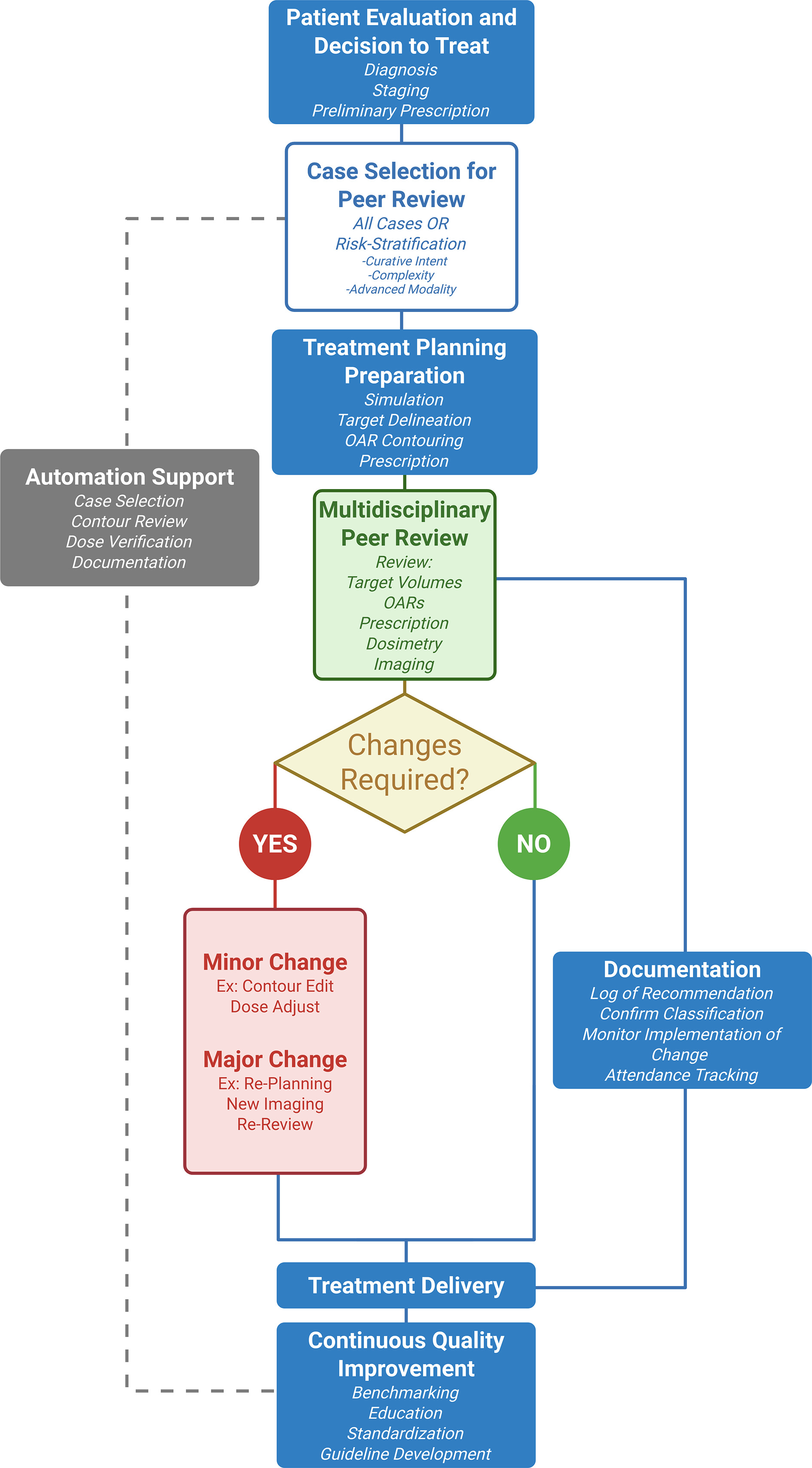
Peer review protocols differed between programs (Table 1). A typical process was prospective and involved a multidisciplinary team that met to examine cases (Figure 1). Decisions would be made during the review and plans approved, or changes recommended. Changes would be made and plans enacted or presented for a second review, depending on the nature of the proposed changes.4,5,15,16 The selection process for cases included for peer review varies significantly among programs. Some locations attempted to audit all new patients, while others would choose cases based on the complexity, site, dosage, and modality.1,15 Whether a patient was decided for review through random selection or because the treatment intention was curative, the decision-making behind which patients will be reviewed appears to be highly specific to the department and faculty.4 Peer review meetings tend to occur on a weekly basis,4 with some institutions holding sessions more frequently, and some even having impromptu meetings, if necessary, to reduce treatment delays.1 Most of the time, meetings would be held in-person, though technology was leveraged to allow for meetings when scheduling issues came up, for example, through video-based meetings or individual review.1,4,15
| Component | Common Approaches Reported | Advantages | Limitations/Variability |
|---|---|---|---|
| Timing of review | Prospective (before treatment initiation) vs retrospective (after treatment starts) | Prospective review allows changes before planning and treatment delivery; retrospective review provides educational value | Significant institutional variation; urgent cases may require retrospective review |
| Case selection | All new cases; curative-intent cases; random selection; risk-stratified selection based on complexity, site, modality, or dose | Focuses resources on cases most likely to benefit from review | No standardized selection criteria across institutions |
| Multidisciplinary participation | Radiation oncologists, peer reviewers, medical physicists, dosimetrists, radiation therapists, trainees; occasional radiologist involvement | Diverse expertise improves detection of clinically meaningful issues | Attendance and specialty involvement vary substantially |
| Meeting frequency | Weekly most commonly; some institutions hold multiple sessions per week or ad hoc reviews | Regular review promotes standardization and education | Scheduling and staffing constraints |
| Meeting format | In-person, video conference, hybrid, asynchronous individual review | Remote participation improves flexibility and attendance | Different formats may affect interaction and consistency |
| Documentation systems | Electronic medical record, dedicated databases, structured audit tools, real-time documentation | Facilitates quality improvement and tracking of recommendations | Documentation practices remain inconsistent across institutions |
| Grading of changes | No change, minor change, major change; ABC classification systems | Allows assessment of clinical significance of recommendations | No universally accepted grading framework |
| Implementation tracking | Variable recording of recommendation adherence and follow-up review | Supports quality assurance and accountability | Often incompletely documented |
| Review duration | Approximately 2-20 min per case; most commonly 2-8 mins | Efficient review of large case volumes | Longer reviews may be required for complex cases |
Peer review in radiation oncology departments has been documented through structured recording systems that track case presentations, recommendations, and outcomes, though practices vary significantly across institutions. The American Society for Radiation Oncology recommends that practices create well-developed peer review strategies that include review processes for the entire practice and for individual clinical care.17 However, documentation of peer review remains inconsistent. In a survey of German radiation oncology departments, it was found that attendance tracking and implementation of recommended changes were inconsistent.18 On a similar note, in a Canadian provincial survey, only 36% of centers reported recording peer review outcomes on the medical record.19
An effective documentation system vastly improves patient outcomes in medicine. Improvements in many aspects to the documentation system include conscious effort on the following: recording of attendance by multidisciplinary team members (physicians, medical physicists, dosimetrists, radiation therapists), documentation of case-specific recommendations and their classification (e.g., no change, minor change, major change), tracking of whether recommended changes were implemented, and use of standardized peer review audit tools (PRATs), such as those developed by the Royal Australian and New Zealand College of Radiologists.1,3,10,18,20-22 The timing and format of documentation varies by institution. Some departments conduct prospective documentation during treatment planning conferences, while others use electronic peer review systems or collaborative methods.1,17,23 The mean time for reviewing each plan ranges from approximately 2 to 8 minutes per case.11,20,24 Despite recommendations for systematic documentation, surveys reveal that many institutions lack standardized approaches. A systematic review found significant variation in documentation and reporting practices internationally, with no consensus on grading systems for peer review outcomes.4 This has led to calls for standardized frameworks to facilitate meaningful evaluation of peer review’s clinical impact.4,12
The incorporation of video-based meeting programs allows for greater flexibility, and the involvement of multiple departments within an institution. This greater logistical freedom improves adherence to peer review sessions.1,4 Others take a different approach, meeting for peer review sessions with the patient to allow for the incorporation of in-meeting physical examination—for example, in a head and neck oncology program.25,26 Peer review sessions tended to be between 30 and 60 minutes at most institutions.4,5,12 Planning sessions most commonly took less than 30 minutes, and rarely would take longer than 1 hour.5 The time needed per case could be as low as 2.7 minutes, up to 12 to 20 minutes.3,5,26-28 Longer time spent per patient was seen with those centers that would include physical examination and was thought to be related to the complexity of the cases.12,26 The more time spent per patient also had a correlation with the rate of change per case, reaching as high as 22.6% to 66% of cases in those that averaged near 20 minutes per patient.12
Effective peer review, by definition, typically requires that the physician attending the case as well as a nontreating “peer” with experience in the relevant tumor site participated at minimum in each session.4 The radiation oncologist was almost always present, as well as a reviewing physician, and teams were often multidisciplinary with attendance from the medical physicists, dosimetrist, radiation therapist, residents, and trainees.4,5,16 The involvement of radiologists in the peer review process was not a common occurrence; however, when it was performed, there was a significant increase in the number of meaningful changes made, emphasizing the value of an interdisciplinary team.14 Larger institutions with multiple departments are able to leverage interdepartmental peer review with faculty from different sites.1
The structure of the peer review proceedings was unique to institutions. Various methods have been devised, with some as simple as recommending changes as a particular case is discussed.15 Formal case review methodologies provided a structured approach to feedback, with a systematic evaluation of various aspects of a treatment plan for each case. One institution devised a form that evaluated 8 aspects of the treatment (workup and staging, treatment intent and prescription, position/immobilization/simulation, motion assessment/management, target contours, normal tissue contours, target dosimetry, and normal tissue dosimetry).16 Grading of changes was another area of variation among centers. Commonly, they would be graded as “no change,” “minor change,” and “major change.”4,5,16 Lymberiou et al. developed an ABC categorization of changes, with “A” referring to Adequate, “B” as treatment may proceed with potential changes in the future, and “C” as unsatisfactory and requiring changes before the next set of treatment.13
For each of the various categories of a case, the reviewing physician had a chance to approve or recommend a different course of action. The feedback that was provided during review was most often documented into the electronic medical record, in a separate secure electronic database, or the changes were made in real time through face-to-face discussion.4,5 The response from the attending physician to the proposed changes was infrequently recorded and changes were inconsistently brought back for further peer review.4,5
Practical Considerations
Peer review was typically performed before treatment began. Intuitively, this allowed for changes and potential overhaul to occur freely without the burdens of re-optimizing a plan that is already in place.4,5 When peer review occurred after the onset of treatment, changes were often met with reluctance by the attending physician due to the need to replan.3 Particularly for technically complicated cases, peer review is best done before the medical physics or dosimetry planning steps to avoid re-planning.4 Retrospective peer review had its benefits as an educational tool.4 In some cases, it is a necessity to review after the treatment began if radiation was administered urgently.15 In one study from Canada, approximately half of the surveyed programs were able to review >80% of curative treatment plans with limitations from time constraints and oncologist availability.5 The protection of time specifically for peer review was highly successful in attaining regularity of attendance, especially when oncologist schedules were specifically planned to maintain time for the review session. Set time blocks allowed for planners and physicians to prepare appropriately.1,12 Maintaining flexibility with the format of peer review facilitates meetings when obstacles occur. Technology and video conferencing should be leveraged to allow for members to join off-site and from other campuses.1,4,5
Clinical Applications of Automation
Advancements in automation should be leveraged to identify cases where peer review may have the most impact. Automated technologies may assess large numbers of patients across broad disease and treatment intent categories with an ability to flag critical issues for potential intervention. Deep learning and artificial intelligence (AI) are developing technologies that may make improvements in the quality of peer review while decreasing the clinician and team workload. For example, models have been successfully trained to rapidly predict dose distributions and aid in identifying which plans needed adjustment in the treatment of nasopharyngeal carcinoma, with applied results comparable to what was planned by the treating teams. It is important to keep in mind that AI models tend to address specific technical concerns, for example, dose distribution optimization, whereas multidisciplinary peer review engages in broader clinical decision-making.29,30
Algorithms can act as a safeguard against erroneous radiation prescriptions, with one trained on thoracic cancer patients achieving a lower error rate than manual peer review.31 These models are trained on high-quality cases and end up personalized for the institution, anatomy, and the metrics that the team selects for. This allows AI to complement the process with the addition of more tangible data to the already existing multidisciplinary clinical expertise. Limitations with these models existed on complex patients and those with anomalies; however, this was thought to be because of a lack of sufficient training data, which is an area that may improve as wider incorporation leads to exposure to these rare cases.29,31
Administrative/Documentation Applications of Automation
Common clinical tasks can be automated, such as the review of relevant literature that informs radiation planning and scouring of the electronic health record, with nearly 95% accuracy/precision.30 In the realm of quality improvement, the production of incident reports can be assisted with natural language processing and machine learning to aid in the classification and severity determination of incidents.32,33 Ambient AI and other tools are being quickly adopted by institutions as a time-saving means in documentation and may find a place in the radiation oncologist’s clinic.34 The time saved from the implementation of automation in various aspects of clinical and administrative realms of practice can be employed towards high-quality peer review for manual and automated processes.
Wherever possible, aspects of the peer review process should be standardized. Protocols and local institutional guidelines should serve as a standard that aids the audit.4 Forms should be made to ensure that all relevant aspects are addressed independently and to improve the efficiency of the review process.4,16 Attendance, data collection, recommendation adherence, response from the attending physician, and other “process outcomes” should be tracked and documented to continually assess the efficacy of the peer review process.5 Tools such as a color-coded automated dose volume histogram (DVH) analysis can assess DVH adherence to set department criteria.1 The RANZCR’s PRAT provides a framework to fulfill such needs.2 Automated systems may aid in the processes of peer review documentation, for example, with the use of AI summarization and contextual enrichment to relay recommendations made during peer review sessions. With structured data gathering, automated analysis can highlight workflow steps that require intervention.
Limitations
This study faces several limitations. The nonsystematic nature of this review inclines selection bias in terms of which papers were chosen, the potential papers that were missed in the search process, and the use of only one database to gather articles. This study is also limited in the heterogeneity of the included studies’ methodologies and populations, which limits direct comparisons of results, and as such listed ranges should be interpreted with caution. Despite these limitations, we aim to provide a broad overview of the current state of peer review in radiation oncology.
Conclusion
Peer review is an essential asset to standardizing and delivering quality care in radiation oncology. It allows for changes in treatment plans that are clinically meaningful and protects against potentially harmful errors in practice. It also allows for standardization and interdisciplinary effort that leads to better care for patients. Despite efforts in peer review in the field, there persist gaps in standardization due to variability in peer review models used across institutions and its employment across the radiation oncology community. To address this gap, future standardized frameworks should incorporate several core elements: risk-stratified case selection criteria that prioritize high-risk, complex, and curative-intent cases; defaulting to prospective pre-treatment review to avoid the burden of re-planning; structured multidisciplinary participation, including radiation oncologists, medical physicists, dosimetrists, and, where feasible, radiologists and other relevant specialists; standardized documentation of case-specific recommendations, change classifications, and implementation status; and systematic tracking of process outcomes over time to enable ongoing quality assessment and benchmarking.
AI and automation hold considerable promise as adjuncts to peer review, with demonstrated applications in dose distribution prediction, prescription error detection, and administrative documentation. However, these tools remain institution-specific and require rigorous prospective validation before broad clinical adoption, and they are not a substitute for the broader clinical judgment afforded by multidisciplinary human review. There remains the pervasive need for a robust effort to develop an organized approach to peer review to maintain and improve high standards of care and avoid medical errors in the field of radiation oncology.
Disclosures
The authors have no conflicts of interest to disclose. None of the authors received outside funding for the production of this original manuscript and no part of this article has been previously published elsewhere.
Citation
. Peer Review in Radiation Oncology: Present and Future Directions. Applied Radiation Oncology. 2026;15(2). doi:10.37549/ARO-D-26-0005.