Practice Changes and Geographic Reach of Postprostatectomy Radiation Therapy After NRG-GU003
Applied Radiation Oncology — Vol. 15 , Issue 3
Published: September 1, 2026
1 Department of Radiation Oncology, Stanford Cancer Institute, Stanford University, Stanford, CA
* Corresponding author: Mark K. Buyyounouski (mbuyyou@stanford.edu)
Abstract
Objective:: Moderately hypofractionated postprostatectomy radiation therapy (HYPORT) is an accepted practice supported by the landmark trial NRG-GU003 that established noninferiority compared to conventionally fractionated radiation therapy (COPORT) in terms of patient-reported toxicity. HYPORT is purported to increase access to postprostatectomy radiation therapy (PPRT) with fewer treatment visits and reduced burden to patients. We hypothesized the introduction of HYPORT at our institution in March 2024 increased the utilization of PPRT in the following year compared to the prior year.
Methods:: 86 consecutive patients who received COPORT or HYPORT from March 2023 to April 2025 at a single, multisite institution in California by multiple treating radiation oncologists were retrospectively analyzed. Demographic, disease, and treatment characteristics were collected. Subgroup analyses were stratified by treatment regimen and by RT initiation before vs after the March 2024 publication of NRG-GU003. Statistical tests included 2-sample t tests, Fisher exact tests, χ² tests, Mann-Whitney U tests, and regression analyses.
Results:: No significant differences in patient demographics aside from margin status were observed between patients treated before vs after March 2024. Patients treated after March 2024 were more likely to receive HYPORT regimens (2.2-2.6 Gy fractions) than those treated before March 2024 (71% vs 38%; P < .01). On multivariable logistic regression, treatment after March 2024 was associated with higher odds of HYPORT receipt after adjustment for facility, margin status, and age (OR 12.85; P < .001) and after additional adjustment for treating physician (OR 13.70; P < .001). Treated PPRT case volume was numerically higher after March 2024 (50 vs 36 patients), and patients treated with HYPORT traveled numerically greater distances than those treated with COPORT.
Conclusion:: Adoption of HYPORT at our institution was associated with a marked increase in the use of hypofractionated treatment regimens following publication of NRG-GU003. Although institutional PPRT case volume and travel distance were numerically greater after HYPORT implementation, these findings warrant confirmation in larger studies to determine whether shorter treatment regimens improve access to care.
Keywords
postprostatectomy radiation therapy, hypofractionated radiation therapy, patient access, genitourinary cancers
Categories
Introduction
Postprostatectomy radiation therapy (PPRT) is an important risk-adapted adjuvant therapy for prostate cancer. Its role and timing have evolved substantially following contemporary randomized trials evaluating adjuvant vs early salvage radiation therapy (RT). While no significant differences have been demonstrated in event-free or biochemical progression-free survival, early salvage RT has been found to have lower rates of genitourinary toxicity and is thus supported as a treatment option, which may spare men from RT and associated toxicities.1-4 However, in addition to clinical factors, receipt of PPRT in routine practice may also be shaped by nonclinical and system-level factors, such as physician practice patterns, patient preference, treatment duration, and access-related barriers, such as residential location. Distance from treatment facilities has been associated with prostate cancer treatment selection more broadly,5,6 including lower likelihood of receiving radiation compared with radical prostatectomy among patients living farther from treatment centers.7 However, whether similar distance-related barriers influence receipt and delivery of PPRT remains less well characterized.
Hypofractionation may increase access to PPRT by reducing the logistical and financial burdens of treatment.8-10 Conventional regimens require several weeks of daily therapy, which may be challenging not only for patients in rural areas but also for those in large, geographically dispersed urban regions where travel is time-consuming and costly. By shortening the overall treatment course and decreasing cumulative travel demands, missed work, and related out-of-pocket expenses, hypofractionated approaches can make RT more feasible and accessible for a broader group of patients.9,11
NRG-GU003 was the first prospective randomized clinical trial that compared hypofractionated (62.5 Gy in 25 fractions) and conventionally fractionated (66.6 Gy in 37 fractions) RT in patients receiving PPRT.12 Hypofractionation demonstrated noninferiority, in terms of patient-reported genitourinary or gastrointestinal adverse effects at 2 years, in addition to biochemical control. These findings supported hypofractionation as a potential radiation regimen in the postprostatectomy setting.
In this study, we evaluate changes in clinical practice for PPRT after the publication of the NRG-GU003 trial by examining their impact on patient access and geographical reach, measured through the number of patients treated, the adoption of conventional vs hypofractionated regimens, and the distances patients traveled. While the NRG-GU003 trial primarily assessed treatment-related toxicity and efficacy outcomes, this study uniquely expands upon these findings by investigating real-world implementation patterns.
Methods
The study retrospectively reviewed 86 consecutive patients who underwent PPRT at a multi-site institution in California between March 2023 and April 2025. The primary endpoint was the shift in radiation modality practices following the publication of the NRG-GU003 trial. The secondary endpoint evaluated the change in the geographic reach of treatment, assessed using patients’ travel distance from their primary residence to the treating facility.
Eligibility criteria included biopsy-proven prostate cancer (at initial diagnosis) and completion of PPRT at one of the institution’s sites. While patients receiving salvage and adjuvant RT represent distinct clinical populations, both subsets were included in the study cohort to capture the breadth of PPRT adoption across practice settings. Demographic data were collected from the electronic health record and survey, including age, gender, race, ethnicity, and miles between residence and treatment facility calculated as driving directions on Google Maps. For patients who resided in temporary accommodations during treatment, the primary residence was used for all analyses because it was more consistently documented across the cohort and provided a standardized measure of geographic access. This approach also better captured the potential influence of shorter hypofractionated treatment regimens on access to care, as patients traveling longer distances may be more willing to arrange temporary lodging when treatment can be completed in fewer fractions. Clinical data, including start and end dates of RT, total dose prescribed, and number of fractions prescribed, were also recorded. Institutional review board approval and waiver of informed consent were obtained for this study.
Demographic, clinical, and treatment characteristics were compared between patients who initiated RT before March 1, 2024, and those who initiated treatment after this date, corresponding to the publication of the NRG-GU003 trial. Continuous variables were compared using 2-sample t tests or Mann-Whitney U tests based on distribution. Categorical variables were compared using the χ² test or Fisher exact test, as appropriate. The association between treatment period and receipt of hypofractionated postprostatectomy radiation therapy (HYPORT) was evaluated using multivariable Firth penalized logistic regression, adjusting for treatment facility, surgical margin status, and age. Treating physician was added as a covariate in a sensitivity analysis. Travel distance by treatment regimen was evaluated using median (quantile) regression adjusted for treatment facility, with a log-linear model used in a sensitivity analysis. Odds ratios (ORs) are reported with 95% profile likelihood confidence intervals (CIs). All statistical tests were 2-sided, and statistical significance was defined as P < 0.05. Analyses were performed using R version 4.6.0 (R Foundation for Statistical Computing, Vienna, Austria).
Results
Eighty-six patients were eligible for this study; their demographic, disease, and treatment characteristics are summarized in Table 1. The mean age of the overall study cohort was 69.1 years (range, 54.5-83.3). Most patients were White (63%), followed by Asian (20%) and Black or African American (7%); 8% identified as Hispanic or Latino. Patients received prostate bed irradiation to total doses of 62.5 to 75 Gy delivered in 25 to 35 fractions (2.0-2.6 Gy per fraction), with elective pelvic lymph node irradiation, when indicated, to 50 to 54 Gy in 25 to 35 fractions (1.5-2.0 Gy per fraction). Most patients (98%) received irradiation to both the prostate bed and pelvic lymph nodes, while the remaining patients received prostate bed irradiation alone. Sixty-nine (80%) patients received hormone therapy at the discretion of the treating physician. The median distance from patients’ residences to their treatment facilities was 19.4 miles (range, 1.4-538.0). Three patients whose primary residences were out-of-state temporarily resided at accommodations closer to the treatment center during treatment; these patients were included in all travel distance analyses based on primary residence.
| Before March 2024 (N = 37) | March 2024 and After (N = 49) | P value | |
|---|---|---|---|
| Age (y) | |||
| Mean (SD) | 69.19 (6.83) | 69.04 (6.08) | 0.9a |
| Race, n (%) | 0.4b | ||
| Caucasian | 21 (57%) | 33 (67%) | |
| Non-Caucasian | 16 (43%) | 16 (33%) | |
| Ethnicity, n (%) | 0.5b | ||
| Hispanic or Latinx | 4 (11%) | 3 (6%) | |
| Not Hispanic or Latinx | 33 (89%) | 46 (94%) | |
| ISUP grade group, n (%) | 0.4c | ||
| 1 | 5 (14%) | 1 (2%) | |
| 2 | 13 (35%) | 23 (47%) | |
| 3 | 11 (30%) | 13 (27%) | |
| 4 | 1 (3%) | 2 (4%) | |
| 5 | 7 (19%) | 10 (20%) | |
| T stage (p), n (%) | 0.06b | ||
| 1 | 4 (11%) | 0 (0%) | |
| 2 | 9 (24%) | 18 (37%) | |
| 3 | 24 (65%) | 31 (63%) | |
| N stage (p), n (%) | |||
| 0 | 35 (95%) | 46 (94%) | |
| 1 | 2 (5%) | 3 (6%) | |
| M stage (c), n (%) | |||
| 0 | 37 (100%) | 49 (100%) | |
| Margin status, n (%) | 0.03c | ||
| Positive | 25 (68%) | 22 (45%) | |
| Negative | 12 (32%) | 27 (55%) | |
| Pre-RT PSA (ng/mL) | 0.8d | ||
| Median | 0.04 | 0.07 | |
| Range | 0.009-0.77 | 0.007-2.13 | |
| Total RT dose, n (%) | 0.004d | ||
| <70 Gy | 13 (35%) | 33 (67%) | |
| ≥70 Gy | 24 (65%) | 16 (33%) | |
| RT no. of fractions, n (%) | 0.002d | ||
| 25 | 13 (35%) | 34 (69%) | |
| 35 | 24 (65%) | 15 (31%) | |
| Distance between patient residence and treatment facility, n (%) | 0.6d | ||
| Mean (SD) | 27.5 (25.5) | 36.8 (78.7) | |
| Treatment facility | |||
| Main | 30 (81%) | 33 (67%) | |
| Satellite | 7 (19%) | 16 (33%) |
When stratified by the RT start date before and after March 1, 2024, there were no significant differences in patient demographics, including age, race, or ethnicity, between the 2 patient cohorts. Among patients treated with PPRT during the study period, a greater number was treated after March 1, 2024, compared with before March 1, 2024 (57% vs 43%, respectively), although this difference in treated case volume was not statistically significant and should be interpreted in the context of slightly unequal observation periods. However, significant differences in the RT regimen were observed; patients treated after March 1, 2024, were more likely to receive HYPORT than those treated before this date (unadjusted OR 4.04, P = .002). This association remained significant after adjustment for facility, age, margin status, and treating physician (adjusted OR 12.85-13.70, both P < .001). Neither age nor margin status independently predicted treatment regimen.
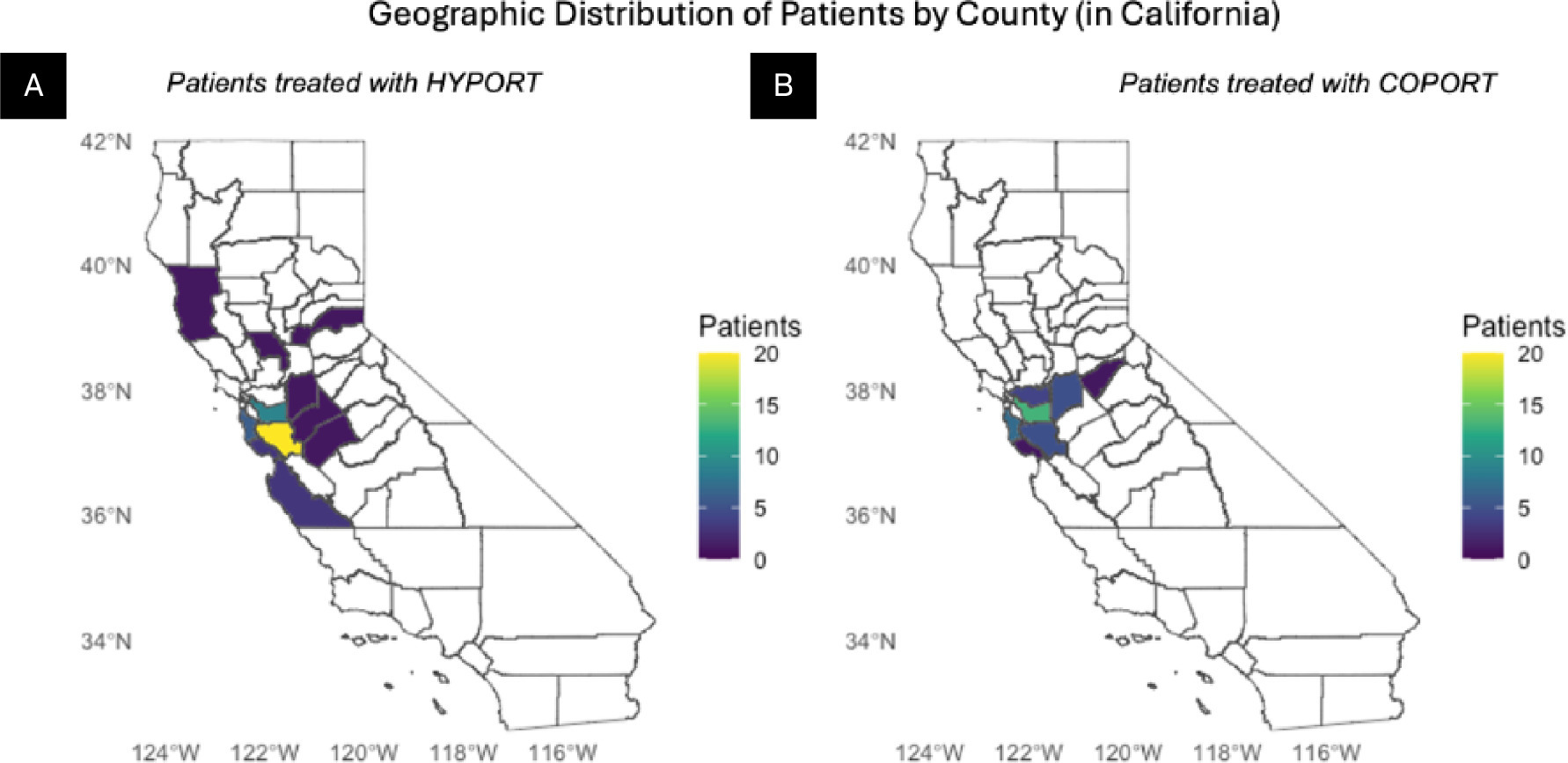
Patients treated on or after March 1, 2024, lived a mean (median, range) of 36.8 (22.8, 1.5-538.0) miles from the treating facility compared with 27.5 (19.4, 1.4-119.0) miles for patients treated before that date; this difference was not statistically significant (P = .517). When stratified by treatment regimen, patients receiving HYPORT lived farther from the treating facility than those receiving conventionally fractionated postprostatectomy radiation therapy (COPORT), with mean (median) travel distances of 43.2 (22.6) and 19.1 (17.3) miles, respectively (P = .04). However, this association did not remain significant after adjustment for treatment facility or after exclusion of patients residing outside the state, suggesting that the unadjusted finding was influenced by a small number of out-of-state patients. The geographic distribution of patient residences by county, stratified by treatment regimen (HYPORT vs COPORT), is shown in Figure 1.
Discussion
In this study, we examined changes in clinical practice for PPRT following the publication of NRG-GU003, focusing on treatment patterns, regimen selection, and geographic access. Of note, this study included patients who received either adjuvant or salvage RT, mirroring the patient cohort of NRG-GU003 and capturing a larger breadth of PPRT regimens. We observed a clear shift in practice beginning in March 2024, with increased adoption of HYPORT on both unadjusted and multivariable analyses. Importantly, this association remained significant and similar in magnitude after adjustment for treating physician, suggesting that the observed increase in HYPORT use was not solely attributable to differences in provider practice patterns.
While increased use of HYPORT after publication of NRG-GU003 may be expected, our analysis characterized early real-world implementation of HYPORT across a multisite radiation oncology network and evaluated whether this practice change was associated with differences in treatment delivery patterns and geographic reach. These findings may help contextualize how shorter-course regimens are incorporated into routine practice and whether they may reduce access-related barriers for patients who live farther from treatment facilities.
While not statistically significant, the numerical increase in patients treated with PPRT among this patient cohort contrasts with prior reports of decreasing use of PPRT (within 6 mo of surgery) from 2005 to 2011 for patients with adverse pathologic features, despite evidence from the SWOG Cancer Research Network and European Organisation for Research and Treatment of Cancer (EORTC) trials supporting improvements in relapse-free survival (RFS) and biochemical RFS with adjuvant RT.13-17 Similarly, Hoffman and colleagues demonstrated a significant association between later year of diagnosis and decrease in recommendations for PPRT in a SEER analysis of patients who underwent prostatectomy in 2000 to 2007.16 When year of diagnosis was analyzed as a dichotomized variable in the multivariable model, there was no difference in RT recommendations between the time periods before and after the SWOG and EORTC trials.
There are no prior reports in the post-prostatectomy literature that empirically link adoption of hypofractionated PPRT with the geographic reach of care. In our study, patients treated with HYPORT traveled a significantly greater distance for treatment than those treated with COPORT; however, this difference was not statistically significant after adjustment for treatment facility or in sensitivity analyses excluding out-of-state patients. This attenuation likely reflects the strong relationship between treatment facility and measured travel distance, as well as the influence of a small number of long-distance out-of-state patients in a modest cohort. Nevertheless, the logistical benefits of hypofractionation, including smaller time commitment, lower costs related to copayments, and fewer missed days from work, may lessen the obstacles many patients face when undergoing and coordinating RT. As a more convenient treatment schedule with fewer fractions may also alleviate the travel burden for patients, they may be more willing to seek care at facilities farther from home. Further prospective evaluation is warranted to determine whether HYPORT may mitigate travel-related barriers to PPRT, particularly for patients who live farther from treatment facilities.
This study carries several limitations. First, this was a retrospective analysis of patients treated at a single institution, limiting the generalizability of its findings. However, data were collected across 4 treatment facilities, which may lead to a more diverse patient population than that of a single-site institution. The total cohort size was limited, which reduced statistical power for subgroup analyses and for detecting differences in treated case volume and travel distance before vs after publication of NRG-GU003. The study also yielded wide confidence intervals in multivariable analyses; therefore, while the direction of the HYPORT adoption effect appeared robust, the precise magnitude of this association remains uncertain. Additionally, this study included only patients who received PPRT and did not include all patients who underwent radical prostatectomy or all patients referred for consideration of PPRT. Therefore, we were unable to evaluate overall PPRT utilization among all potentially eligible patients, and changes in the number of treated patients should be interpreted as changes in treated PPRT case volume within our radiation oncology cohort rather than population-level utilization. This study did not measure other variables, which may also have influenced the number of patients initiating HYPORT/PPRT, such as selection bias, evolving referral patterns, institutional growth, satellite expansion, centralization of care, and broader trends toward hypofractionation beyond NRG-GU003. The collection of additional data, such as patient-reported outcomes, socioeconomic status, and quality of life measures, would render a more comprehensive understanding of the potential impact of the establishment of hypofractionation on access to care.
Importantly, although our findings suggest that hypofractionation may help mitigate travel-related barriers, this study did not evaluate the full range of clinical, physician, and patient-level factors that inform fractionation selection. Long-term toxicity, disease control, baseline urinary function, comorbidities, and patient preference should also be considered. For example, one study of 161 consecutive patients treated with salvage hypofractionated PPRT, with a median follow-up of 13.5 years, reported late grade 3 to 5 toxicities in 44 patients (27.3%). Therefore, geographic access should be considered as one of several factors, rather than the sole determinant, when selecting a PPRT regimen.
Conclusion
This multisite study demonstrated a significant shift in clinical practice, with a greater proportion of hypofractionated regimens delivered after the publication of NRG-GU003 in March 2024. In addition, patients treated after March 2024 traveled numerically greater distances for treatment, warranting further study of whether shorter treatment courses may reduce logistical barriers. Multi-institutional studies with larger cohorts are needed to clarify the impact of hypofractionation on access to PPRT.
References
- Sargos P, Chabaud S, Latorzeff I. Adjuvant radiotherapy versus early salvage radiotherapy plus short-term androgen deprivation therapy in men with localised prostate cancer after radical prostatectomy (GETUG-AFU 17): a randomised, phase 3 trial. Lancet Oncol. 2020;21(10):1341-1352. doi:10.1016/S1470-2045(20)30454-X.
- Kneebone A, Fraser-Browne C, Duchesne G. Adjuvant radiotherapy versus early salvage radiotherapy following radical prostatectomy (TROG 08.03/ANZUP RAVES): a randomised, controlled, phase 3, non-inferiority trial. Lancet Oncol. 2020;21(10):1331-1340. doi:10.1016/S1470-2045(20)30456-3.
- Parker C, Clarke N, Cook A. Timing of radiotherapy after radical prostatectomy (RADICALS-RT): a randomised, controlled phase 3 trial. Lancet. 2020;396(10260):1413-1421. doi:10.1016/S0140-6736(20)31553-1.
- Vale C, Fisher D, Kneebone A. Adjuvant or early salvage radiotherapy for the treatment of localised and locally advanced prostate cancer: a prospectively planned systematic review and meta-analysis of aggregate data. Lancet. 2020;396(10260):1422-1431. doi:10.1016/S0140-6736(20)31952-8.
- Dirican C, Jumean S, Al Mardini A, Maroules M. Rural-urban variation in guideline-concordant management of early-stage kidney, prostate, and testicular cancer in the United States (2010-2022). Urol Oncol. 2026;44(6):189-196. doi:10.1016/j.urolonc.2026.111088.
- Shen X, Kane K, Katz A. Differences in rural versus urban patients with prostate cancer in diagnosis and treatment: an analysis of a population-based cohort. JCO Oncol Pract. 2024;20(8):1109-1114. doi:10.1200/OP.23.00547.
- Muralidhar V, Rose B, Chen Y, Nezolosky M, Nguyen P. Association between travel distance and choice of treatment for prostate cancer: does geography reduce patient choice?. Int J Radiat Oncol Biol Phys. 2016;96(2):313-317. doi:10.1016/j.ijrobp.2016.05.022.
- Zhou K, Renouf M, Perrocheau G. Cost-effectiveness of hypofractionated versus conventional radiotherapy in patients with intermediate-risk PROstate cancer: an ancillary study of the prostate fractionated irradiation trial - PROFIT. Radiother Oncol. 2022;173:306-312. doi:10.1016/j.radonc.2022.06.014.
- Patel T, Jain B, Vapiwala N. Trends in utilization and medicare spending on short-course radiation therapy for breast and prostate cancer: an episode-based analysis from 2015 to 2019. Int J Radiat Oncol Biol Phys. 2024;119(1):17-22. doi:10.1016/j.ijrobp.2023.11.043.
- He J, Wang Q, Hu Q, Li C. Cost-effectiveness analysis of ultra-hypofractionated radiotherapy and conventionally fractionated radiotherapy for intermediate- to high-risk localized prostate cancer. Front Oncol. 2022;12:841356. doi:10.3389/fonc.2022.841356.
- Yu J, Sun Y, Jia A. Increasing use of shorter-course radiotherapy for prostate cancer. JAMA Oncol. 2023;9(12):1696-1701. doi:10.1001/jamaoncol.2023.4267.
- Buyyounouski M, Pugh S, Chen R. Noninferiority of hypofractionated vs conventional postprostatectomy radiotherapy for genitourinary and gastrointestinal symptoms: the NRG-GU003 phase 3 randomized clinical trial. JAMA Oncol. 2024;10(5):584-591. doi:10.1001/jamaoncol.2023.7291.
- Bolla M, van Poppel H, Collette L. Postoperative radiotherapy after radical prostatectomy: a randomised controlled trial (EORTC trial 22911). Lancet. 2005;366(9485):572-578. doi:10.1016/S0140-6736(05)67101-2.
- Bolla M, van Poppel H, Tombal B. Postoperative radiotherapy after radical prostatectomy for high-risk prostate cancer: long-term results of a randomised controlled trial (EORTC trial 22911). Lancet. 2012;380(9858):2018-2027. doi:10.1016/S0140-6736(12)61253-7.
- Thompson I, Tangen C, Paradelo J. Adjuvant radiotherapy for pathological T3N0M0 prostate cancer significantly reduces risk of metastases and improves survival: long-term followup of a randomized clinical trial. J Urol. 2009;181(3):956-962. doi:10.1016/j.juro.2008.11.032.
- Hoffman K, Nguyen P, Chen M. Recommendations for post-prostatectomy radiation therapy in the united states before and after the presentation of randomized trials. J Urol. 2011;185(1):116-120. doi:10.1016/j.juro.2010.08.086.
- Swanson G, Thompson I, Tangen C. Phase III randomized study of adjuvant radiation therapy versus observation in patients with pathologic T3 prostate cancer (SWOG 8794). Int J Radiat Oncol Biol Phys. 2005;63. doi:10.1016/j.ijrobp.2005.07.007.
Disclosures
The authors have no conflicts of interest to disclose. None of the authors received outside funding for the production of this original manuscript and no part of this article has been previously published elsewhere.
Citation
. Practice Changes and Geographic Reach of Postprostatectomy Radiation Therapy After NRG-GU003. Applied Radiation Oncology. 2026;15(3). doi:10.37549/ARO-D-26-0010.