Radiation Oncology Coding for Medical Students: All You Ever Wanted to Know but Were Afraid to Ask
ARO Student Scan — Vol. 3 , Issue 2
DOI: 10.37549/RadOncOverview_Q2_2026
Published: June 1, 2026
Categories
Medical billing and coding is one area of medicine that remains mysterious and misunderstood for many practitioners, especially those at the beginning of their careers. 1 Medical students are rarely taught even the fundamentals of billing and coding until they are on rotations, in residency, or out in their first attending position. Rutgers is one institution beginning to include lectures on billing and coding in the preclinical phase, but since many institutions still do not have formal preclinical training on this, it is a challenge for students and residents when faced with these complexities for the first time. 2
If you have never delved into medical billing, you may be asking, “What are medical codes?”. Medical coding is the process of transforming every billable service into the alphanumeric codes that best describe the services rendered, along with an associated relative value. 3 This is the cornerstone of the medical billing process. They are not specialty-specific, so that anyone who provides the services described by the code can use them in their billing process. The way in which codes can be assigned a corresponding value is through relative value units (RVUs). 1 As described by Jahraus et al:
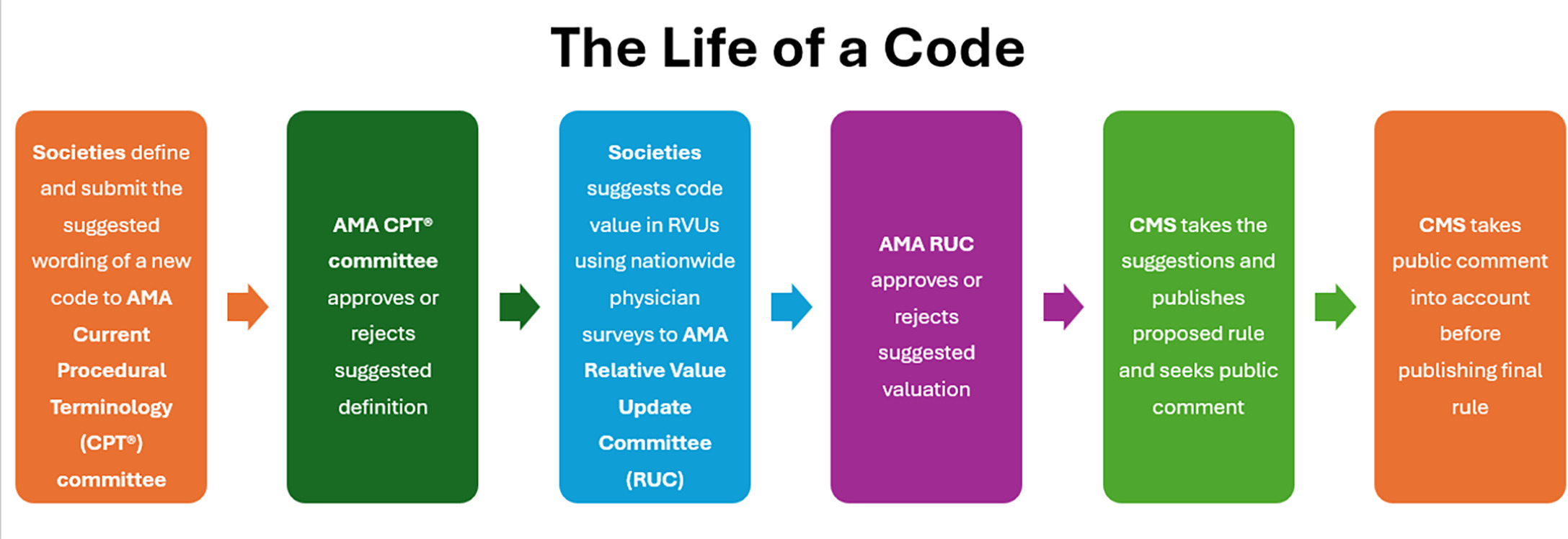
RVUs are converted to a dollar amount, based on a congressionally determined number called the “Conversion Factor.” 3 Medical codes are created, defined, and valued by a collaboration between many different groups, including input from specialty groups (such as the American Society for Radiation Oncology and the American College of Radiation Oncology in the field of radiation oncology), the Centers for Medicare and Medicaid Services, and the American Medical Association. They are evaluated and updated about every 5 years, and 2026 brought a major update to radiation therapy codes, as the existing codes were deemed “out of sync with contemporary practices.” 1 How a code comes into use is a complex process that is summarized in Figure 1.
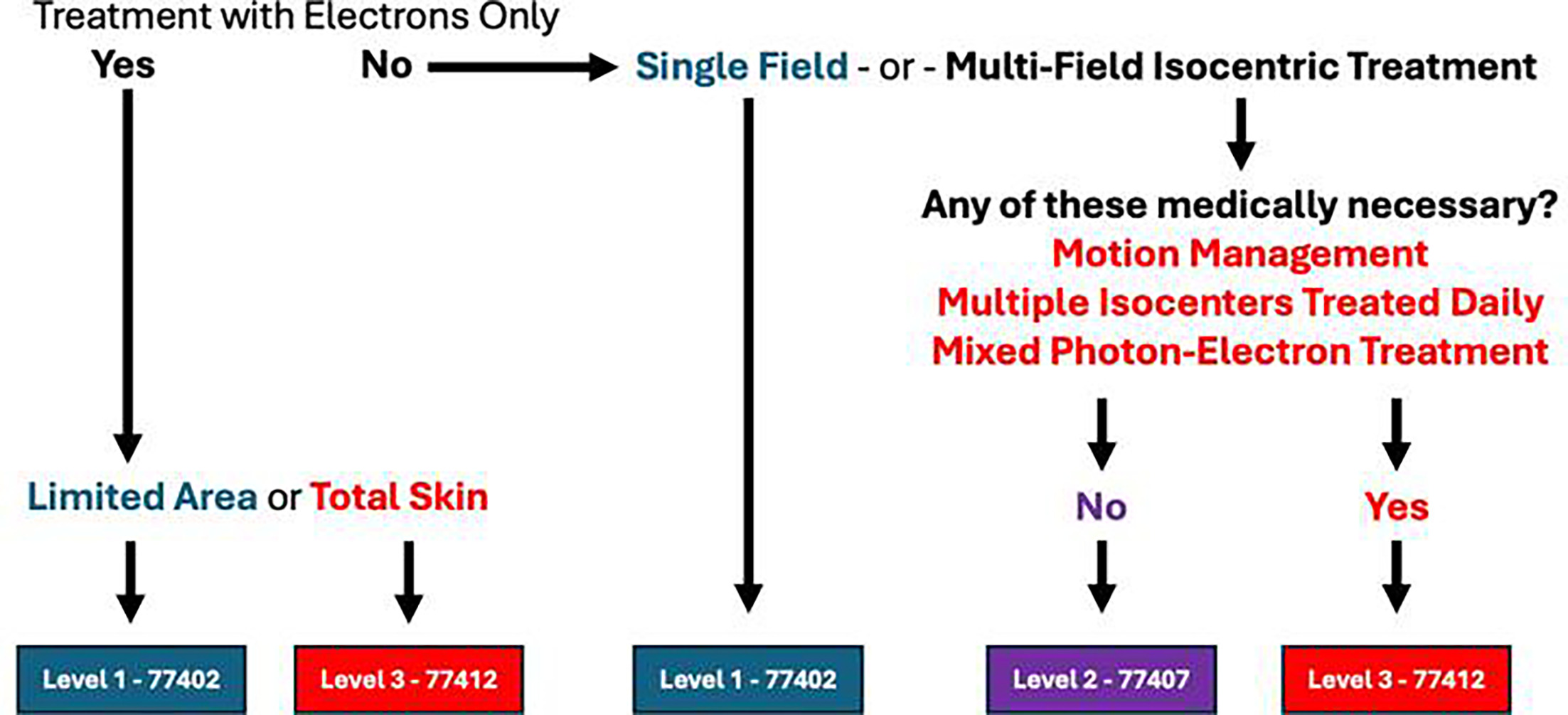
The new radiation oncology codes have been divided into a level system, created to stratify codes based on the amount of work and resources required for treatment planning and delivery, and therefore their reimbursement. The highest level of reimbursement (Level 3-77412) requires multifield isocentric treatment with 1 of 4 of the following: motion management, multiple isocenters treated daily, mixed photon-electron treatment, or total skin electron therapy. 1,4
Ultimately, the takeaway for medical students is simple. Physicians can substantially influence their future reimbursement by participating in the Relative Value Update Committee surveys. When asked to respond to a survey while practicing, take it seriously. Consider every little detail of what it takes to deliver the standard of care, including the parts in which every staff member is involved, not just the physician. In doing so, everyone is a critical part of keeping radiation oncology a sustainable, cutting-edge specialty in medicine (Figure 2). 1
References
- Jahraus C, Heron D, Thomas T. Making Sense of the 2026 Centers for Medicare and Medicaid Services (CMS) Radiation Oncology Treatment Delivery Codes: Historical Context and Practical Applications for Clinicians. Cureus;18(1). doi:10.7759/cureus.102412.
- Tran J, Cennimo D, Chen S, Altschuler E. Teaching Billing and Coding to Medical Students: A Pilot Study. Med Educ Online. 2013;18:10. doi:10.3402/meo.v18i0.21455.
- What is medical coding?.
- Oncology Centers “Struggling to Survive” After Reimbursement Changes. Oncology News Central. 2026.
Acknowledgments
The author would like to thank Dr Christopher Jahraus, MD, FASTRO, FACRO, for contributing a discussion on medical billing in radiation oncology to this article.
Citation
. Radiation Oncology Coding for Medical Students: All You Ever Wanted to Know but Were Afraid to Ask. ARO Student Scan. 2026;3(2). doi:10.37549/RadOncOverview_Q2_2026.