Rasmussen Aneurysm
Applied Radiology — Vol. 55 , Issue 5
Published: June 1, 2026
1 Department of Radiology, Baylor College of Medicine, Houston, Texas
2 Texas Tech University, Health Sciences Center, Lubbock, Texas
* Corresponding author: Kyler Shin (kyler.shin@bcm.edu)
Abstract
Tuberculosis (TB) is a major cause of mortality and morbidity worldwide, with provisional data suggesting a recent increase in case counts in the United States. Complications from pulmonary TB (PTB), including cavitation, bronchiectasis, pleural disease, and vascular abnormalities, can occur despite treatment and are associated with high mortality. A rare vascular complication is aneurysmal dilatation of the pulmonary artery, known as a Rasmussen aneurysm. Massive hemoptysis is a common manifestation with a high mortality rate that exceeds 5-25%. While most cases of PTB-associated hemoptysis arise from the bronchial circulation, hemoptysis due to a Rasmussen aneurysm stems from an affected pulmonary artery. Initial diagnosis relies on CT pulmonary angiography. Pulmonary artery angiography and embolization are required for treatment.
Keywords
rasmussen, tuberculosis, pseudoaneurysm, hemoptysis
Categories
Case Summary
An adult with a history of decompensated alcoholic cirrhosis complicated by hepatic encephalopathy and ascites, small esophageal varices, and recent admission for newly diagnosed active pulmonary tuberculosis (PTB) presented with multiple tablespoons of hemoptysis. The patient’s symptoms were accompanied by worsening abdominal distension. The patient reported coughing up a larger volume of blood than when initially diagnosed with TB. Laboratory evaluation revealed a hemoglobin of 8.4 g/dL, a prothrombin time (PT) of 25.5 seconds, an activated partial thromboplastin time of 37.6 seconds, and platelets of 103,000/µL.
Imaging Findings
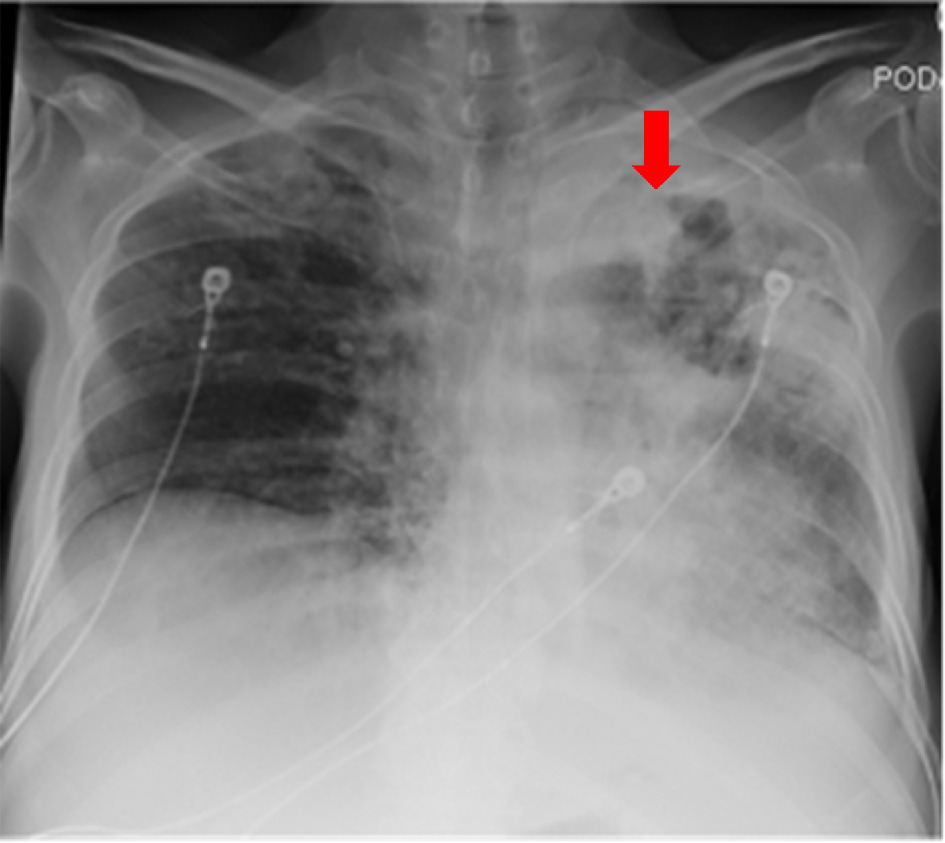
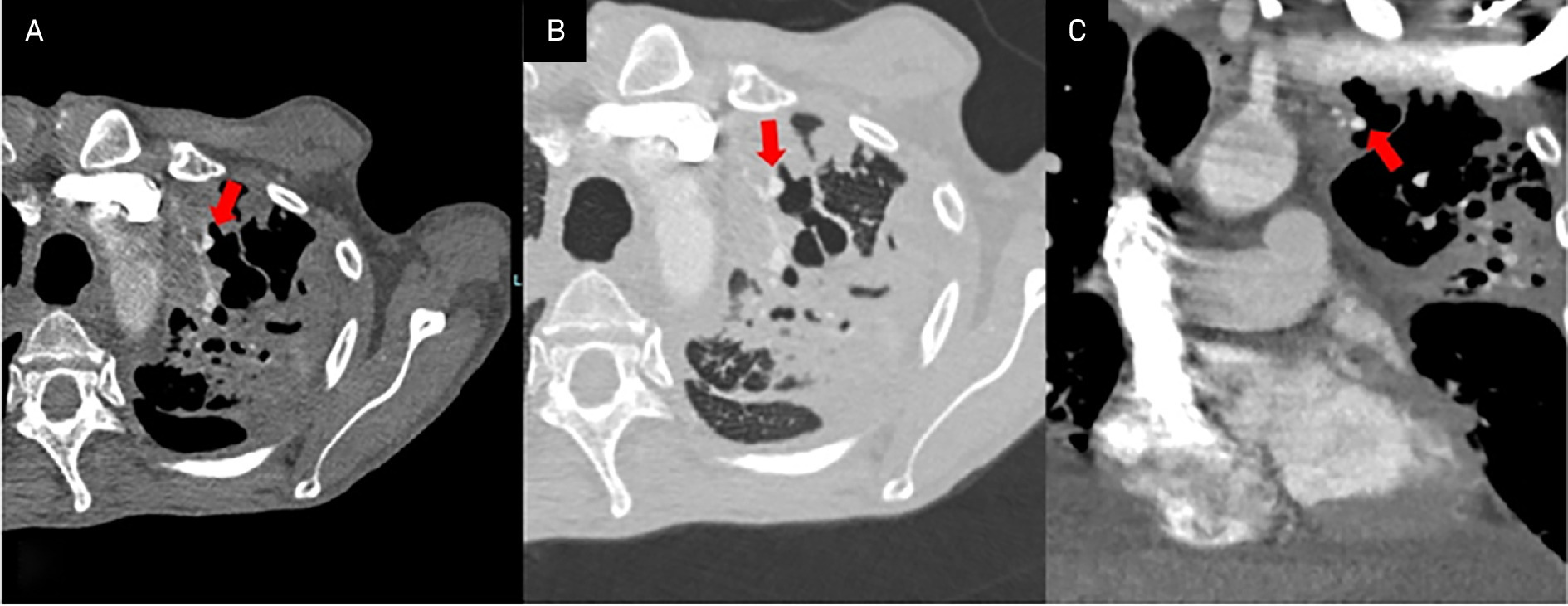
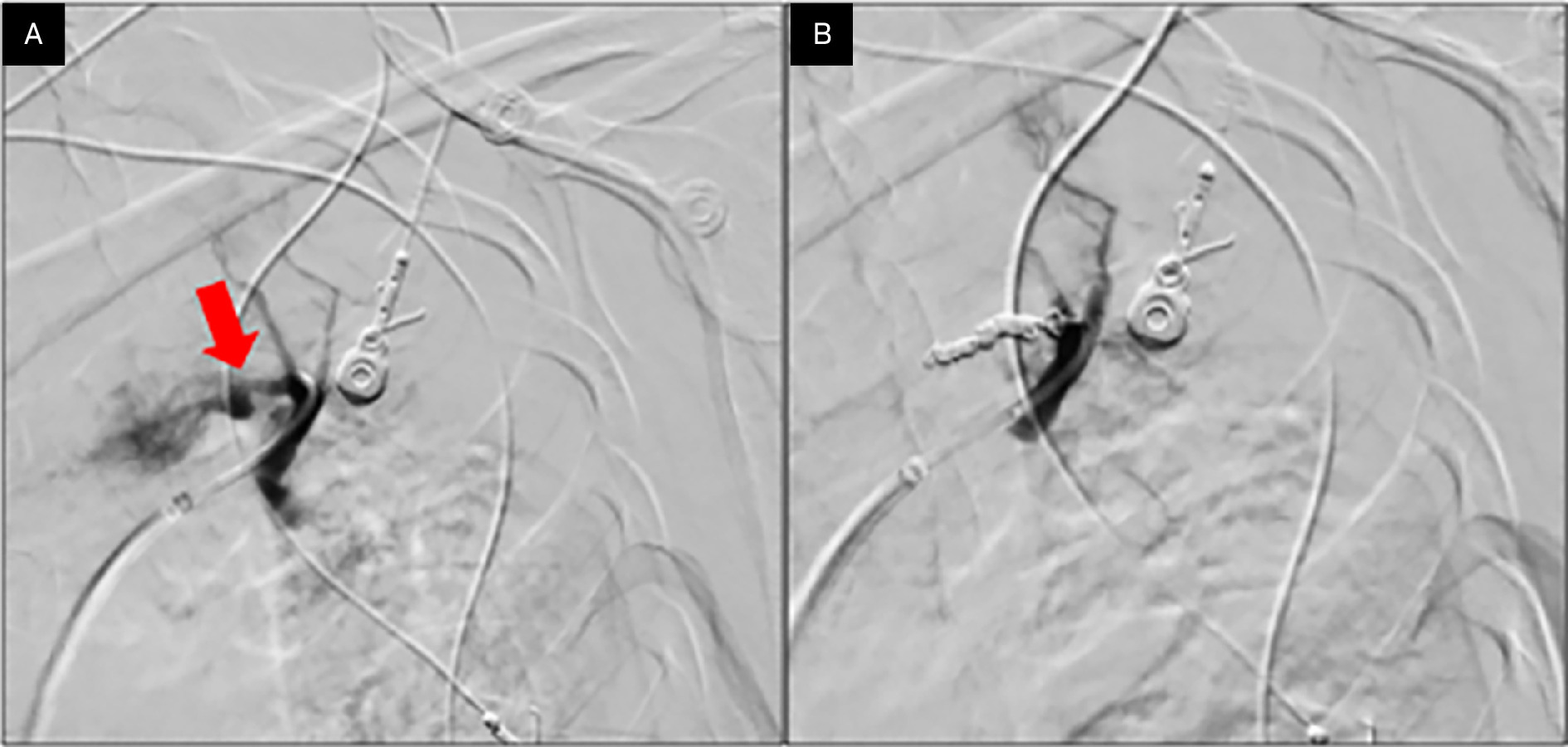
Chest radiography on admission (Figure 1) demonstrated diffuse multifocal airspace opacities throughout the left lung with an associated left apical cavitary lesion. Subsequent chest CTA performed in the pulmonary arterial phase (Figure 2) demonstrated a 0.6 × 0.5 cm saccular focal outpouching from the anterior segmental branch of the left upper lobe pulmonary artery adjacent to the left apical cavitary lesion, suspicious for a Rasmussen aneurysm. Follow-up CTA performed in the systemic arterial phase ruled out active arterial extravasation and excluded aneurysmal involvement of the surrounding bronchial arteries. The patient was referred for pulmonary angiography with coil embolization of the anterior segmental branch of the left upper lobe pulmonary artery just distal and proximal to the aneurysm (Figure 3), with subsequent resolution of hemoptysis.
Diagnosis
Rasmussen aneurysm.
Differential diagnosis in a patient with PTB and hemoptysis includes pulmonary embolism, bronchial artery hypertrophy/bronchiectasis, aspergilloma, and lung cancer.
Discussion
Rasmussen aneurysm is a rare but potentially life-threatening complication of PTB. Granulomatous inflammation from a cavitary tuberculous lesion results in caseous necrosis and mural thinning of the adjacent pulmonary arterial wall, leading to pseudoaneurysm formation.1-4 Rasmussen aneurysm formation has been described in approximately 5% of cases of PTB,4 with mortality rates as high as 50% in untreated patients due to rupture into the airway resulting in massive hemoptysis.5 Early diagnosis and treatment are essential to avoid morbidity and mortality.
Contrast-enhanced CT pulmonary angiography (CTPA) plays a crucial role in differentiating Rasmussen aneurysm from bronchial arterial hemorrhage as the source of hemoptysis, thus guiding further management. Typical CTA findings include an eccentric, nodular outpouching arising from a pulmonary artery with contrast opacification in the pulmonary arterial phase.4 Rakesh et al report that the source of hemorrhage was actually Rasmussen aneurysm in approximately 38% of patients with persistent hemoptysis following bronchial artery embolization.6
Treatment of a Rasmussen aneurysm is centered on endovascular embolization of the affected pulmonary artery.1 Coils, vascular plugs, n-butyl cyanoacrylate glue, and ethylene-vinyl alcohol copolymers are all effective in achieving hemostasis while preserving lung parenchyma.7,8 Surgery is rarely required and is reserved for patients with recurrent large-volume hemoptysis who have failed endovascular therapy. Effective management of hemoptysis in the setting of Rasmussen aneurysm relies on early detection with CTPA and consultation with diagnostic radiology, interventional radiology, and pulmonology to reduce morbidity and mortality.
Conclusion
Rasmussen aneurysm is a rare, life-threatening complication of PTB. Granulomatous inflammation from an adjacent tuberculous lesion results in thinning of the pulmonary arterial wall and pseudoaneurysm formation, with rupture leading to often-fatal, large-volume hemoptysis. Prompt diagnosis with CTPA and endovascular treatment are crucial in reducing morbidity and mortality.
References
- Leung A. Pulmonary tuberculosis: the essentials. Radiology. 1999;210(2):307-322. doi:10.1148/radiology.210.2.r99ja34307.
- Seedat U, Seedat F. Post-primary pulmonary TB haemoptysis - when there is more than meets the eye. Respir Med Case Rep. 2018;25:96-99. doi:10.1016/j.rmcr.2018.07.006.
- Iqbal S, Nassar M, Kondaveeti R. Massive hemoptysis in previously treated pulmonary tuberculosis: a case series. Cureus. 2022;14(8). doi:10.7759/cureus.27882.
- Kim H, Song K, Goo J. Thoracic sequelae and complications of tuberculosis. Radiographics. 2001;21(4):839-860. doi:10.1148/radiographics.21.4.g01jl06839.
- Sanaa H, Souad N, Merzem A. Rasmussen’s aneurysm: a rare cause of massive hemoptysis in pulmonary tuberculosis. SAS J Med. 2024;10(10):1282-1284. doi:10.36347/sasjm.2024.v10i10.053.
- Rakesh S, Gagan S, Arvind K. Rasmussen’s aneurysm: a rare and forgotten cause of hemoptysis. Indian Heart J. 2015;63:53-56.
- Farooqi W, Alosaimi N, Alsenaidi S, Almalik A, Alosaimi E. Massive hemoptysis secondary to Rasmussen’s aneurysm in a patient with active pulmonary tuberculosis: a case report. Cureus. 2025;17(12). doi:10.7759/cureus.99117.
- Martin-Champetier A, Di Bisceglie M, Ravaud S, Soussan J, Habert P. Successful embolization of a rasmussen aneurysm perfused by an intercostal artery using ethylene-vinyl alcohol copolymer. J Vasc Interv Radiol. 2023;34(6):1098-1100. doi:10.1016/j.jvir.2023.01.025.
Disclosures
The authors have no conflicts of interest to disclose. None of the authors received outside funding for the production of this original manuscript and no part of this article has been previously published elsewhere.
Citation
. Rasmussen Aneurysm. Applied Radiology. 2026;55(5). doi:10.37549/AR-D-26-0007.