RCOM RADIOLOGICAL CASE OF THE MONTH
Applied Radiology — Vol. 31 , Issue 6 , pp. 35 -36
DOI: 10.37549/AR1096
Published: June 1, 2002
Categories
CASE SUMMARY
A 29-year-old woman with relapsing acute promyelocytic leukemia was placed on all-trans retinoic acid (90 mg PO per day) after being admitted to the hospital with worsening neutropenia and thrombocytopenia. Nine days after initiation of therapy she developed subconjunctival hemorrhages, headache, mild chills, and a temperature of 101° F. Total leukocyte count was 37.4 × 10⁴/μL. Initial leukocyte count was 7.09 × 10⁴/μL prior to onset of therapy. A blood gas was drawn, PO2 was 36. Dermatologic exam was positive for papular hemorrhagic lesions on the arms, chest and back. A chest X-ray was obtained and the patient was started on ceftazadime, vancomycin, and erythromycin for broad-spectrum antibiotic coverage. She was also placed on acyclovir for possible disseminated herpes zoster. Repeat chest films were obtained (Figure 1). Respiratory status continued to deteriorate. Biopsy of the skin lesions showed hemorrhage and infiltration by maturing myeloid cells. All antibiotics were discontinued and the patient was started on decadron. Skin lesions resolved and follow-up chest radiographs showed resolution of the bilateral infiltrates. Oxygen requirements began to decrease, and the patient was discharged 7 days after initiation of steroid therapy.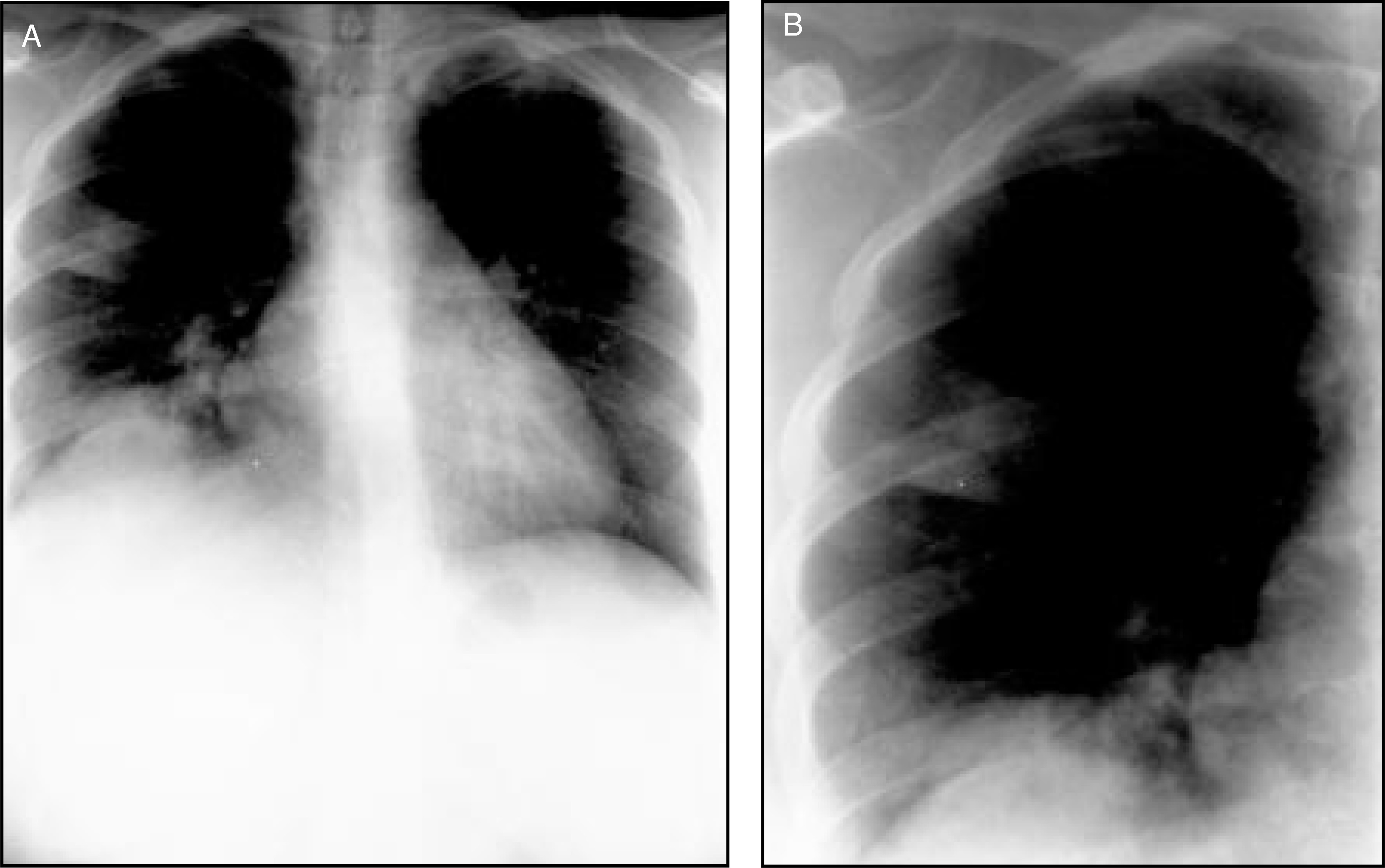
DIAGNOSIS
Retinoic acid syndrome
IMAGING FINDINGS
An initial chest radiograph showed patchy right upper lobe airspace density. Follow-up radiographs revealed worsening airspace density in the right upper lobe and new airspace density in the right lower lobe with associated perihilar interstitial density (Figure 1). Differential diagnosis includes alveolar/interstitial pulmonary edema and infectious pneumonia.
DISCUSSION
Acute promyelocytic leukemia is a form of acute myelogenous leukemia. Until the advent of all-trans-retinoic acid in the 1980s, it was a rapidly fatal disease, with most patients dying of hemorrhagic complications or disease or relapse. All-trans-retinoic acid is used to induce remission in patients with promyelocytic leukemia.1-3 It causes leukemic cells to differentiate into mature myeloid elements.2,3 This causes the patient’s peripheral neutrophil count to rise transiently. Most patients tolerate this transient increase in neutrophil count well. Retinoic acid syndrome can complicate therapy.4-5 This syndrome consists of fever, respiratory distress, lower extremity edema, pleural or pericardial effusions, and pulmonary infiltrates. The syndrome develops 2 to 21 days after initiation of therapy in patients treated with retinoic acid. The occurrence of the syndrome is associated with the peak value of the peripheral blood leukocyte count. Respiratory distress develops in up to 89% of the patients. The most common findings on chest radiographs consist of pleural effusions and pulmonary interstitial infiltrates. Alveolar hemorrhage and pulmonary capillaritis have also been described, and may have contributed to the focal densities seen in our patient.6 In many cases, symptoms were initially attributable to infectious pneumonia or congestive heart failure. Postmortem evaluations revealed pulmonary interstitial infiltration with mature myeloid cells. Patients also developed transient leukocytosis. The cause of the syndrome is not known, but it may be due to increased capillary permeability, which has been seen with the administration of cytokines such as interleukin.7 Retinoic acid up regulates the expression of integrin, which is known to play a role in adherence of leukocytes to vascular endothelium, and may stimulate leukocyte migration (though the myeloid cells derived from retinoic acid therapy are usually described as nonfunctional). Promyelocytic leukemia is associated with a translocation which places the promyelocytic leukemia gene (PML) next to a gene that encodes for retinoic acid receptor alpha (RARA) on chromosome 17. The altered retinoic acid receptor may block the expression of retinoic acid target genes involved in granulocyte differentiation, adherence, and migration.
Patients have been treated with high-dose corticosteroids (dexamethasone 10-mg IV q 12 hours) with symptomatic relief and full recovery.4,5 It is believed the steroids impair the leukocytes’ ability to adhere to capillary endothelium and also the ability of cells to migrate into tissues. Dexamethasone also inhibits cytokines that cause increased capillary permeability.
References
- Huang M, Ye Y, Chen J. Use of all-retinoic acid in the treatment of acute promyelocytic leukemia trans. Blood. 1988:567-572.
- De Botton S, Dombret H, Sanz M. Incidence, clinical features, and outcome of all trans-retinoic acid syndrome in 413 cases of newly diagnosed acute promyelocytic leukemia. The European APL Group. Blood. 1998;92:2712-2718.
- Castaigne S, Chomienne C, Daniel M. All-trans retinoic acid as a differentiation therapy for acute promyelocytic leukemia. Initial clinical results. Blood. 1990;76:1704-1709.
- Warrell R, Frankel S, Miller W. Differentiation therapy for acute promyelocytic leukemia with tretinoin (all-trans retinoic acid). N Engl J Med. 1991;324:1385-1393.
- Frankel S, Weiss M, Warrell R. A “retinoic acid syndrome” in acute promyelocytic leukemia: Reversal by corticosteroids. Blood. 1991;78(Suppl):380a.
- Frankel S, Eardley A, Lauwers G. The “retinoic acid syndrome” in acute promyelocytic leukemia. Ann Intern Med. 1992;117:292-296.
- Nicolls M, Terada L, Tuder R. Diffuse alveolar hemorrhage with underlying pulmonary capillaritis in the retinoic acid syndrome. Am J Respir Crit Care Med. 1998;158:1302-1305.
- Vetto J, Papa M, Lotze M. Reduction of toxicity of interleukin-2 and lymphokine-activated killer cells in humans by administration of corticosteroids. J Clin Oncol. 1987;5:496-503.
- . 2000.
Citation
. RCOM RADIOLOGICAL CASE OF THE MONTH. Applied Radiology. 2002;31(6):35-36. doi:10.37549/AR1096.