Snowboarder’s fracture
Applied Radiology — Vol. 37 , Issue 4 , pp. 45 -46
DOI: 10.37549/AR1600
Published: April 1, 2008
Categories
CASE SUMMARY
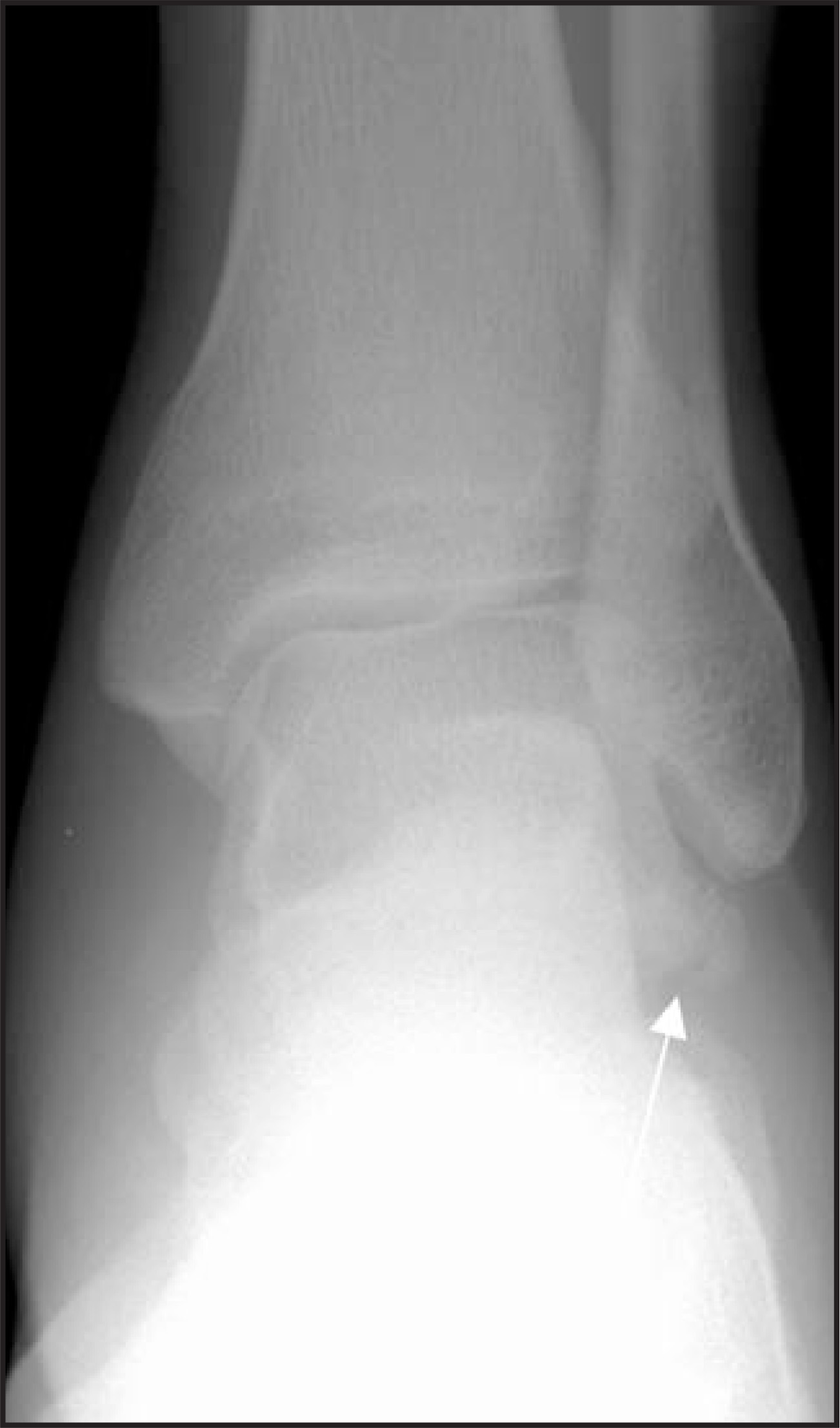
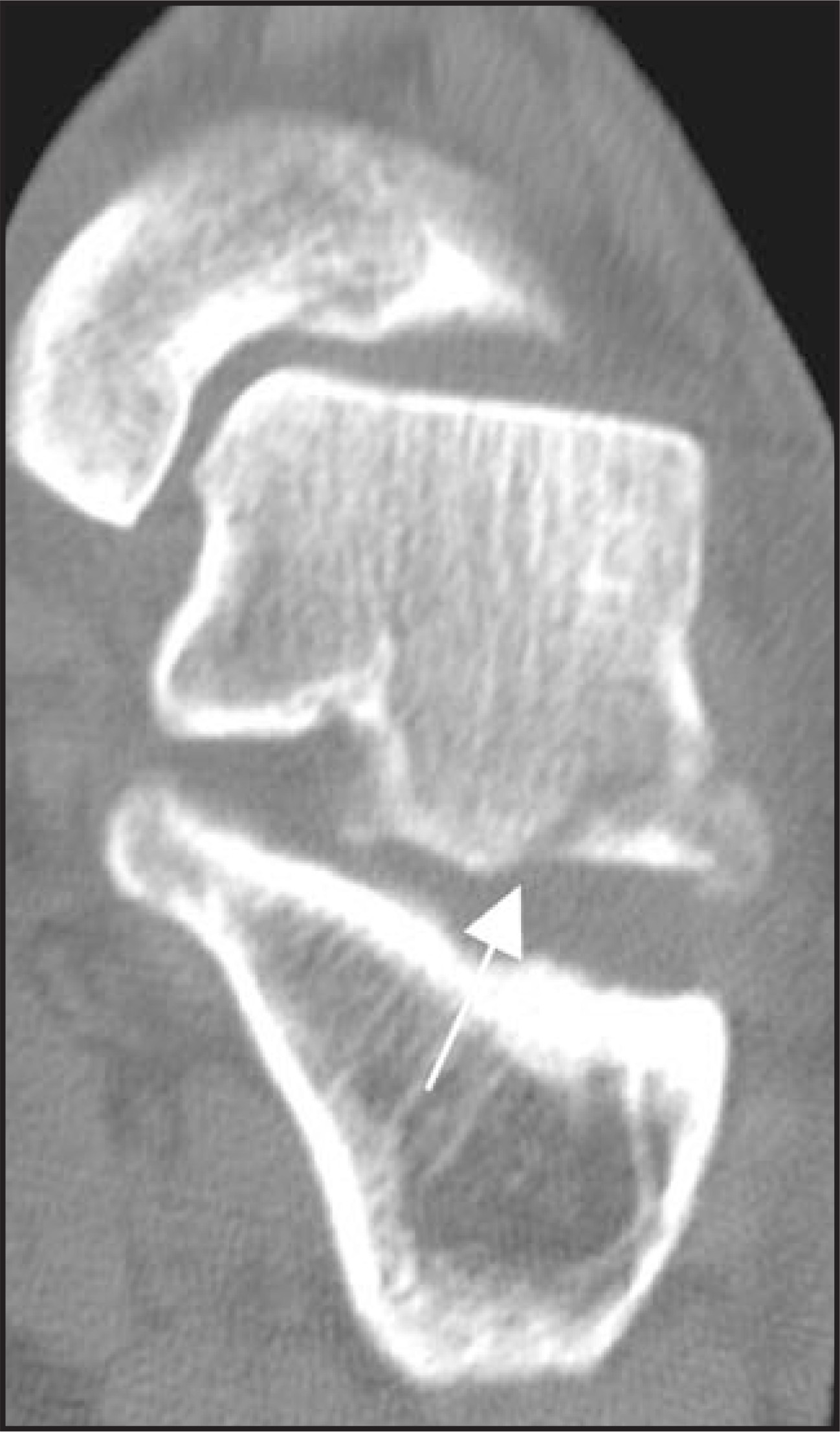
A 28-year-old man presented to the emergency department complaining of acute left ankle pain. The patient relayed a history of trauma to the ankle during physical training but was unable to describe the position of his foot at the time of injury. Physical examination revealed point tenderness over the lateral aspect of the ankle without associated swelling or erythema. Conventional radiography of the ankle (Figure 1) showed an abnormality that was further evaluated with ankle computed tomography (CT) (Figure 2).
IMAGING FINDINGS
Conventional radiographic evaluation of the ankle showed a subtle fracture of the lateral process of the talus. An ankle CT, ordered to evaluate the extent of osseous injury, revealed extension of the fracture to involve a small portion of the inferolateral articular surface.
DIAGNOSIS
Fracture of the lateral process of the talus (snowboarder’s fracture)
DISCUSSION
The lateral process of the talus is a large, wedge-shaped osseous projection that extends laterally from the body of the talus. Its inferolateral surface comprises a portion of the posterior facet of the talocalcaneal joint, while its superolateral surface articulates with the lateral malleolus.1 Its functions include lateral stabilization of the ankle, weight bearing by means of its articulation with the fibula, and subtalar motion. The lateral process of the talus is aided by the lateral talocalcaneal ligament that extends between it and the calcaneus.2 During ankle inversion, contact at the posterior talocalcaneal joint is maintained by the lateral process. With concurrent dorsiflexion, increased forces transmitted via the fibula can lead to fracture.1 This entity has been recognized as a cause of acute ankle pain in the younger population as the sport of snowboarding has increased in popularity.3 This activity routinely requires landing with the feet oriented in a vulnerable position, making this fracture a common hazard to snowboarders.2,4 Approximately 40% of lateral talar process fractures are improperly diagnosed at initial presentation.3 Individuals typically present with acute onset of pain over the anterolateral ankle, with varying degrees of swelling. Pinpoint tenderness is typically localized over the lateral process. Radiographic findings are subtle, with the lateral view providing the best visualization of the lateral process. When radiographs are negative and clinical suspicion remains high, ankle CT—optimally with coronal and sagittal reformations—is the definitive diagnostic study.
Failure to diagnose and properly treat a fracture of the lateral process of the talus can result in long-term disability caused by subtalar arthrosis, mal-union, or nonunion.5 These fractures have been classified into 3 types by Hawkins,3 with treatment based accordingly. Type I is a simple fracture that extends from the articular surface of the posterior talocalcaneal joint space to the talofibular articular surface (as observed in the case reported here) and can be treated with casting; internal fixation is usually reserved for fragments >1 cm or fragment displacement ≥2 mm. Type II is a comminuted fracture of the lateral process. Smaller fragments should be excised while the larger component is reduced and fixed internally to decrease the likelihood of future instability and persistent symptomatology. Type III is a chip fracture on the anteroinferior portion of the lateral process that is limited to the subtalar joint; this type may be treated conservatively or surgically, depending upon the severity of the injury.3
CONCLUSION
Fractures of the lateral process of the talus are infrequent but may be a significant source of acute ankle pain, particularly in the adolescent and young adult population whose growing participation in the sport of snowboarding puts them at particular risk for this inversion-dorsiflexion injury. Often misdiagnosed as a severe lateral ankle sprain, failure to recognize and treat this entity early can result in significant morbidity in otherwise healthy young adults. Essential to the diagnosis are an elevated index of suspicion in the proper clinical presentation with a thorough radiographic evaluation, including CT ankle evaluation if radiographs are equivocal or only suggestive and clinical suspicion of a fracture remains.
References
- Leibner E, Simanovsky N, Abu-Sneinah K. Fractures of the lateral process of the talus in children. J Pediatr Orthop B. 2001;10:68-72.
- Cantrell M, Tarquinio T. Fracture of the lateral process of the talus. Orthopedics. 2000;23:55-58.
- Hawkins L. Fracture of the lateral process of the talus. J Bone Joint Surg Am. 1965;47:1170-1175.
- Mills H, Horne G. Fractures of the lateral process of the talus. Aust N Z J Surg. 1987;57:643-646.
- Boon A, Smith J, Zobitz M, Amrami K. Snowboarder’s talus fracture: Mechanism of injury. Am J Sports Med. 2001;29:333-338.
Citation
. Snowboarder’s fracture. Applied Radiology. 2008;37(4):45-46. doi:10.37549/AR1600.