The “fuzzy” line
Applied Radiology — Vol. 37 , Issue 8 , pp. 6 -8
DOI: 10.37549/AR1635
Published: August 1, 2008
Categories

Within a year or two of starting my residency in our specialty, it was pretty clear what the life of an academic radiologist was like. The faculty arrived roughly 8 to 9 a.m., spent a lot of time in their offices, no doubt thinking deep scientific thoughts, or attending meetings outside the department in some really nice places. Usually they had time to go to lunch outside the department, often to the “world famous” Lexington market 2 blocks away for good, inexpensive, international cuisine. By 4 p.m. one could fire a cannon ball down the center of the department without fear of hitting anyone. A resident covered the house evenings, nights, and weekends (we ran a half-day schedule Saturday morning) and checked out at 7 a.m. the next morning. The Vascular and Neuroradiology faculty were on call, but most cases were handled by the on-call resident and the faculty could cruise in, verify the resident‘s diagnosis, and zip out. Some faculty never even took their coats off. Reviewing cases with clinicians happened at the convenience of the radiologist. Yes, one still had to write papers and teach, but neither seemed so onerous. To a young resident, this seemed a pretty idyllic life style. Of course, you made less income than private practice, but as far as I could tell, the faculty appeared to be doing just fine financially.
Of course, I needed to moonlight in the real world and do some “locums” to try out the path most graduates chose. Clearly, you had to work hard and fast. There was no time for long discussions about esoteric topics. Lunch was a sandwich and soda at the alternator. Clinicians ruled, and you did what they wanted happily and made yourself available whenever for consultation. There did not seem to be much interdepartment rivalry, and everyone was pulling in the same direction—ie, figure out what’s wrong, treat the patients, and get them home or wherever. The income was very good, even for a lowly moonlighter, and there seemed to be genuine camaraderie among the radiology group members. The major problem for me was I could not wait for the whistle to blow at 5 o’clock to zip down the dinosaur’s back like Fred Flintstone.
The line between the 2 worlds was very distinct. Now, it’s 25 years later and the line has gotten fuzzy.
In my department, at least one section attending is expected to be physically in their reading area at all times. We are totally customer (patient and referring physician) oriented. The referring physicians get consultations whenever needed, and we are usually happy to do whatever studies they request, although we try to talk them out of anything that is really contraindicated and offer better choices. The house is covered 24/7 by attending radiologists, and attendings covering after daytime hours act as much as residents as our residents do in performing their duties. No procedure is even started without an attending in the room. As is increasingly common among academic radiology departments, our department has taken over other radiology departments in area hospitals that our medical system has acquired. Also, we have acquired other departments, outside our hospital system, from which private groups have left because of insufficient staffing or to move to “greener pastures.” We are always on the lookout for new opportunities to increase revenue. We do this to be able to add new staff, fund research, offer competitive salaries, and acquire a “rainy day” fund, among other goals.
Today, few of us can spend a lot of time thinking deep thoughts in our offices, and research time is provided as available (but is certainly notplentiful). Publications, teaching, and administrative duties are all still required. For many of us, the line between the private and academic practice worlds has become fuzzy indeed. There is now a lot of overlap. Some of the senior staff still wish to return to the old days of the “classic” academic radiologist, the one whom the clinicians made fun of for their easy life style (driven by some jealousy, no doubt). Some really chafe at the new work paradigm. Unfortunately, reality rears its ugly head and pushes noses to the grindstone, like it or not.
P.S. I still sneak out to lunch, now and again, armed with a pager and a cell phone. Even for an emergency radiologist, there are few true emergencies, and it does a lot to boost my morale. Please don’t rat me out.
Erratum
Erratum to: Casey S. Workflow and 8 pitfalls that can impair a practice’s efficiency. Appl Radiol. 2008;37(July Suppl):1-5.
In the July supplement article by Sean Casey, MD, “Workflow and 8 pitfalls that can impair a practice’s efficiency,” the graphs shown as Figures 1 and 2 were reversed. The editorial staff of Applied Radiology sincerely regrets this error. The figures and legends should have appeared as shown below.
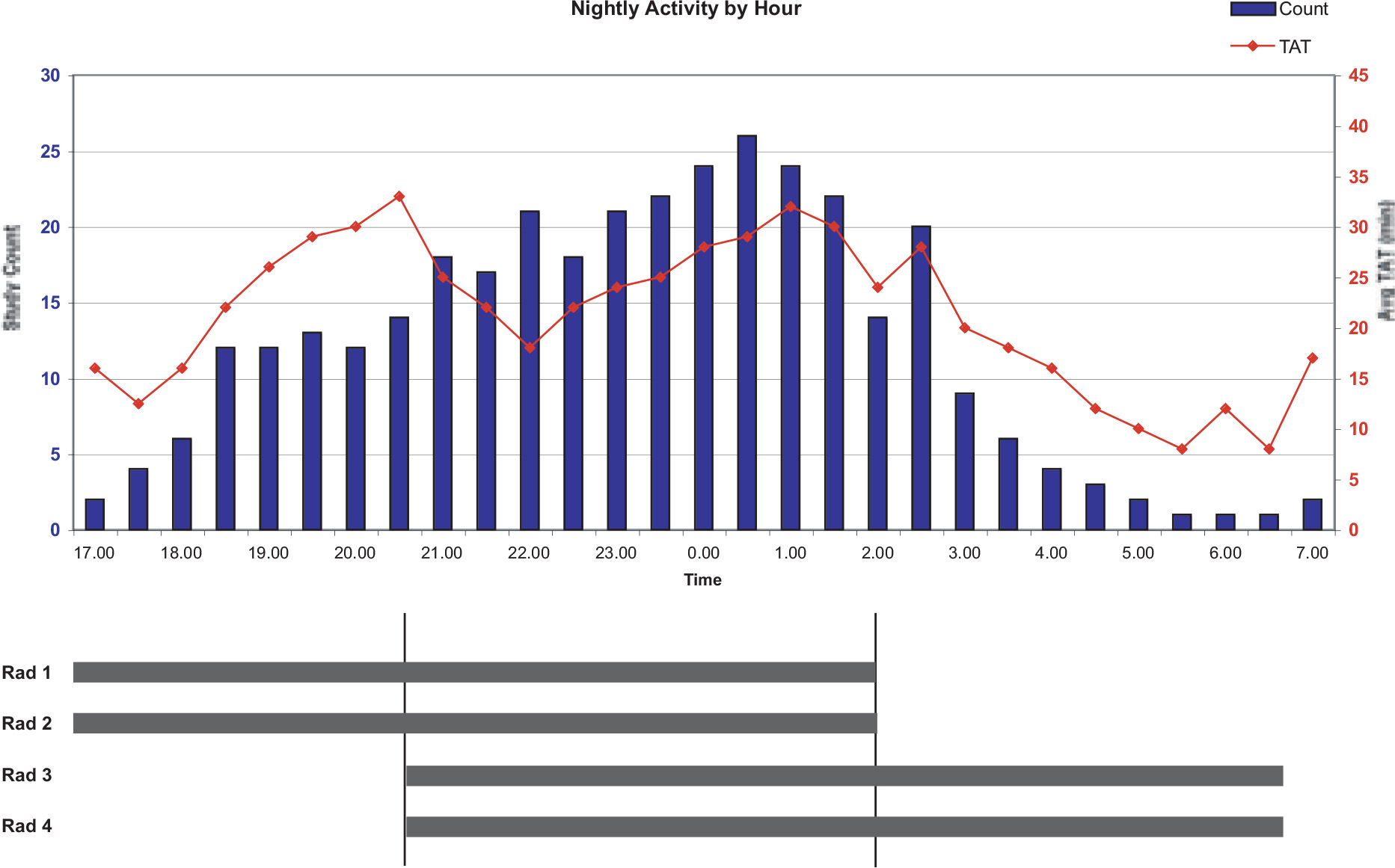
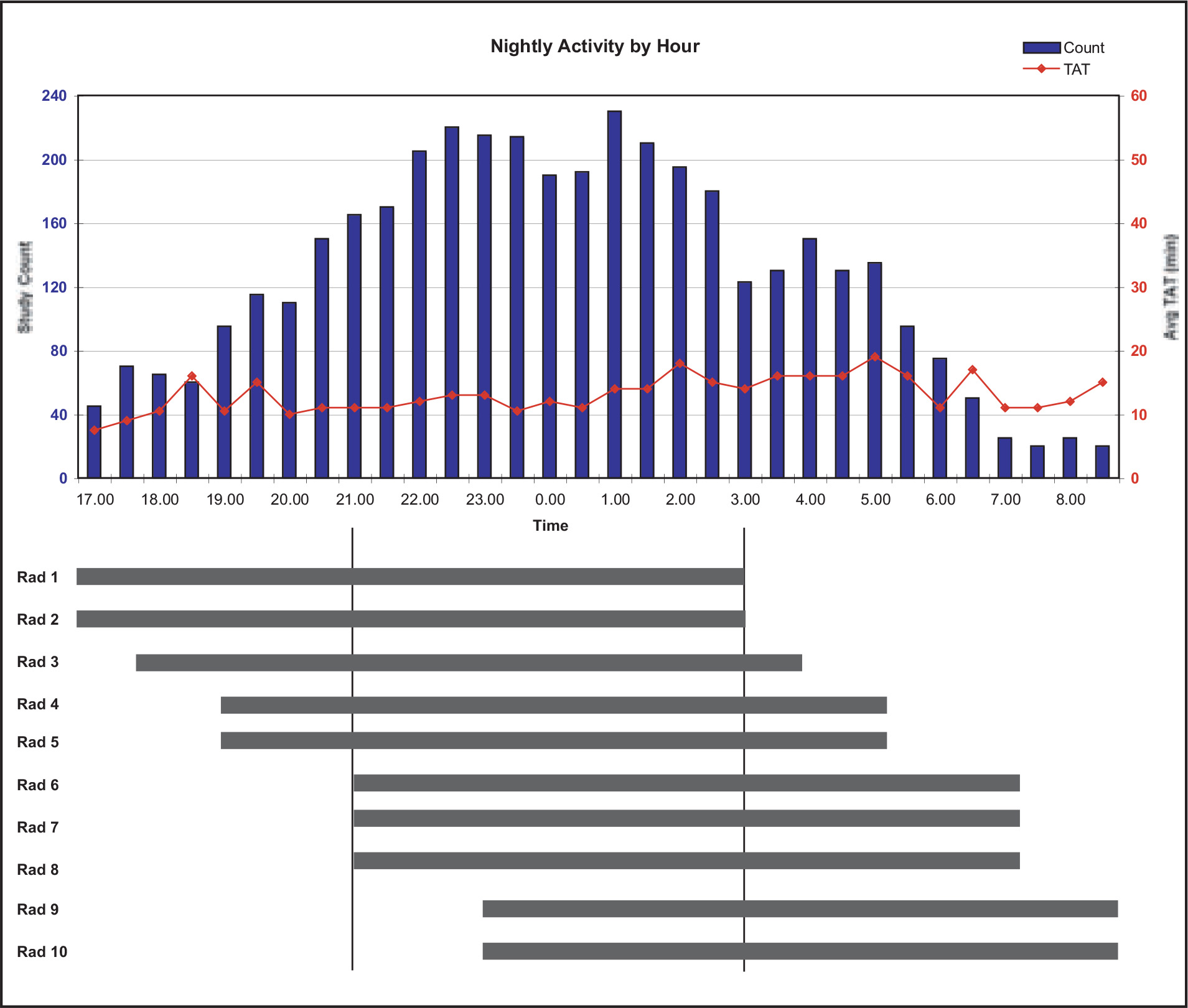
The corrected article is available online in its entirety in a CME program at appliedradiology.org and at appliedradiology.com.
Citation
. The “fuzzy” line. Applied Radiology. 2008;37(8):6-8. doi:10.37549/AR1635.