The Growing Demand for Lung CT Screening
Applied Radiology — Vol. 55 , Issue 3
Published: November 26, 2025
Categories
The demand for low-dose CT (LDCT) screening scans has increased steadily since 2021, when the US Preventive Services Task Force (USPSTF) broadened lung cancer screening eligibility criteria, lowering the recommended age from 55 to 50 years and pack-year smoking history from 30 to 20 years. 1 Still, screening volumes have significant room to grow due to education and access disparities across various demographics.
“We estimate that about 15.3 million people in the United States are eligible for screening, and roughly [only] 16% of them get screened. We’d like to get a lot more,” says Lary Robinson, MD, director of the Lung Cancer Early Detection Center for Moffitt Cancer Center in Tampa, Florida, who points out that lung cancer is the leading cause of cancer deaths in the United States 2 . “An estimated 80,000 lives could be saved per year if every eligible person were screened, because you’d find the cancer [which has no symptoms] at a curable and early stage.”
Treating early stage lung cancer, identified through screening, yields both better clinical outcomes and lower costs, and LDCT is the only proven way to find early stage lung cancer and improve cure rates, according to Dr. Robinson. Despite screening program growth across the United States, including the incorporation of mobile CT units, limited public awareness of lung cancer screening—and the nuanced eligibility guidelines that determine insurance coverage—has hindered widespread uptake of task force recommendations.
Screening Education and Eligibility
Overcoming awareness barriers requires both primary care providers and public education of lung screening as an effective, early detection tool for at-risk people. Researchers who studied perceived barriers to LDCT screenings found that 40% of patients were simply unaware of lung cancer screening 3 —no one ever talked to them about it, Dr. Robinson says.
“There’s a real problem with awareness, so we’re working on trying to educate people,” he explains, describing lung cancer screening as “the new kid on the block” for both potential screening patients and primary care providers who must get on board with recommending it.
Specialty organizations, including the American College of Chest Physicians, the American Lung Association, the American Thoracic Society, the President’s Cancer Panel, and the American College of Radiology, provide a variety of frameworks, resources, and recommendations in tandem with initiatives to promote lung screening benefits and shared decision-making for patients. While campaigns are moving the needle in the right direction, it is taking time to translate knowledge into action.
“Where we are with lung cancer screening is where we were with mammography screening 20 to 30 years ago,” says Tina M. Sowers, FACHE, administrator of the thoracic service line at The James, The Ohio State University Comprehensive Cancer Center in Columbus, noting that mammography was not widely accepted or discussed much prior to a highly successful awareness campaign. “Like mammography, the more education we get out, the more awareness there is for people, the more we will see the demand for lung CT grow.”
Today, about 75-80% of eligible women are up to date with breast cancer screening, 4 a stark contrast to the 16% of eligible people who have gone for their lung screen. Insurance eligibility requirements founded on USPSTF recommendations are much simpler for mammograms, says Dr. Robinson, while LDCT requirements for specific groups leave many people uncertain about how their specific smoking history factors into the determination for a covered exam.
“With current reimbursement policy, if someone has stopped smoking for over 15 years, they are no longer eligible for screening,” says Douglas Wood, MD, chair of surgery at the University of Washington in Seattle and chair of the Lung Cancer Screening Guidelines for the National Comprehensive Cancer Network (NCCN). He adds that barriers to better screening uptake include complex eligibility requirements and restrictions that some argue are unjustified. “This limitation is not justified by the data we know about lung cancer risk, and it also paradoxically gives individuals an incentive to resume smoking if they want to qualify to receive lung cancer screening in the future. That is just poor policy.”
Dr. Wood also notes that NCCN guidelines have simplified the inclusion criteria for screening, using smoking duration [20 years] as an alternative to pack-years. “Recent research shows that smoking duration is easier to calculate, more accurately identifies individuals at risk of getting lung cancer, and lowers disparities of access to lung cancer screening due to a clearer understanding of inclusion guidelines.”
For people who don’t meet smoking duration or pack-year history criteria but have concerns for their health or non-smoking-related familial risks, they can seek the exam out-of-pocket, says Dr. Robinson, whose institution provides screening LDCTs at cost for $189 to ensure “people can get screened if they want to,” he says.
Meeting Demand with Mobile Screening
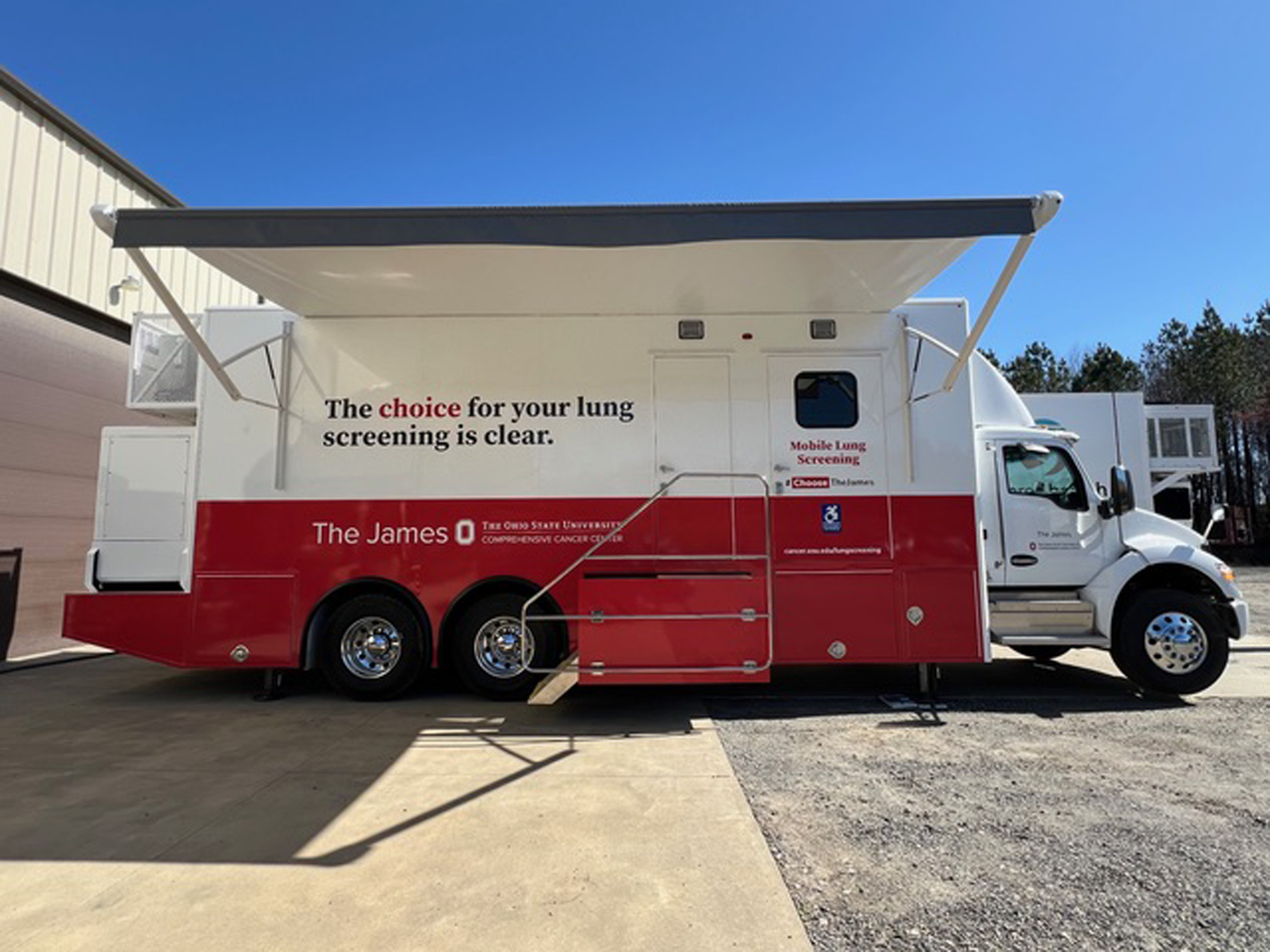
In response to access barriers, mobile screening programs—complemented by educational campaigns that spread awareness of early detection to people who have smoked cigarettes—are popping up nationwide to bring cancer prevention efforts to underserved areas.
Sowers said her institution has recently invested in mobile lung CT screening to increase rural access for eligible adults. As awareness of screening for lung cancer grows, it becomes critical to “meet people where they are,” she says, referring both to logistical considerations and an effective communication approach.
“Our goal is to … make it easy and convenient for [patients] to have their lung cancer screening,” Sowers says, noting that Ohio’s mobile unit is closing gaps in nine rural counties that do not have any health care facilities, giving them “the ability to serve populations where the incidence of lung cancer is higher.”
The James has successfully partnered with community cancer prevention coalitions and other community groups to reach more screening candidates on their terms. Sowers says her team approaches education about screenings and smoking history in a judgment-free, culturally sensitive way. Dr. Robinson agrees that a positive provider outlook will continue to help reduce the stigma around patients being “at fault” for their risk due to smoking. He reports that Moffitt’s mobile unit has experienced high on-site demand in part due to shifting perceptions resulting from awareness campaigns.
“[People are] less likely to feel intimidated about going to get a screening CT scan,” he reports.
Regardless of screening setting, health system best practices include providers notifying patients of the findings, with processes in place that will support them in receiving timely, appropriate care. Ensuring that LDCT screenings and subsequent care pathways fit into the real lives of the communities served is critical to maintaining a program that successfully meets the needs of patients.
“The most important thing is for patients not to ignore the recommendations if they have a positive screen and see an experienced lung nodule physician,” concludes Dr. Robinson. “And if a solitary single lung nodule turns out to be cancer, it probably has been found at an early, and likely curable, stage.”
References
- Maki K, Tan N, Toumazis I, Volk R. Prevalence of lung cancer screening among eligible adults in 4 US states in 2021. JAMA Netw Open. 2023;6(6). doi:10.1001/jamanetworkopen.2023.19172.
- Key statistics for lung cancer.
- Kota K, Ji S, Bover-Manderski M, Delnevo C, Steinberg M. Lung cancer screening knowledge and perceived barriers among physicians in the United States. JTO Clin Res Rep. 2022;3(7). doi:10.1016/j.jtocrr.2022.100331.
- Sabatino S, Thompson T, Croswell J. Use of cancer screening tests, United States, 2023. Prev Chronic Dis. 2025;22. doi:10.5888/pcd22.250139.
Citation
. The Growing Demand for Lung CT Screening. Applied Radiology. 2025;55(3). doi:10.37549/AR-D-25-0144.